


The continuing blockade of the Strait of Hormuz could cause an increase in food insecurity in Asia and Africa, an UN official warned on Wednesday, October 14, asking both the US and Iran to allow free shipments, particularly of fertilisers.
“It is absolutely crucial to get the deal in the next few weeks. Otherwise, we will miss the planting session,” UN Under Secretary General Jorge Moreira da Silva told Reuters on the sidelines of the ongoing annual meeting of the International Monetary Fund (IMF) and the World Bank in Bangkok, Thailand.
Almost one-third of all global supplies of urea and around half of sulphur used to pass through the Strait of Hormuz before the US-Israeli war on Iran began in late February, and Iran blocked traffic through it in retaliation.
Most countries in Asia and Africa get their urea products, used in the majority of fertilisers worldwide, from the Gulf nations.
Given the fact that global fertiliser supplies from Russia had already been affected due to the war in Ukraine and sanctions against Russia imposed by the EU and US, the restrictions on the Gulf have intensified already existing shortages, pushing up prices and making farming more expensive for the majority of farmers.
Food prices are already rising in different countries in Asia and Africa, and it is expected that if the supply constraints remain the same, food production could be impacted and prices will rise further in the coming days, affecting millions of people in the region.
The crisis is further intensified due to the rising cost of oil, particularly diesel, which is extensively used in farming.
The Strait of Hormuz was the source of around a quarter of world energy supplies before the war. Despite the claims that supplies of energy have been normalised in recent days, the global oil prices remain much higher than in the pre-war period.
According to a Reuters report, fertiliser supplies from the Strait of Hormuz have remained negligible despite the resumption of other shipments, including the oil, in recent weeks.
Iran asserts control over the Strait of Hormuz
The UN set up a task force to facilitate the passage of fertilisers through the Strait of Hormuz in March itself. The task force has proposed an interim arraignment to resume the fertiliser supplies through the region with the consent of both the US and Iran.
Iran has demanded that it will only allow normal traffic through the Strait of Hormuz after the US ends its war, lifts its naval blockade on the country, and fulfils its obligations under the interim peace deal signed in June.
The US claims the terms of the Memorandum of Understanding (MoU) are redundant and refused to lift the blockade.
Reuters reported the US State Department reiterating on Wednesday that it will continue to target Iran, accusing it of disrupting freedom of navigation and taking the global economy hostage.
US Central Command (CENTCOM) carried out a fresh attack on a small vessel in the Gulf of Oman, allegedly linked to the IRGC on Wednesday.
The US and President Donald Trump have also repeatedly claimed the Strait was fully under its control and free for all kinds of navigation. CENTCOM also reiterated on Wednesday that Iran has no navy to control the Strait.
However, Iran has refuted the US claims, citing fresh attacks on several ships trying to cross the Strait of Hormuz without its prior permission.
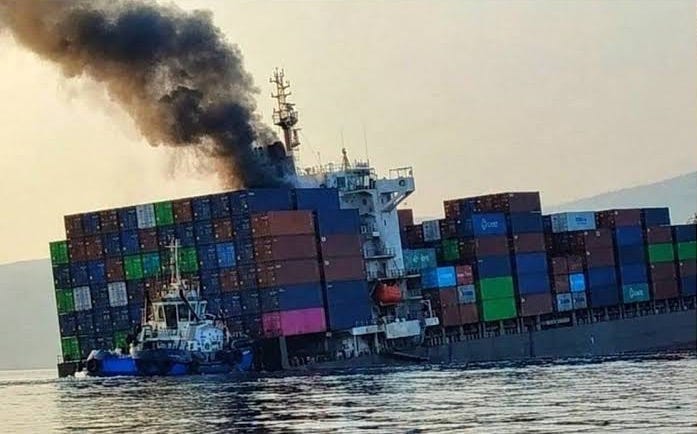
At least two ships, one container ship and a large bulk carrier, reportedly bound for Singapore, sank after allegedly being hit by projectiles on Wednesday.
The IRGC also claimed that another tanker was hit by the Iranian Navy on Thursday after it ignored repeated warnings. The ship carrying oil caught fire in the attack.
“The Americans claim that the Strait of Hormuz is open and they control it, but this claim is far away from the realities on the ground,” Ali Ozmaei, IRGC Navy chief, said on Tuesday, asking the US armed forces to “step into the field and see who is in control of it.”
It blamed US restrictions on media reports for a wrong impression about the status of the shipping through the Strait and repeated that all ships wanting to transit through it must obtain prior Iranian permission if they want to avoid any kind of mishap.