


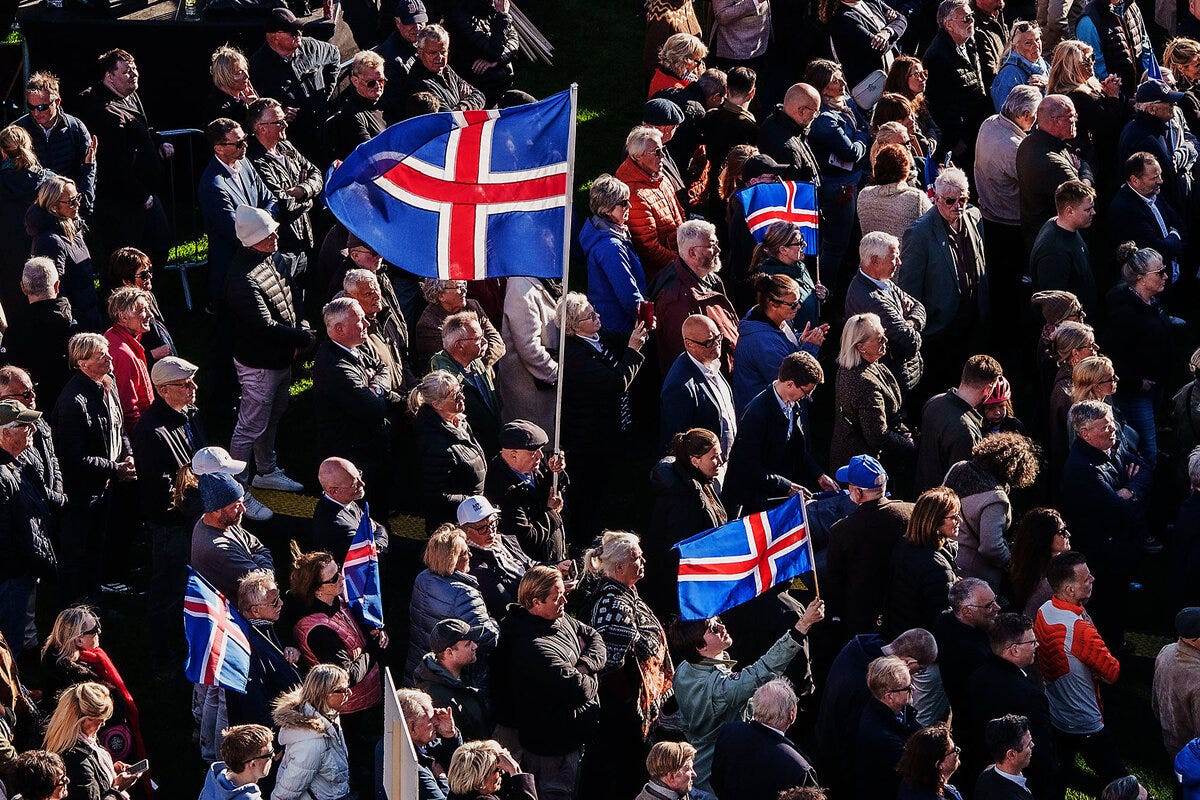
On 29 August, a majority of Icelanders voted against resuming accession negotiations with the European Union. In a high-turnout referendum, close to 53% of the 225,031 participants rejected the proposal, while 47% supported it.
Mainstream reports emphasised that the campaign against negotiations focused on issues of agriculture and fishing. At first glance, this aligned the “No” campaign with far-right talking points in the region—reflected in congratulatory notes circulated by European right-wing leaders. According to the same reports, the “Yes” campaign centred on international policy and alignment, apparently suggesting the EU as a path to provide more stability in the face of an aggressive US administration with eyes on the Arctic’s mineral reserves.
Yet progressive parties and groups also voiced opposition to joining the EU, criticising the bloc’s political and economic agenda. While some left-wing political figures, like the Left-Green Movement’s Rósa Björk Brynjólfsdóttir, announced they would support new talks—reflecting polls indicating a significant share of their voters planned to do the same—large sections of the parties' membership did the opposite. The Left-Green Movement’s youth, for example, opposed the referendum proposal.
Together with youth members from other progressive parties, the Left-Green Movement youth activists criticised the EU’s harsh economic and migration policies, as well as its failure to act against Israel’s genocide in Gaza. “There is enough information available for left-leaning people to familiarise themselves with what the EU stands for, and it should be very clear that it is not what we want,” Silja Sóley Birgisdóttir from the Socialist Party of Iceland told local media.
The Socialist Party provided more information on its opposition to joining the EU ahead of the referendum. “The EU is an economic bloc and a union of states fundamentally built on capitalist economic policies, a foreign policy that serves imperialism, militarism, and Zionism, the distancing of citizens from decision-making, and the weakening of independent working-class struggle,” the party wrote.
“Within the EU’s legal and regulatory framework, market laws are prioritised at the expense of the public interest,” they added, expressing concern about policies related to public education, housing, and healthcare in case of EU accession. “At the same time, the EU’s legal and regulatory framework further opens the door to privatisation, competition, and the outsourcing of public services.”
Progressives' concerns regarding accession to the EU were also based on other Nordic countries' experiences, where activists and trade unionists warned of erosion of social and labour policies as a result of EU policies. “Any attempt to maintain specific standards for the environment, health, food quality, working conditions and the like is, in the EU’s view, an example of interfering with market forces,” Danish activist and politician Karen Sunds said during a discussion on this topic organised by the Socialist Party.
Critics also questioned the argument that joining the EU would bring Iceland more security, emphasising the bloc’s militarisation agenda pursues very different goals from countering concrete threats from the Trump administration. Instead, this line of argument insisted that EU leaders and institutions remain mostly aligned with the US, eyeing confrontation with Russia and China. In this context, Sunds suggested the EU’s interest in Iceland might not rest on building a more coherent regional bloc but instead on securing energy resources located in Arctic regions.
According to Sunds, traces of this interpretation can also be found in statements by EU officials. Already a year ago, European Commission President Ursula von der Leyen said the following on the Arctic’s strategic importance during a Nordic Council meeting: “Yes, global warming brings new and dangerous risks to the Arctic. But it also brings new responsibilities and new opportunities. Take critical raw materials. Greenland alone holds 25 of the 34 critical materials that Europe needs—a treasure locked beneath ice and rock.”
