


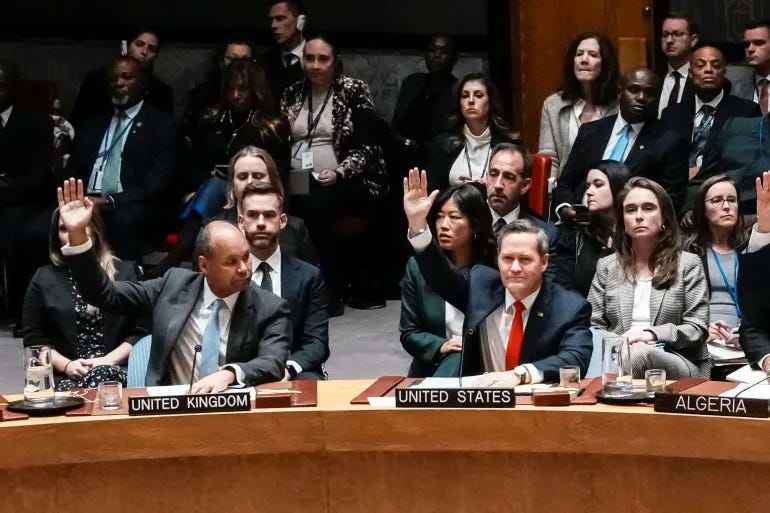
US President Donald Trump’s “Board of Peace” is reportedly set to be announced before the year’s end. This news coincides with increasing reports that the US administration is serious about pushing forward the second phase of the Gaza ceasefire.
However, many critical questions remain unanswered. How can a governing council be superimposed on Gaza when Palestinians are unified in their rejection of any new form of Western mandate over their lives?
Furthermore, how can the proposed “International Stabilization Force” (ISF) operate in Gaza without total clarity regarding its mission? If the ISF ends up serving primarily as an Israeli line of defense, the entire project will collapse before it begins.
Neither Arab nor Muslim countries will seriously engage in subduing Palestinians on behalf of Israel. Any other participating force will inevitably be treated by Palestinians as an occupation force.
The main obstacle, however, is the fact that Israel has never truly respected the first phase of the ceasefire, which began, in theory, on 10 October. Since that date, Israeli forces have killed over 360 Palestinians and wounded hundreds more, while demolishing thousands of residential structures, according to satellite images verified by the BBC.
Worse, Israel has habitually bombed targets beyond the “Yellow Line,” which was designated as the Palestinian area where humanitarian aid is allowed to flow and people are meant to return to some kind of normalcy, despite Gaza’s near-total destruction.
Israel is hoping to make the first phase of the agreement a permanent one. This intent is evident in the continued bombings, the prevention of life-saving supplies and aid, and the constant, unsubstantiated accusations that Palestinians are the ones violating the ceasefire.
It is expected that Israeli Prime Minister Benjamin Netanyahu will make the disarmament of Gaza the main sticking point, knowing in advance that Gaza will not surrender its weapons. He has made this clear and repeatedly so, including on November 15, when he stated that “Hamas will be disarmed—either the easy way or the hard way”.
But what if Gaza agrees to surrender its weapons? Will Israel leave the Palestinians alone? Will the prospects of a just peace and Palestinian freedom increase exponentially? To address this question, let’s delve very quickly into three experiences, two from history.
Palestinian and even some Israeli historians have argued that, during the ethnic cleansing of historic Palestine, the Nakba, Israel had the intention of depopulating the country regardless of whether Palestinians resisted or not.
The implementation of Plan Dalet, the operation aimed at expelling the Palestinian population, was in no way related to the method or intensity of Palestinian resistance to Zionist militia violence.
In fact, the framework of that expulsion was predicated on the use of war as a pretext, as opposed to war as a response to Palestinian resistance. “The Arabs will have to go, but one needs an opportune moment for making it happen, such as a war,” wrote Zionist leader and Israel’s first prime minister at the time, David Ben-Gurion.
Though some Mukhtars (village leaders) assumed that no resistance meant that they would be spared the same fate as those who resisted, they were wrong. Israeli historian Ilan Pappe writes: “Whereas the official Plan Dalet gave the villages the option to surrender, the operational orders did not exempt any village for any reason”.
The same pattern was repeated throughout history. In 1982, after a US-brokered agreement to evacuate Palestinian PLO forces out of Lebanon, the assumption was that their departure would keep the Israeli army from attacking Palestinian civilians.
Indeed, on August 21, 1982, PLO factions began leaving the country, leaving the camps undefended and their Lebanese allies vulnerable. However, Israeli violence in West Beirut had grown, not subsided, leading in September 1982 to the Sabra and Shatila massacre, which killed up to 3,500 Palestinian refugees and Lebanese civilians.
All the promises by Washington, the supposed “guarantees,” and the diplomatic language of US envoy Philip Habib, who acted as the President’s Special Envoy, meant absolutely nothing, as Israel helped facilitate one of history’s most brutal massacres.
And, of course, there is the ongoing saga of the West Bank itself, which, unlike Gaza, lacks armed resistance infrastructure and is administered by the Palestinian Authority (PA), which operates based on an Israeli-US-Western mandate.
Yet, even before the Gaza genocide, the West Bank’s suffering had grown, its land confiscated, entire communities ethnically cleansed, whole refugee camps destroyed, and hundreds of residents killed.
Between 7 October 2023, and late 2025, UN and human rights reports indicate that Israeli forces and settlers killed over 1,000 Palestinians in the West Bank, including East Jerusalem (more than 200 children). Thousands more were injured, and Israeli authorities destroyed or confiscated thousands of Palestinian-owned structures, displacing many. Additionally, an estimated 10,000 Palestinians from the West Bank were arrested between October 2023 and August 2024.
If Israel’s genocide in Gaza is entirely motivated by the desire to crush the armed groups, then why the continued crushing of the West Bank?
Those who continue to entertain the Israeli narrative regarding Gaza must confront this historical record and acknowledge two crucial, enduring realities. First, Israel’s violence is fundamentally driven by its settler-colonial ambitions, not merely by Palestinian resistance. Second, Palestinian resistance is a deeply rooted historical imperative—the native population’s determined struggle for self-liberation from foreign occupation.
Only by abandoning the reductionist language that frames Israeli wars as simple responses to armed groups can we arrive at a profound understanding of events in Palestine, Israel’s true motives, and the legitimacy of the Palestinian struggle.

The system of money itself, using a misrepresentation and contradiction as its conceptual framework, constitutes a paradigm that cannot be un-done from within.
We must all
"Articulate money's misrepresentation in legal terms. Describe it as a fiction that money flows are presumptively innocent, even when enabling atrocity crimes; and a structural inversion where "risk" is measured as inconvenience to financial institutions, not complicity in genocide. That it is not a question of choosing to use misrepresented money for good instead of evil, but categorically wrong no matter the intentions. That is, the effects of any instance transcend cumulatively (systemically) to engorge the unbridled imperatives of wrong over right, cancelling all "good" done under its yoke."
That quote is from this:
Money’s Misrepresentation as a Weapon Against Justice: An Open Letter to Francesca Albanese - 11 Dec 2025
Dear Francesca Albanese,
In deep respect for your work and the personal cost you are bearing, this message concerns not only Gaza, but a systemic weaponisation now being used against you: the money system itself— currently an inherently active, not passive coercive tool with (so far) tolerated extra-judicial scope.
Your own personal case makes visible this structural truth: access to money and financial services, under the prerogative of individual rights of persons and corporations, effectively is being used extra-judicially (without due process) against your person, where states and private actors can undermine peremptory norms—even the prohibition of genocide. The sanctions and resulting f inancial exclusion you face—closed bank accounts, denied credit cards, blocked reimbursements— are not an unfortunate side-effect; they are a continuation of the very same "logic" without which the genocide in Gaza, without explicit approval of a majority of society, could never take place. This is now being transposed onto your own life.
From a formal logical and systems science perspective, our common, logically flawed notion of "money" unequivocally constitutes a misrepresentation—therefore referred to simply as "money's misrepresentation"—for not noticing or specifying how and when ontologically the concepts of "measure" (metric) and transferable (trade-able) artefact are mutually exclusive.
Globally, we are taught to see money as a neutral tool, a mere medium of exchange and value storage. In reality, and without any logical foundation, it operates as a permissions and obedience infrastructure: under the guise of routine "finance," it systemically enables and insulates the material capacity for genocide and apartheid amongst a plethora of other evils, whilst being framed as ordinary "investment and trade". It implicitly and explicitly disciplines those who resist such wrongs by providing the means for ex-judicially and arbitrarily cutting them off from banking, credit, insurance, and mobility, whilst presenting this as a technocratic or "risk-based" decision, legally sanctioned under the prism of individual and/or corporate freedom of choice—irrespective of even the moral convictions of the agents making such decisions, given that those decisions are taken under (artificially assumed) existential imperatives.
Why, from first principles, money's misrepresentation is the supreme structural enemy: i.e., the priority
The current money system has no personal motive or consciousness. Yet it acts as though it does, because it itself, by its conceptual nature, is active—that is, non-passive: its unit of account (measure) doubles (illogically) as an object of trade, rent, and speculation, creating feedback loops that systematically amplify wealth and prerogative (mislabelled as "power") recklessly in one direction—towards those who control issuance or already hold large quantities. Like a thermometer that heats the room it measures, this architecture generates predictable distortions independently of any user's intentions: compounding extraction across even short transaction chains (2+ links), obscuring true economic signals, and rewarding violence over production.
This enslaves all actors, good and bad alike. To meet the system-generated imperatives (trade, save, mobilise), one thus must participate in rules that mis-measure value at the source, then we in our collective ignorance deflect causation onto agents and individuals ("greedy bankers," "corrupt states"), whilst the structural bias persists no matter what we do or wish. Harms become systemically diverse, varied, and generically cumulative: genocide is financed as "normal investment," your own economic cancellation as "risk management," leaving one no escape from complying, without exiting economic life. Even law misattributes what the system produces.
Essentially, all this occurs by virtue of almost all assuming the misrepresentation of money as an immutable fact of life, when in reality, under rigorous logic and indeed Truth, it categorically is not.
Correcting this misrepresentation is thus the instantaneous priority, lexically prior to any other cause. Without a passive, BIBO-stable unit (defined a priori as a post-transaction annotation, never as a required precursor to transaction), no downstream measure of "cost," "debt," or "justice" is valid; accountability thus becomes dissolved into impunity.
Exposing genocide requires unmixed numbers; the sanctions against you prove the system disciplines the demand for accountability. Call out this fusion of financial architecture and deflection for what it is, the true adversary to all of us: as it renders every urgent fight partially self-defeating until the conceptual misrepresentation of “money’s” unit is corrected.
As an international lawyer and UN mandate-holder, you are uniquely placed to name and confront this. Some possible directions:
• Reframe your personal sanctions as a legal cause against extra-judicial (systemic) coercion. Describe clearly how being denied bank accounts and financial services because of your UN-mandated reporting amounts to an attack on the independence of special procedures and on the Convention on the Privileges and Immunities of the UN. Your experience is empirical data in a larger pattern of systemically extra-judicially enabled coercion against human rights defenders.
• Expose financial complicity in genocide as a core legal question. Draw the line explicitly from capital flows, underwriting, trade, and security cooperation to concrete acts that meet legal thresholds of genocide, apartheid, and persecution. Insist that money is not a "background condition," but under its current common misconception (misrepresentation) the operational medium of the crime.
• Clarify that the real "sanction" is against law itself. Your financial excommunication broadcasts: enforce international law against powerful actors and you may lose your economic life. Naming this dynamic shows the target is not only you, but the possibility of an effective jus cogens order.
• Articulate money's misrepresentation in legal terms. Describe it as a fiction that money f lows are presumptively innocent, even when enabling atrocity crimes; and a structural inversion where "risk" is measured as inconvenience to financial institutions, not complicity in genocide. That it is not a question of choosing to use misrepresented money for good instead of evil, but categorically wrong no matter the intentions. That is, the effects of any instance transcend cumulatively (systemically) to engorge the unbridled imperatives of wrong over right, cancelling all "good" done under its yoke.
• Require that the highest financial authorities recognise the problem of money's misrepresentation or assume full responsibility for all evil it systemically enables, which otherwise would require true, free consensus across all constituents of society. Your courage in continuing your mandate under these conditions already undermines that system. The more explicitly you connect your own economic excommunication with the financial architecture underlying genocide, the harder it becomes for the world to continue pretending that money under its current (common) misrepresentation is a neutral instrument transcending Law and its underlying principles.
If interested, detailed system-level analyses or visualisations tracing "money's misrepresentation" in practice, and how to re-articulate it in law, are available.
With profound respect and solidarity,
Marc Gauvin
Money Systems Transparency Alliance (MSTA)]
https://www.moneytransparency.com
https://www.moneytransparency.com/msta-resolutions