


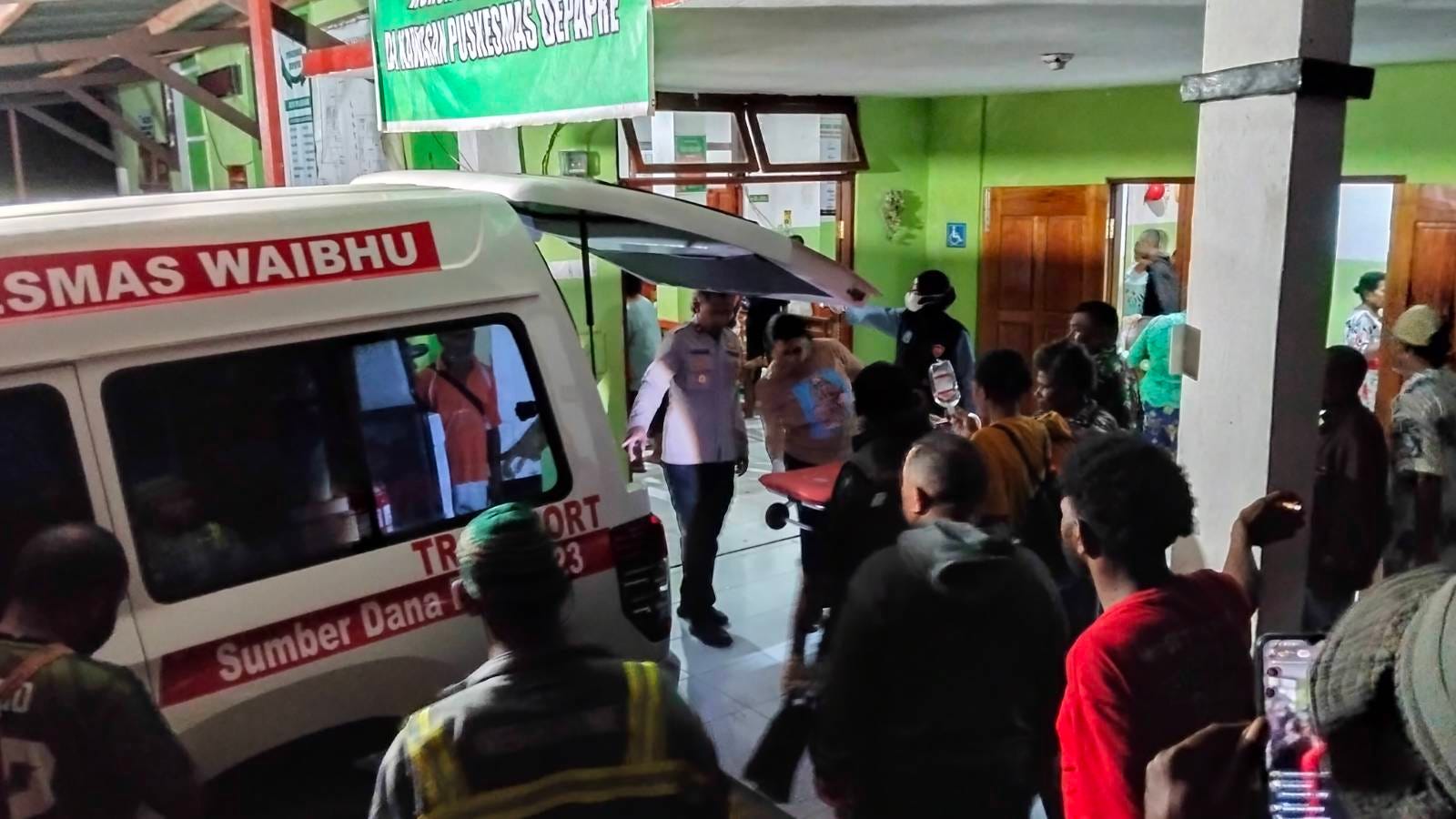
August 2026. Depapre District, Jayapura, Papua. A Tuesday morning like any other—yet just days before the flag is raised for the archipelago’s 81st anniversary of kemerdekaan (independence), the state’s promise of sovereignty rings hollow. Children file into schools, toddlers cling to their mothers, and the government arrives—as it swore it would—with food. The Makan Bergizi Gratis meals are distributed, a flagship policy meant to nourish a generation and cement a president’s legacy.
Within hours, the same hands that reached for the meal are clutching their stomachs. Vomiting. Diarrhoea. Dizziness. In this season of commemoration, when the nation celebrates freedom from colonial rule, Indonesia finds itself not liberated, but cruelly deceived by its own custodians—the very apparatus of the state trading nutrition for negligence, turning the bodies of Papuan children into the ledger of bureaucratic hubris.
Parents rush children to Puskesmas (community health centre) Depapre, only to find the facility overwhelmed. Tents go up outside RSUD Yowari. The state’s promise turned to poison, and 543 bodies—PAUD (early childhood education) students, elementary children, junior high teenagers, toddlers, and adults—became the statistic the government would soon try to bury.
This is not a conspiracy of deliberate state violence. It is something far more common—and far more indicting—in the annals of modern statecraft: the violence of a rushed bureaucracy. The tragedy in Jayapura is a brutal collision of three forces that should give every policymaker in the Indo-Pacific pause: centralised biopolitical ambition, decentralised infrastructural abandonment, and partisan procurement networks that treat children’s bodies as collateral damage in a political project.
The operational details are damning. The kitchen—run by the Yayasan Kasih Iman Samuel Papua, a foundation chaired by the local Gerindra Party chairman—began cooking at 7:00 PM the night before. By 11:00 AM the next day, the food had spent sixteen hours in Papua’s tropical heat, unrefrigerated, a perfect breeding ground for Bacillus cereus and Salmonella.
This was not a rogue operator. It was a rational response to an impossible demand: feed thousands of children in a district with no reliable electricity, no clean water infrastructure, no cold chain—and meet a political deadline. The state’s standard operating procedure, designed in Jakarta for a frictionless Java, was stamped onto a Papua that had been systematically deprived of the very infrastructure needed to comply.
The numbers tell a story the state would prefer remain invisible. The Indonesian Education Monitoring Network (JPPI) has documented over 37,000 students poisoned by MBG meals between January 2025 and May 2026—9,000 of those in just the first five months of 2026. This is not a series of unfortunate accidents; it is a systemic failure of state protection.
Amnesty International Indonesia has called for an immediate suspension, rightly rejecting the government’s utilitarian calculus that minimises individual suffering against aggregate statistics. As Amnesty’s Usman Hamid put it: “How many more students have to become victims before the government listens?” The National Human Rights Commission (Komnas HAM) has found “strong indications of human rights violations” in the program’s implementation, including violations of the rights to health, children’s rights, and the right to food.
When a welfare program produces tens of thousands of casualties, the language of “isolated incidents” becomes an obscenity.
The political economy of this disaster is even more disturbing. The foundation responsible for the poisoned meals is chaired by Edison Awoitauw—the Chairman of the local Gerindra Party DPC in Jayapura. By channelling billions of rupiah through a registered social foundation rather than a commercial corporation, the procurement process bypassed strict state tender laws, allowing for direct, closed-door appointments based on partisan loyalty rather than professional food-handling certification.
This is patronage capitalism at its most lethal: public funds redistributed upward to local political elites, health risks externalised onto the poorest children. The MBG program operates on a meal cap of roughly IDR 15,000–20,000 (USD 1.00–1.30). In remote Papua, where transport costs are exorbitant and infrastructure is absent, this cap is a structural driver of risk. Operators must cut corners—skip refrigeration, buy cheaper ingredients, hire untrained labour, cook early. The economics of the meal cap predicts the poisoning.
The tragedy demands comparison. Brazil’s Programa Nacional de Alimentação Escolar (PNAE), widely recognised as the global gold standard, mandates that at least 30 per cent of the school meal budget be spent purchasing food directly from local family-farmer cooperatives. This shortens supply chains, supports local agriculture, and embeds community oversight.
India, after its own catastrophic Bihar pesticide poisoning in 2013, restructured its Mid-Day Meal Scheme with automated mega-kitchens and mandatory parent-committee tasting. In deep rural zones, a three-tier monitoring system requires local teachers and parents to taste and sign off on food quality before any child eats.
Indonesia has none of these safeguards. Instead, it has political foundations, unaccredited kitchens, and a “zero tolerance” policy that only ever seems to tolerate the next outbreak.
The Constitutional Court’s July 2026 ruling—that MBG funding must be separated from the mandated 20 per cent education budget—was a structural repudiation of the program’s fiscal extraction. The court recognised what Papuan parents have long known: diverting education funds to a failing welfare program starves schools of teachers and textbooks while poisoning children.
It is a legal victory, but it does not solve the infrastructural debt accumulated over decades. Papua’s clean water deficits, unreliable electricity, and absence of cold chains are not administrative inconveniences; they are forms of infrastructural violence that predate and exceed the MBG program. The state imported a food system that assumed infrastructure that did not exist, transforming infrastructural debt into acute bodily harm.
What does this mean for the Indo-Pacific and the global community of policymakers? The Jayapura tragedy is a sentinel event—a warning that the collision of political ambition and infrastructural neglect in frontier regions produces predictable, preventable catastrophe.
It is a case study in how biopolitics can slip into thanatopolitics, how the state’s project of managing life can become a machinery of exposure to death. It is a reminder that development is not a slogan; it is a set of material conditions—clean water, reliable electricity, cold chains, trained professionals, accountable governance. Without these, the most noble welfare policy becomes a hazard.
President Prabowo Subianto’s administration has invested heavily in the MBG programme’s political symbolism. But symbolism does not stop bacterial contamination. The international community—ASEAN partners and global development institutions—must watch closely. The question is not whether Indonesia can afford to fix this programme. The question is whether it can afford not to.
And beneath that question lies a deeper one, reverberating through Papua’s long history of state-sponsored benevolence that has so often masked extraction and control: if independence was meant to guarantee dignity and safety for all citizens, does kemerdekaan (independence) still mean kemerdekaan when the very bodies of its people are exposed to systemic harm under the banner of national progress?
The children of Depapre are not statistics. They are the bearers of a long history of abandonment and the victims of a present that refuses to learn from the past. Their poisoned bodies are a wound in the body politic of Indonesia—a wound that reveals the deeper pathologies of a developmental model that treats the periphery as a testing ground, that privileges future promises over present lives, and that allows political loyalty to substitute for technical competence.
The task ahead is enormous. It requires legal reform, infrastructural investment, political accountability, and epistemic humility. But it is not impossible. The examples of Brazil and India show that alternative models exist.
The voices of Papuan communities show that resistance and knowledge endure. The Depapre poisoning must become a turning point, not a footnote—a catalyst for a different kind of statecraft that refuses to sacrifice the periphery on the altar of the future and that recognises that justice is always, irreducibly, a matter of the present.
