


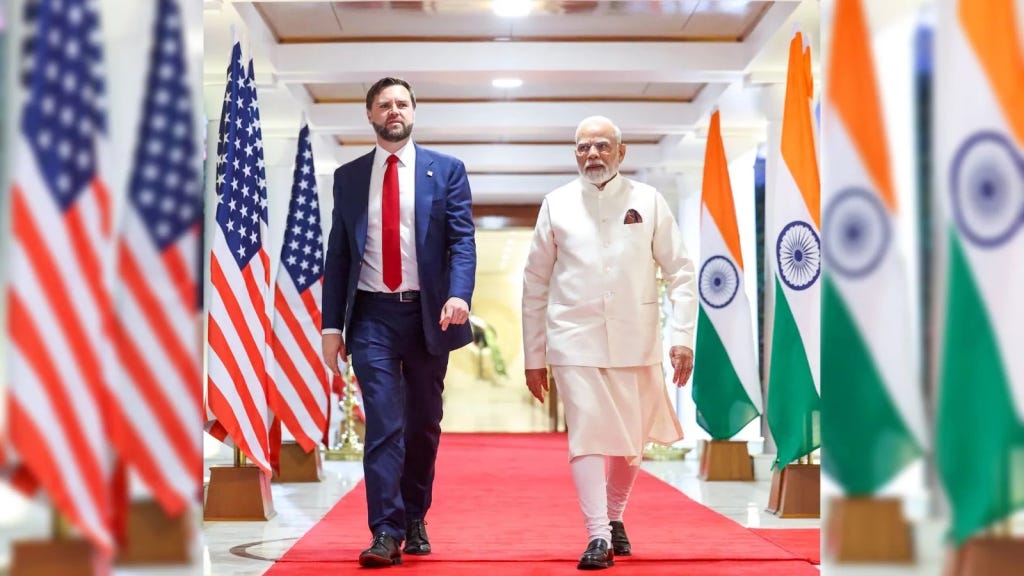
The telephone call from US Vice-President JD Vance to Prime Minister Narendra Modi on 8 August came as a surprise. Neither the American nor the Indian side has thrown light on the urgency of the contact at the highest level of leadership.
Arguably, this is the first time Trump let go of his vice-like grip on the US-Indian relationship with India by deputing Vance. It radiates mixed signals. The “big picture,” of course, is that the quasi-alliance between China and Russia is decidedly shifting the co-relation of forces against the West in general and the US in particular.
Specifically, Trump’s “maximum pressure” strategy towards Iran is in ruins. It becomes hard to overstate the profound geopolitical significance of the US’ war in Iran. No one expected the war to reach such an impasse when it is no longer possible to talk about a US-led order in West Asia anymore.
Questions of the US’ withdrawal and retrenchment are surging, compounded by Trump’s style of diplomacy toggling between force, threats of force and negotiation. Washington is hamstrung today in the pursuit of its core interests—preventing threats to the free flow of oil, helping to ensure Israeli security, providing security to its client states, and, above all, blocking any country or combination of countries from challenging American primacy in the region.
It is against such a backdrop that Trump directed Vance to dial up Modi—using Vance as a “faith healer” in a presidency that depends critically on live prayers and healing events. Trump would be aware that being a civilisation, Indians cherish kinships and calculated that their sense of hurt and alienation is best healed by someone whom they would regard as a “relative.” That said, make no mistake, Trump also reserves the prerogative to wade in at some future date.
What did Trump hope to achieve? Simply put, he has pampered Indian vanity by offering a fresh lease of life to the US-Indian “Global Partnership,” a moribund slogan of yesteryears. Unsurprisingly, there was no readout or press release on Vance’s conversation with Modi; neither Washington nor the US embassy in Delhi uttered a word. But Modi wrote in a social media post: “Received a phone call from US Vice President JD Vance. We discussed ways to further deepen the India-US Comprehensive Global Strategic Partnership across key areas. Warmly congratulated him and the second lady on the birth of their son and conveyed best wishes to the entire family.” [Emphasis added.]
There was also an anodyne Indian press release highlighting that the two leaders “exchanged views on regional and global developments of mutual interest.” Interestingly, however, the US ambassador Sergio Gor followed up Vance’s call in a real-time meeting with Foreign Secretary Vikram Misri and the National Security Advisor Ajit Doval. Gor didn’t meet EAM Jaishankar, which suggests that the “operational part” to Vance’s call fell within the NSA’s domain (who has lately assumed a larger role as India’s top diplomat-in-waiting as well.)
Curiously, this time around, Doval was taciturn, but his American visitor was effusive. Gor wrote, X: “Had a fruitful meeting with National Security Advisor Ajit Doval to discuss deepening U.S.-India strategic cooperation. Our close partnership with India is vital to addressing global security challenges. The United States and India share many of the same goals, and our engagement continues to grow!” [Emphasis added.]
Importantly, Gor linked the deepening of US-Indian strategic cooperation with the Trump administration to “addressing global security challenges,” where, he emphasised, the US and India “share many of the same goals.” Taken together, Gor’s characterisation of the meeting with Doval as “fruitful” would mean, in spokesmanspeak, that Gor and Doval got somewhere, although the meeting fell short of a “constructive” outcome.)
One doesn’t have to be a rocket scientist to figure out the topmost “”global security challenge” the Trump administration faces today—war with Iran. Simply put, Trump, who has ridiculed, humiliated and even threatened to destroy Modi’s political career, didn’t have the face to seek his help and instead put Vance on the job.
Indeed, Trump’s political career is at stake, as things stand. His decision to attack Iran is opposed by the majority opinion in America and casts a shadow on the Republican Party’s prospects in the midterms in November. Put differently, Trump faces the prospect of Democrats gaining control over the Congress if the public opinion turns into a tsunami of hostility. Yesterday, for the first time, Trump pleaded that rising petrol prices are a small price to pay for America’s crusade against Iran!
There is no question that Jewish billionaires who control the Congress are demanding that Trump should destroy Iran no matter the costs involved. Trump hinted yesterday that the Strait of Hormuz will become American territory, which is tantamount to threatening Iran with a land invasion. Analysts speculate already that lacking the military capability to conquer Iran, Trump may order the use of tactical nuclear weapons to gain the upper hand.
The US’ Achilles heel lies in the GCC states” opposition to the war, which translates as their refusal not to partake in a war against Iran. Reportedly, the UAE has secretly reached out to Tehran.
Is it coincidental that Trump directed Vance to get in touch with Modi the day after the announcement of the Turkey-Saudi Arabia-Pakistan defensive military alliance? India, for sure, is the Pentagon’s nearest friendly landmass if push comes to shove in the Arabian Sea. This is Modi’s 2003 moment.
When the George W. Bush administration sought India’s participation in the US-led “coalition of the willing” to invade Iraq, a powerful lobby in India was rooted for Indian participation, but for then PM AB Vajpayee’s firm refusal (with the parliament’s unanimous support), the pro-American lobbyists would have carried the day—with disastrous consequences for the country’s national interests.
The situation today is even more complicated. For, there is an albatross around India’s neck, namely, the Logistics Exchange Memorandum of Agreement—the military logistics pact signed by India and the US on 29 August 2016 by the present government (something which the UPA government had refused to do) that allows both nations to use each other’s designated military facilities for refuelling, repairs, and replenishment of supplies on a reciprocal, reimbursable basis during joint exercises, training, and humanitarian missions.
In reality, Trump is fighting this war primarily in the interests of Israel, the lodestar in Modi’s government’s West Asia policy. And the outcome of this war will largely determine Israel’s future. To be indifferent is a tough decision for the Indian leadership—for a variety of reasons; whilst to partake of a war against Iran for safeguarding Israel’s core interests is also a bizarre choice to make, especially as Russia and China, as well as the entire Global South, will be watching where India stands on a turf that even America’s European allies fear to tread.
