


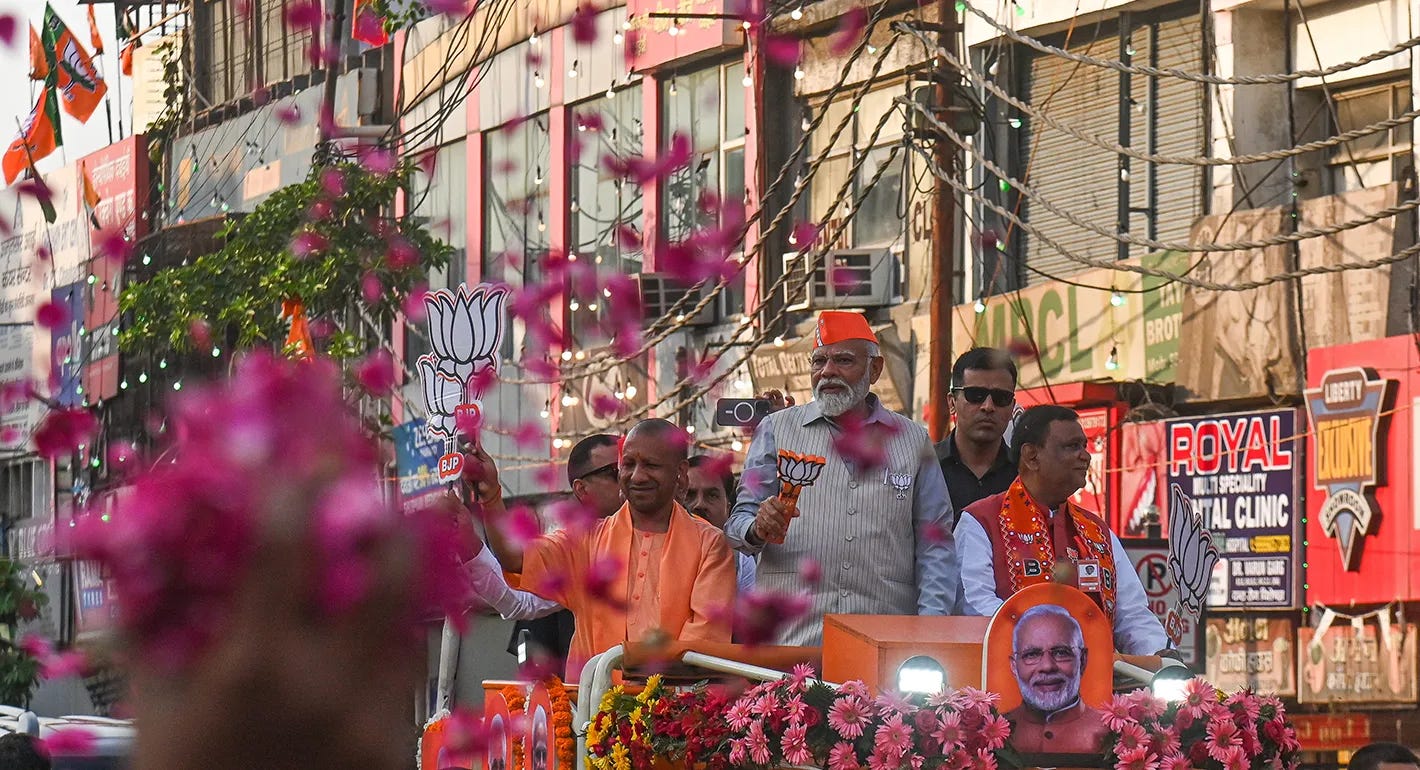
Narendra Modi, the politician, was rather immaturely precipitate in taunting the Congress about having drawn a blank in the just-concluded Member of Legislative Council (MLC) elections.
News has now arrived that the grand old party has, in fact, bested the Bharatiya Janata Party (BJP) in its sanctum sanctorum of Nagpur—the home ground of the Maharashtra Chief Minister Devendra Fadnavis, the redoubtable Union minister Nitin Gadkari and, most of all, the Vatican of the Rashtriya Swayamsevak Sangh (RSS).
In embarrassing contrast, the ruling BJP has lost both seats in Varanasi, the abode of Lord Shiva and the parliamentary constituency of the honourable prime minister.
This fuels speculation that, had the parliamentary elections of 2024 been held using ballot papers, Modi may indeed have lost to Ajai Rai of Congress.
Indeed, another redoubtable leader, Adityanath, seems to have secured the BJP’s home-ground seat of Gorakhpur by the skin of its teeth, with a margin of some 300 votes or less.
In Maharashtra, the ruling Mahayuti (grand alliance) is, as of now, reported to have lost three of the five seats up for contest. In Bihar, both the Rashtriya Janata Dal (RJD) and the Jan Suraaj Party (JSP) have done credit to their standing by winning two and one seats, respectively.
The crucial state of Uttar Pradesh has brought ominous tidings for the right wing: the combined strength of the Samajwadi Party (SP) and the Congress has resulted in the SP procuring five of the 11 seats in contention.
Most significantly, as a pointer to the coming Assembly elections, the SP-Congress combine has won its seats with margins far in excess of those secured by the BJP in its relatively modest victories.
Modi’s taunt that the ballot paper , too, had shown the opposition the door, just as the EVMs, is therefore not only factually inaccurate but has also drawn an obvious counter from the opposition: namely, if that is the case, why not agree to hold all forthcoming elections using ballot papers rather than machines?
From the ballot to the streets
The establishment has sought to employ every implausible trick in the book to thwart the INDIA alliance from holding its mass “Chalo Dilli” rally on 1 November.
The trading lobby, a known adherent of the BJP, has been drafted to discredit the opposition’s move by contending that the rally would damage traders’ earnings during the nearing festival days.
The opposition has cutely, and justly, countered that those attending the rally would, in fact, do plenty of shopping in the markets surrounding the Ramlila Maidan!
Needless to highlight, such considerations were never part of the BJP’s thinking during its own days in the political opposition.
The fakery of the official position has subsequently been exposed by a rally held by the ruling BJP through the heart of Chandni Chowk, with little apparent care for the possible damage to trading interests.
Notably, whereas opposition mass actions are routinely sought to be impeded by barricades and other obstacles to movement, the said BJP rally was allowed to proceed without an obstacle in sight.
The Cockroach Janta Party (CJP) has, in the meantime, declared its support for the INDIA bloc’s rally, reiterating its demand for the ouster of the Chief Election Commissioner (CEC) Gyanesh Kumar.
Police harassment seems to have made no dent in the organisation’s resolve to continue its principled opposition of the electoral establishment.
Student protests at the prestigious Jamia Millia Islamia University and elsewhere also seem bent on realising their own hitherto-suffocated aspirations for the right to democratic expression, within and beyond university organisations.
ECI under judicial scrutiny
The twists and turns of judicial observations, regardless of their shortfalls, make it increasingly evident to the ECI that the Supreme Court is wise to its gambits—a sentiment captured in one succinct phrase on 28 October: “We understand everything.”
Thus, the commission’s disingenuous positions on form 6, on “logical discrepancies,” and on the centralisation of software that controls voter inclusion and exclusion have all come under more muscular scrutiny than before, as the proceedings before the honourable court continue.
The court must, of course, be aware that popular angst demands that these proceedings reach a speedy and just conclusion, enabling citizens to exercise their most fundamental right to vote without chicanery.
It will be interesting to see what the discrete affidavits due to be submitted by the three election commissioners (ECs) might yield as further material for questioning.
For example, how can it be maintained that all the decisions of the ECI were unanimous when, in fact, two of the ECs wrote 14 letters of dissent after the decisions had already been made?
The media’s reluctance to take sides
Media houses owned by influential corporates of the day continue to deploy language that might present the powers-that-be in an exculpatory light, even as their anchors often squirm for want of adequate counters to criticisms offered by opposition spokespersons.
As The Indian Express reported some days ago, many in the media, the bureaucracy and among the government’s political allies are “hedging their bets.” This emphasises the cardinal reality that only interests are permanent.
As political cyclones gather pace and switch direction, India, after the rally of 1 November, may witness surprises that are rather more substantial than seen so far.
Following the disclosure of one minister’s one-on-one interaction with the late paedophile Jeffrey Epstein, who knows whether others may follow?
Clearly, the republic is, for now, at war with itself. It is to be hoped that popular spirit, in alliance with constitutional verities, will yet bring it back to an even, just, lawful and democratic keel.