


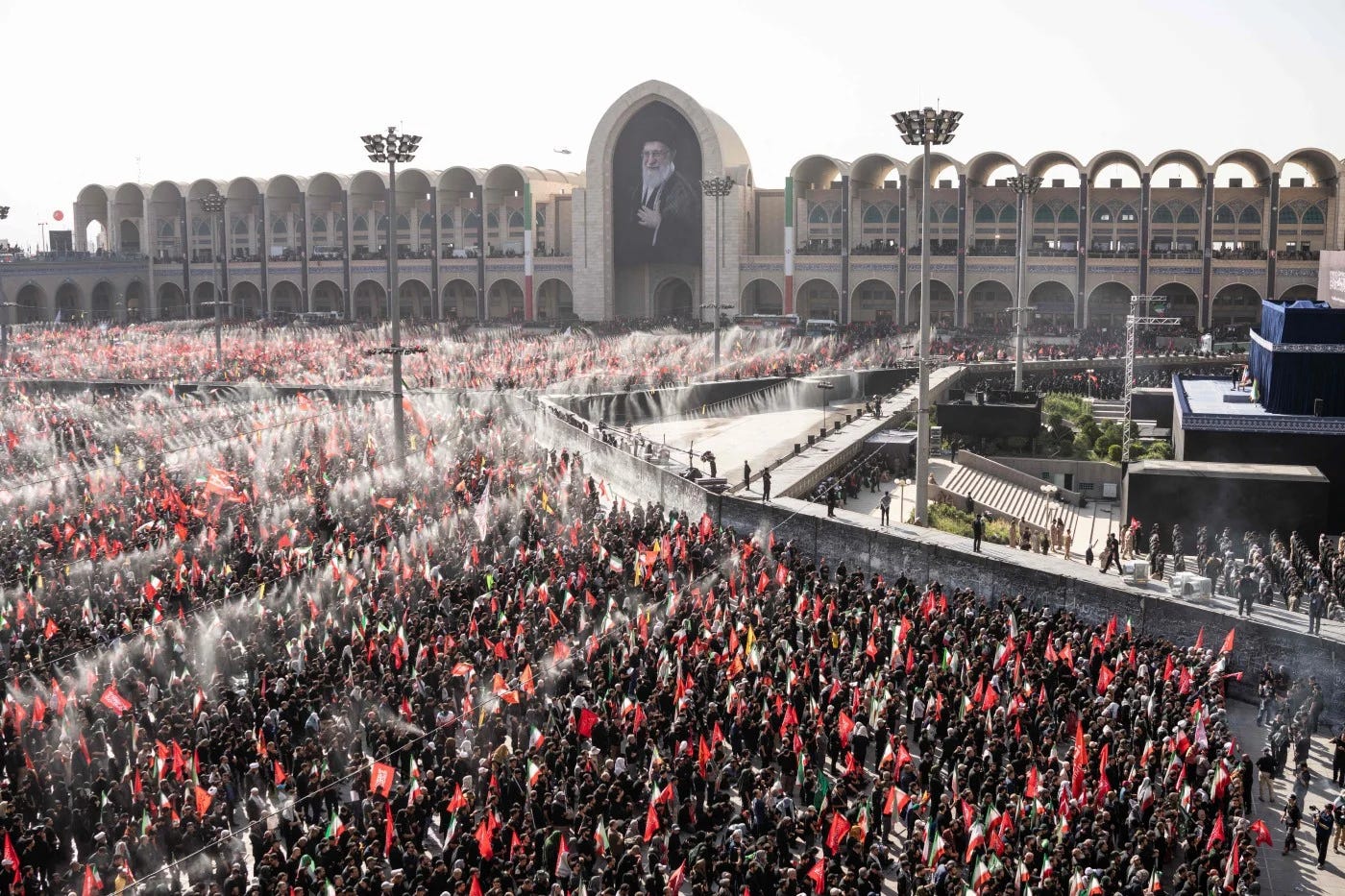
Delhi’s attempt to play the Shia card to moderate the Iranian disquiet over our “forever honeymoon” with the Israel-UAE-Bahrain axis failed to impress Tehran. It was a clumsy attempt but was, arguably, the best card Delhi held potentially. The best alternative would have been to send an all-party delegation to represent India at the funeral ceremony of the late Supreme Leader Ayatollah Ali Khamenei. But the toxicity of India’s democracy under BJP rule simply did not allow it.
In the event, the Indian delegation’s participation was largely ignored, while Mullah Abdul Ghani Baradar, Deputy Prime Minister for Economic Affairs of Afghanistan, was received by President Masoud Pezeshkian. However, Iran’s embassy in Delhi made amends with a lengthy statement—posted, ironically, on “X”—duly expressing its “heartfelt gratitude and sincere appreciation to the friendly government and people of India, especially the official delegation that attended on behalf of the government and people of India.”
The statement claimed that “It [the Indian delegation’s visit] also stood as a powerful expression of mutual respect and sincere solidarity with the people of Iran during this time of national mourning.” “The people of Iran will never forget this gesture of friendship, compassion, and heartfelt respect. They regard it as a precious testament to the enduring ties between the Islamic Republic of Iran and the Republic of India and as a valuable foundation for further strengthening the longstanding friendship between our two countries.
“The Embassy of the Islamic Republic of Iran in India once again conveys its sincere appreciation to all Indian officials, distinguished personalities, and the noble people of India who stood with the people of Iran and expressed their sympathy during this period of grief.”
Persian is the language of mystics and lovers. It often appears to be bizarrely formal but conveys everyday staples with rhythm, subtlety and emotional nuance. A passionate lover of Persian once wrote, “It is a language that carries music in its tone and wisdom from the music of Bollywood to the mountains of Afghanistan to the valleys of Iran, orchids of Central Asia and as far as the gates of Europe in Turkey. “ Even the most ordinary phrases seem to hum with history and feeling. It’s as if every word carries a centuries-old heartbeat.”
Truly, Tehran has messaged that Iran’s civilisational ties go far beyond the diplomatic and political ties with the present ruling elite in Delhi and encompass the richness of the people-to-people relationship and the vastness of the cultural and historical bondings.
In the Iranian conception of time and space, the recent decline in the bilateral relationship is viewed as a temporary phase that will eventually pass. Meanwhile, realism prevails. Persian is uniquely capable of expressing emotions deeply felt but never articulated.
In a stunning display of realpolitik, however, no sooner than the plane carrying the Indian delegation returned from Tehran, the external affairs minister, S. Jaishankar, made a rare appearance in Bahrain on a pre-planned visit, next door to Iran, from where the US mounts its military operations and where the US Naval Forces Central Command is headquartered, which is in Tehran’s crosshairs.
Bahrain is a unique autocracy in the Persian Gulf region where a repressive Sunni regime lords over Shias, who constitute over 80 per cent of the population. Did Jaishankar intentionally travel to the hotspot to show the middle finger from Bahrain, which is a de facto participant in the US-Israeli war? One cannot be sure.
At any rate, in the cat-and-mouse game going on in the Strait of Hormuz, Bahrain plays a crucial role as the Pentagon’s vassal. The Americans are making desperate attempts to write the rules of the game in Hormuz. The script runs like this: the US Central Command sponsors tankers to cross Hormuz, ignoring Iran’s IRGC, and the inevitable follows with Iranians blocking the tanker’s passage, whereupon Central Command seizes the alibi to punish Iran by bombing Iran’s military installations, especially missile sites, and the IRGC retaliates by bombing the countries from where the Central Command stages its provocations.
In fact, Jaishankar narrowly missed the high drama as he concluded his Manama visit just as the IRGC’s attacks on Bahrain were getting under way on Wednesday.
At some point, this pantomime will be called to a halt once the US realises that Iranians won’t capitulate, but it only adds to the fluidity of the world oil market. Of course, it is a risky game. Whilst it lasts, India is the loser, our stated policy being our refusal to buy Iran’s oil in fear of American reprisal. Of course, various (non-Iranian) shady interest groups are also interested in India continuing to buy oil in the spot market, where transactions are opaque and, historically, cutbacks are commonplace.
Indeed, the geopolitics of Iran are crystallising in new, unforeseen directions, where a template of the utmost concern that has appeared will be the slow and steady accruement of critical mass in the Iran-Pakistan mutual understanding, which has profound implications for India’s futile attempts to “isolate” Pakistan. In fact, Pakistani Prime Minister Shehbaz Sharif attended the funeral ceremony in Tehran, accompanied by the Chief of Army Staff, Field Marshal Asim Munir.
The bottom line is, all these gyrations introduce some scepticism as to whether Delhi is really sincere in salvaging the relationship with Iran going forward. Suffice it to say, a definitive answer will be possible only after the Israeli parliamentary elections, which are scheduled to be held by 27 October at the latest, get over and a new government is formed. Our leadership, in the meanwhile, will be marking time to see whether Benjamin Netanyahu will get a renewed mandate as prime minister. It’s all very deeply personal, stupid!
