


Indonesia is no longer grappling with separate crises. It is confronting a convergence. Each emergency—the fires, the markets, the corruption, the wiretapping—fuels the next, and the state’s response has become the crisis itself. For strategists and policymakers across the Indo-Pacific, the question is no longer whether Indonesia’s governance model is under strain. It is whether the Republic has the institutional capacity—and the political will—to arrest a descent now visible in every headline, every burning hectare, and every soldier on the streets of Jakarta.
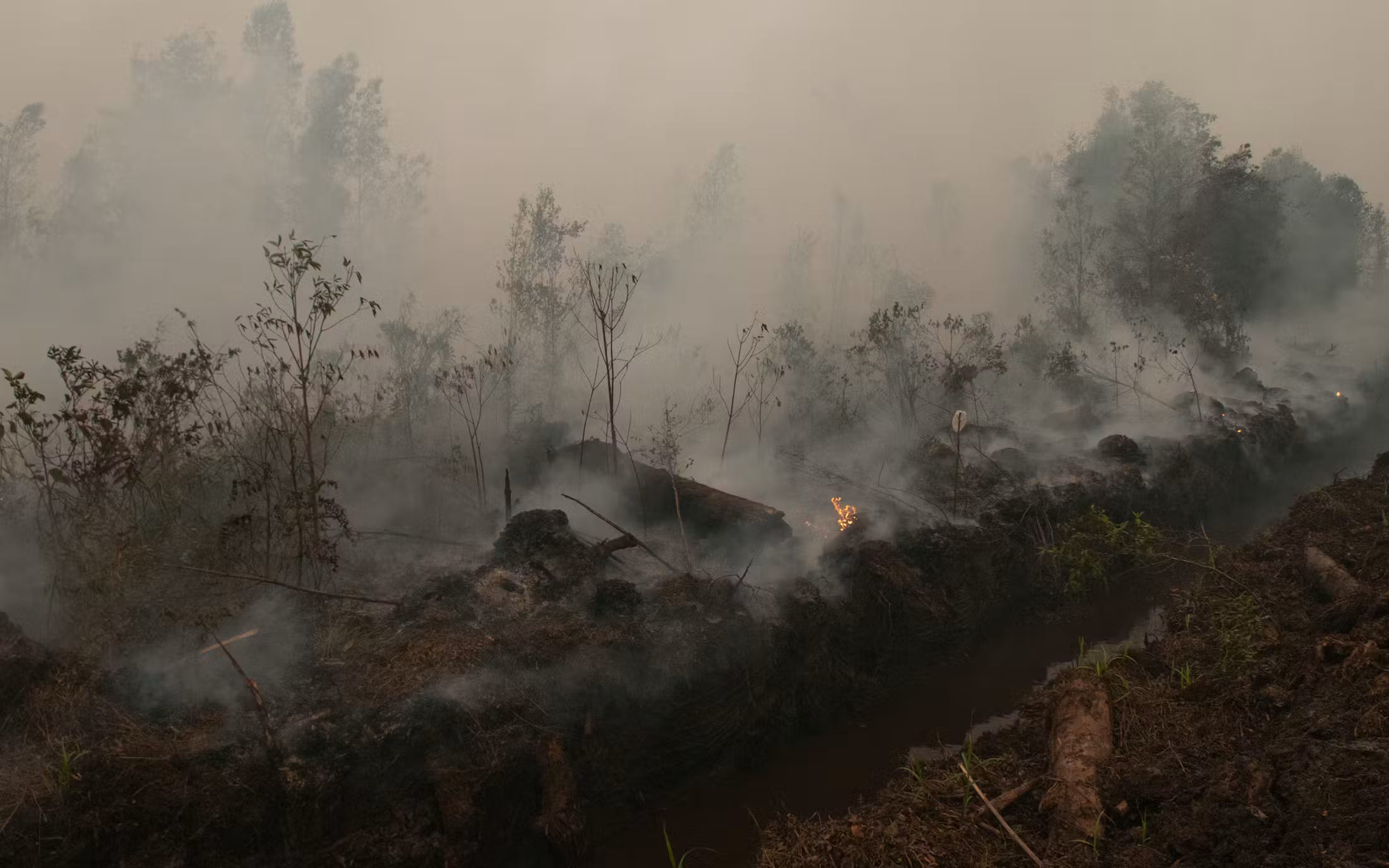
The numbers are not abstractions. Since July, nearly two million hectares of forest and peatland have burnt across Sumatra, Kalimantan and Papua. The National Disaster Mitigation Agency’s routine budget has been cut from Rp 2.01 trillion to Rp 491 billion, even as the fires rage. The government has refused to declare a national disaster, thereby denying itself the resources and manpower that such a declaration would unlock.
The haze is not merely an environmental failure. It is a public-health emergency, a diplomatic irritant for Malaysia and Singapore, and a daily indictment of a state that has chosen fiscal populism over ecological stewardship.
That same fiscal populism has collided with the market. On 16 October, Indonesian equities recorded their steepest single-day fall since 1998—an 11.6 per cent collapse—after MSCI warned that Indonesia’s emerging-market classification was “no longer appropriate,” citing opaque shareholding structures and suspected coordinated trading. The rupiah touched 18,040 to the dollar, near its record low. Foreign investors have sold a net $4.88 billion of Indonesian stocks this year, putting the market on course for its largest annual outflow in at least sixteen years. When the president responded that “the Indonesian people are not afraid of anyone and will not tremble,” the markets heard not defiance but denial.
The corruption allegations cut deeper because they affect the poor. Three officials from the disaster agency have been arrested on allegations of misuse of emergency funds, and investigators have seized Rp 1.4 billion in cash, gold bars, and certificates. The flagship free nutritious meals programme has been linked to nearly 53,000 cases of food poisoning, and the red-and-white cooperatives have been allocated Rp 34.6 trillion from village funds, amid expert warnings about the risk of fraud.
Public approval for the meals programme stands at 62 per cent, with opposition at 38 per cent. The President’s own approval rating has collapsed from 81.2 per cent in November 2025 to 44.5 per cent—a descent without precedent in the Reformasi era.
Then came the wiretapping scandal, the clearest signal yet that the crisis has shifted from the material to the constitutional. On 1 November, three senior police generals—including Listyo Sigit Prabowo, the recently appointed presidential chief of staff and former national police chief—were arrested over an alleged surveillance operation that intercepted the communications of the president, cabinet ministers, business figures, journalists and civil-society leaders.
The State Secretariat declared that the compromise of the head of state’s sensitive data constituted conduct “leading toward treason.” Yet the same government acknowledged that investigators had found no indication of treason under the Criminal Code. The rhetoric of existential threat is being deployed to create a political exception that the law does not support.
The response was not a judicial process. It was a deployment of 20,980 troops. The deployment—2,100 personnel in the first phase, 5,740 reinforcements from Java and Lampung, and 13,140 on high-alert standby—has saturated the National Monument, the Presidential Palace, the Hotel Indonesia roundabout and the East Jakarta District Court.
The military calls it “standard procedure.” Independent analysts see three purposes: to deter institutional infighting between the presidency and police factions, to pre-empt the student and labour protests planned for the days after the arrests, and to secure the flashpoints where the state’s authority is most visible. Civilian watchdogs, including Imparsial and Human Rights Watch, see something older: the spectral return of Suharto’s dwi-fungsi, the doctrine that placed the military at the centre of civilian governance.
The comparison with 1998 is not rhetorical. Twenty-eight years ago, Prabowo Subianto was a Kopassus commander who ordered unauthorised troop movements around Jakarta and was discharged by an officers’ honour council for insubordination and the abduction of pro-democracy activists. In November 2026, President Prabowo again responded to an internal institutional threat with a massive military deployment to the capital.
The difference is that he now commands the state apparatus he once tried to bend. The echo is not lost on a public that remembers the disappeared activists, the torture, and the thirteen families who never received a body.
This is what convergence looks like. A currency crisis eroding household purchasing power. A fire season poisons the air children breathe. A corruption scandal stealing from disaster victims. A surveillance scandal turning the state’s own security apparatus inward. And a military deployment treating the symptoms of democratic breakdown as a public-order problem. Each crisis is legible on its own. Together, they describe a governance model that has run out of fiscal space, ecological runway, and political legitimacy at the same time.
Other analysts, on the other hand, have described Indonesia’s foreign policy under Prabowo as “free and active drift”—a widening accumulation of partnerships without a coherent strategic purpose. What is now clear is that the drift is not confined to foreign policy. It is the governing style itself. Jakarta is accumulating crises faster than it is deciding what each one means, and the cost of that indecision is being paid in rupiah, hectares, hospital admissions, and the quiet erosion of the post-1998 democratic consensus.
The Indonesian convergence is not a national story with international implications. It is the first live-fire demonstration of a new planetary condition: the simultaneous failure of the carbon-intensive growth model, the debt-financed populist state, and the surveillance-enabled security apparatus, all within a single sovereign jurisdiction. What Jakarta is experiencing is what Lagos, Karachi, Cairo and Manila will experience within a decade, as climate breakdown, fiscal exhaustion and digital surveillance capacity collide in states whose legitimacy rests on delivering material progress they can no longer afford.
Indonesia is the canary in the coal mine of the twenty-first-century state, and it is not singing. It is choking on haze, watching its currency collapse, and counting troops in the capital. The lesson is not that Indonesia is failing. The lesson is that the institutional toolkit available to any government facing convergent crises—central bank intervention, fiscal transfers, emergency deployments—was designed for a world of discrete shocks. That world no longer exists. Every state now faces convergence, and almost none have the architecture to absorb it.
What the world is watching in Indonesia is the emergence of a new grammar of state legitimacy—what we might call the parser state, in which the sovereign is no longer judged by its capacity to deliver outcomes but by its capacity to parse chaos into legible categories that citizens can navigate. The Prabowo administration has failed at exactly this task. It has parsed a burning archipelago into a budget line. It has parsed a currency collapse into a nationalist slogan. It has parsed a wiretapping scandal into a treason accusation that its own prosecutors cannot sustain.
And it has parsed public anger into a map of military deployments. Citizens across the Global South are watching and learning: the state that cannot parse its crises into actionable governance will eventually parse its citizens into security threats. The choice Indonesia makes now—whether to build parliamentary oversight of intelligence, whether to restore environmental budgets, or whether to accept international assistance without framing it as humiliation—will be studied by every government facing its own convergence. The tools exist. The question is whether the political will exists to use them before the streets become the only parser left.
The global community must now confront a reality the post-1998 architecture of international support was never designed to address. Indonesia is not a failing state. It is a functioning democracy with an elected government, a vibrant civil society, a free press, and an active judiciary. It is still experiencing convergence. This insight should reframe every strategic calculus: the old binary of fragile versus stable state has collapsed. The states most vulnerable to convergent crisis are not the weakest. They are the middle-income democracies whose legitimacy rests on performance and whose performance is now constrained by forces—climate, financialisation, digital surveillance—that no single government can control.
The international community’s choice is not whether to watch or name the fracture in Indonesia. It is whether to build a new architecture of planetary resilience that treats convergence as a shared condition rather than a national failure. That architecture would include: a sovereign debt restructuring mechanism that does not treat climate-driven fiscal stress as a moral failing; a global minimum standard for intelligence oversight that prevents the wiretapping of presidents by their own police; a regional environmental governance framework that replaces the non-interference norm with enforceable obligations to address transboundary harm; and a new development compact that finances resilience rather than extraction.
Indonesia’s convergence is not an aberration. It is an early warning. The question for every strategist in every capital is not whether their own state will face the same convergence. It is whether they will have built the tools to parse it before the troops arrive. The canary is not singing. It is telling us something. The question is whether we are listening.