


Five civilians. Five aspiring cooperative managers. Five preventable deaths in a state-run training program that was never supposed to kill anyone.
Between 17 and 26 June 2026, Yonanda Muhammad Taufiq, Anisa Muyassaroh, Novia Rahmadhani Sihotang, Muhammad Rifki Renaldi Gunawan, and Nola Dya Sari—young Indonesians filled with dreams of serving their villages—collapsed and died while undergoing military basic training for a program designed to produce village cooperative managers. They were not soldiers. They were not combatants. They were civilian graduates who had dared to hope for stable employment in a brutally competitive economy.
The causes of death read like a medical indictment of systemic failure: cardiac arrest during an environmental orientation march; heat stroke after complaints of breathlessness and nausea were dismissed; active pulmonary tuberculosis that somehow escaped detection; pneumonia complicated by pre-existing hypertension and obesity; and finally, respiratory distress followed by cardiac arrest in a West Kalimantan hospital. Five bodies. Five distinct pathologies. One common denominator: an institution that valued schedule compliance over human survival.
The Ministry of Defence insists the drills were “basic”—just marching drills and military salutes. Yet basic drills killed five people in ten days. The Ministry offers fifty million rupiah in condolence money per family—roughly two years of a junior civil servant’s salary. It announces “white ribbons” for medically vulnerable participants. It signs a memorandum with the Health Ministry. It promises evaluation.
But evaluation of what? The program itself is the problem. Indonesia’s Red and White Village Cooperatives (Kopdes Merah Putih) are President Prabowo Subianto’s signature rural development initiative—a program intended to uplift village economies, not break civilian bodies. Yet the government chose to train cooperative managers through the Indonesian military, subjecting civilian accountants and community organisers to the physical rigours of recruit training.
“There is no relationship between professionalism in managing cooperatives and military training,” a coalition of Indonesian civil society organisations—including Imparsial, KontraS, Amnesty International Indonesia, and the Indonesian Legal Aid Foundation—declared in a joint statement. “Cooperative management competence is built through mastery of organisational governance, participatory leadership, accountability, financial literacy, and community empowerment—not through military training.”
The coalition is unequivocal: this is a “serious consequence of a policy that was wrong from the start because it forces a military approach into civilian space without basis, without relevance, and without justifiable accountability.”
Amnesty International Indonesia’s executive director, Usman Hamid, put it more bluntly: “This must be stopped. What is needed is training in business management skills and dialogic communication—not military training based on physical strength and monologic communication.”
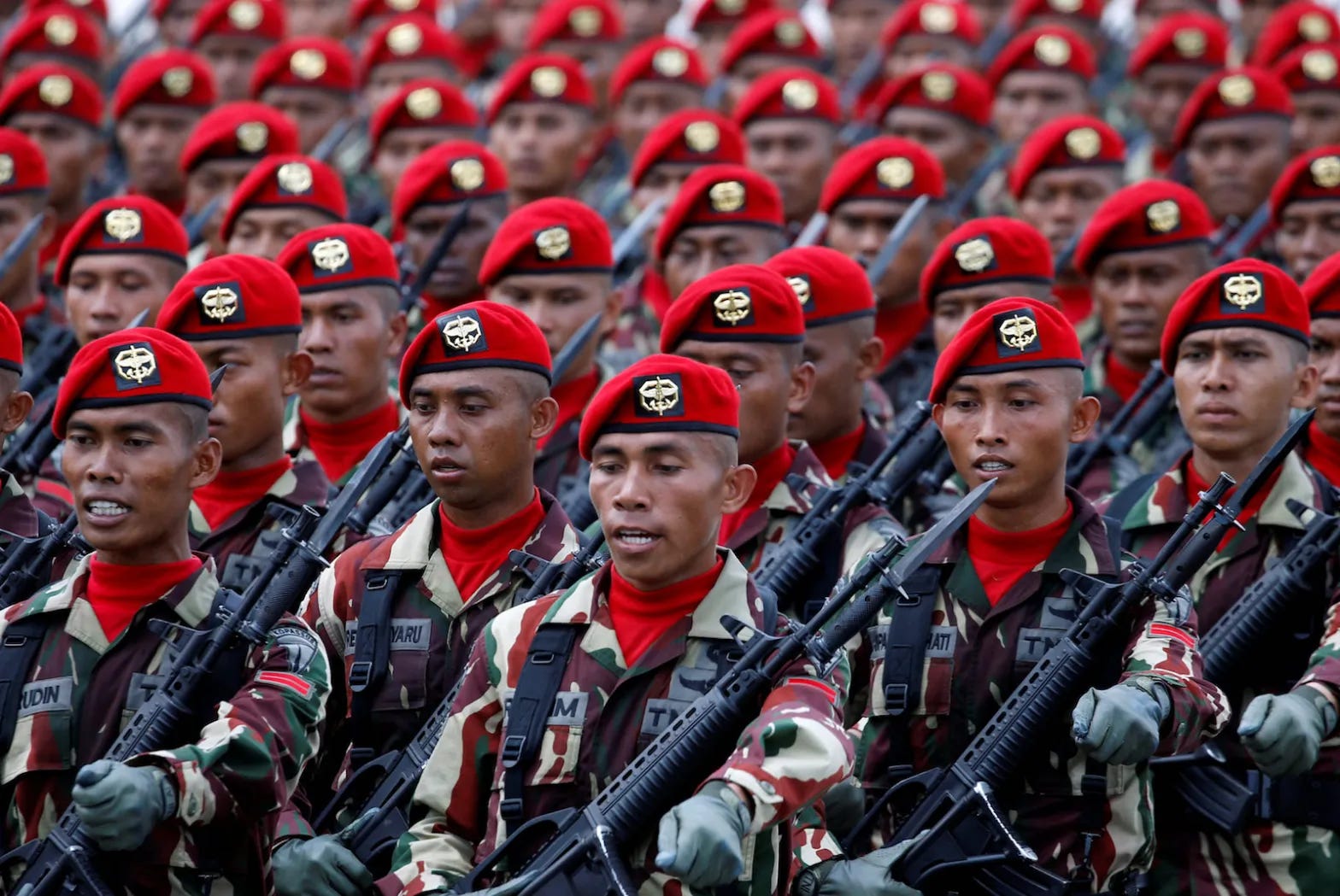
The SPPI—Latsarmil tragedy did not emerge from a vacuum. It is the product of a slow, quiet remilitarisation of Indonesian civilian life that has accelerated alarmingly since the revision of the Indonesian National Armed Forces (TNI) Law.
The 2025 amendment to the TNI Law now permits active military personnel to occupy civilian positions in at least fourteen—and potentially nineteen—state institutions without resigning their commissions. As analysts have noted, this “erodes the principle of civilian supremacy” and “formally authorises the TNI to participate in civilian governance.” The boundary between military and civilian spheres—painfully carved out during the Reformasi era—is being systematically dissolved.
Military reform in Indonesia has always been inconsistent, “shaped by the ebb and flow of the country’s democratic consolidation.” But the SPPI case represents something more insidious: not merely the military’s influence over civilian affairs, but the military’s active remaking of civilians in its own image. Civilian cooperative managers are not being trained; they are being militarised. And when civilian bodies fail to withstand military rigour, the system shrugs and reaches for the condolence fund.
Structural violence is violence built into the architecture of society—unequal power producing unequal life chances. The SPPI program is structural violence in its purest form.
Indonesia’s youth unemployment rate remains stubbornly high. Secure, stable employment is scarce. When the state offers a pathway to a guaranteed career—even a pathway that includes thirty days of military-style hazing—young people have no real choice but to accept. The alternative is the slow, grinding violence of precarity, unemployment, and social exclusion.
“There are many irregularities,” Usman Hamid observed. “The families of the victims and the public have the right to know the cause of death and to thoroughly investigate who is responsible.” The victims had all passed medical screenings that declared them fit for training. They had all been deemed healthy enough to endure. They were not.
The state, by designing this program as a mandatory gatekeeping ritual that includes physical drills irrelevant to the job, exploits this desperation. It does not need to point a gun; the economy does that for it. Consent, in this context, is a fiction. The choice is between the violence of unemployment and the violence of a potentially lethal training program. That is not a choice. That is coercion.
Perhaps the most chilling aspect of this tragedy is the institutional response: not accountability, but deflection; not justice, but compensation.
Indonesia’s military justice system “lacks transparency, independence, and impartiality, and has failed to properly investigate and prosecute alleged serious human rights abuses by military personnel.” As rights group Imparsial has documented, “impunity for TNI personnel persists due to the lack of impartiality in the military justice mechanism.” UN experts have warned that processing cases through the military justice system “risks perpetuating longstanding patterns of impunity and fragmented accountability in Indonesia’s dual justice system.”
No high-level official has been named as a suspect. No commander has been charged with negligence. No one has resigned. The Ministry of Defence continues to defend the program while promising to “evaluate” it. The five dead become a line item in a budget, a statistic in a press release, a tragedy absorbed by grieving families while the institution absorbs nothing.
This is not governance. This is impunity institutionalised.
For global strategists and policymakers, the SPPI—Latsarmil tragedy should sound an alarm. Indonesia is Southeast Asia’s largest economy, a G20 member, and a democracy of 280 million people. It has a seat on the UN Human Rights Council. It projects itself as a model of democratic transition in a region marked by authoritarian backsliding.
Yet here, in plain sight, is a state that treats its own citizens as expendable inputs for bureaucratic goals. Here is a democracy where institutional prestige matters more than human life. Here is a system that weaponises poverty, militarises civilians, and shields itself with opacity and impunity.
This is not a “technical” problem solvable by white ribbons and health ministry memoranda. This is a constitutional crisis. This is a human rights crisis. This is a crisis of democratic legitimacy.
The Indonesian state has a choice. It can continue to sacrifice its young people on the altar of an obsolete ideology of toughness, or it can recognise that the purpose of public institutions is to protect life, not gamble with it. It can decouple civilian roles from military hazing. It can pursue criminal accountability for negligence. It can restore human dignity as the foundation of all state programs.
Or it can add more names to the list.
How many more lives must be lost before the state remembers that its citizens are not expendable?
