


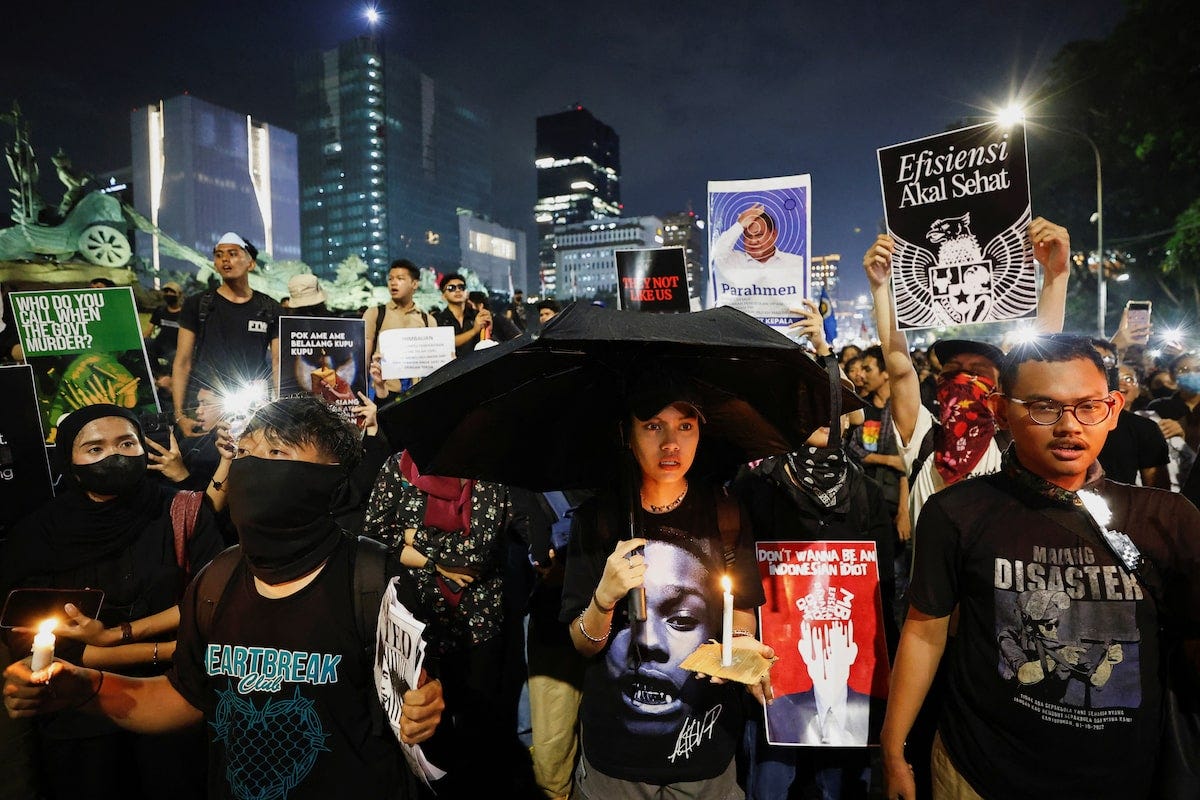
Indonesia’s democratic troubles are not born of faith, but of a political economy that has learned to hide behind it. For too long, analysts have misread Indonesia’s democratic frustrations as a religious story rather than a structural one. The world’s largest Muslim majority democracy is too often discussed as though Islam itself explains corruption, patronage, and institutional decay. That reading is not only wrong—it is strategically dangerous. Indonesia’s governance problem is not Islam. It is an oligarchy.
The deeper story is far more uncomfortable for Jakarta’s political class and far more relevant for global policymakers. Behind the language of reform, pluralism, and democratic transition sits a remarkably durable architecture of elite capture—a system inherited from Suharto’s New Order and modernised rather than dismantled after Reformasi in 1998.
Indonesia today is governed less by ideology than by networks: conglomerates, political dynasties, military-linked business interests, and transactional party machines. Political scientist Vedi Hadiz and Jeffrey Winters have long described this as an oligarchic democracy—elections without genuine redistribution of power. Reuters recently noted that Indonesia’s corruption perception score fell again, from 43 to 42, with the country dropping ten places in the 2025 rankings as oversight weakened and civil liberties narrowed. Transparency International was blunter: corruption has become normalised because the institutions designed to stop it have been politically hollowed out.
This is not a failure of belief. It is a failure of incentives. Indonesia’s political parties are largely “catch-all and patronage-driven.” Electoral coalitions are built not around coherent policy platforms but around access to ministries, procurement channels, and campaign finance. Vote-buying remains routine. Public office is often treated as an investment requiring return.
In such a system, moral language becomes theatre. Islamic parties that once promised ethical governance have largely fused into the same patronage ecosystem. PKB, PAN, PPP, PKS—despite different branding—operate within the same cartel logic. Cabinet seats matter more than reform. Coalition access matters more than accountability.
Even more striking is the co-option of Indonesia’s great Islamic civil society institutions. Nahdlatul Ulama and Muhammadiyah, together representing well over 100 million followers, once served as independent moral ballast in national life. They were capable of challenging state excess and defending social justice.
Today, much of that independence has been traded for proximity to power. Under President Joko Widodo, senior NU figures were elevated into ministerial roles, vice-presidential tickets, university grants, halal certification programs, and bureaucratic appointments. Greg Fealy described the shift starkly: NU increasingly came to see itself as obliged to “assist and defend” the government rather than scrutinise it. Critics have called it a Faustian bargain.
The symbolism matters. When religious authority becomes financially dependent on the state, public accountability weakens. Hisbah—the Islamic principle of moral oversight against injustice—becomes performative rather than institutional.
Even the Ministry of Religious Affairs has not escaped this corrosion. The detention of a former religious affairs minister in the Hajj quota graft scandal was not merely another corruption headline. It was a devastating metaphor: even the custodians of pilgrimage administration were drawn into the machinery of rent-seeking.
This is why blaming Islam misses the point entirely. In fact, classical Islamic governance principles align remarkably well with modern democratic ideals. Shura demands consultation and participatory governance. Hisbah demands anti-corruption oversight. Maslahah prioritises public welfare over elite accumulation. These are not obstacles to reform; they are potential foundations for it.
The problem is that Indonesia’s institutions were built to protect elite continuity rather than ethical accountability. The Dutch colonial administration co-opted religious courts to prevent rebellion. Suharto later forced Islamic parties into a single controlled bloc, created the Majelis Ulama Indonesia to discipline clerics, and made Pancasila the compulsory ideological framework. Independent Islamic authority was never allowed to become an autonomous check on state power.
Reformasi changed the electoral machinery, but not the underlying political economy. The weakening of the Corruption Eradication Commission (KPK) in 2019 was perhaps the clearest warning. One of the world’s most respected anti-graft institutions was deliberately neutered because it became too effective. Honest investigators were smeared, sidelined, and in some cases absurdly labelled “Taliban” as a political justification for removal.
The Economist sharpens this warning by showing how President Prabowo Subianto’s rule is accelerating Indonesia’s democratic backsliding through executive consolidation rather than ideological change. By building an overwhelming parliamentary coalition, Prabowo has effectively erased meaningful opposition. At the same time, the judiciary and the once-powerful KPK have been steadily neutralised, hollowing out the safeguards created during the post-1998 Reformasi era.
The Jokowi—Gibran political succession has further normalised dynastic nepotism at the highest level of government, turning democratic institutions into instruments of elite continuity. At the same time, costly populist programs such as the universal free school meals scheme and the continued construction of Nusantara are placing dangerous pressure on Indonesia’s strict 3 per cent budget deficit cap, alarming investors and fiscal technocrats alike.
Combined with aggressive nickel downstreaming policies that deepen dependence on Chinese capital, Indonesia risks replacing rule of law with patronage, and fiscal prudence with political spectacle—an increasingly dangerous path for Southeast Asia’s most important democracy.
That episode should have alarmed not just Indonesians but also Australia, ASEAN partners, BRICS and G20 policymakers alike.
Indonesia is not simply a domestic governance story. It is Southeast Asia’s largest economy, a G20 member, the anchor of ASEAN stability, and a critical actor in Indo-Pacific strategic competition. Governance failure here has regional consequences—from investor confidence and supply chain resilience to democratic norms and maritime security. Australia, in particular, should resist the temptation of shallow stability diplomacy. Quietly tolerating elite consolidation in exchange for short-term predictability is strategically shortsighted. Stable corruption is not stability. It is deferred instability.
The lesson from Malaysia’s 1MDB scandal, from the Philippines' dynastic resilience, and from democratic backsliding elsewhere is clear: institutions hollowed from within eventually become geopolitical liabilities.
Indonesia still has extraordinary strengths—a young population, vibrant civil society, globally respected Islamic pluralism, and democratic legitimacy that many neighbours envy. But moral capital cannot indefinitely survive institutional cynicism. The path forward is not theological reform. It is structural reform: restoring KPK independence, enforcing campaign finance limits, protecting whistleblowers, reducing dynastic patronage, and safeguarding civic space against digital authoritarianism.
The question is not whether Islam can save Indonesian democracy. The question is whether Indonesia’s ruling elite will finally allow ethical accountability—religious, civic, and constitutional—to matter more than oligarchic survival. That is the real test of the republic. And the world should stop pretending otherwise.
