


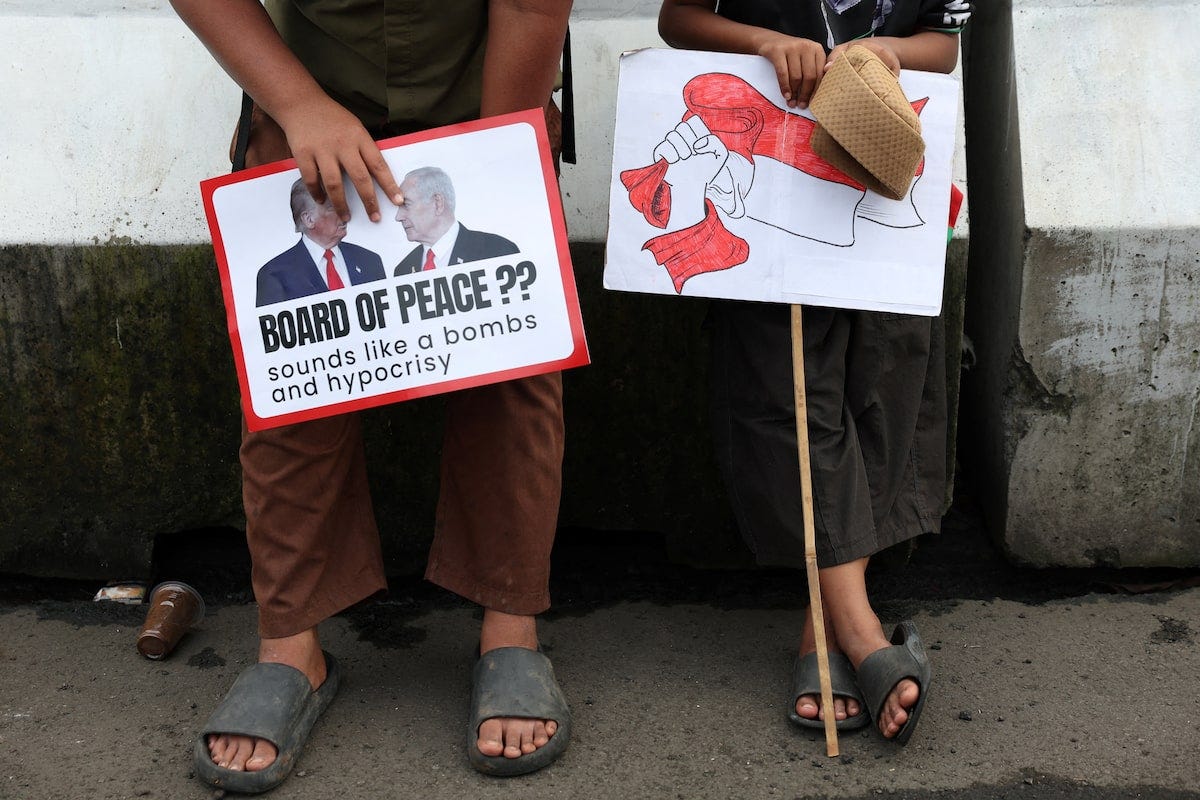
A quiet diplomatic decision in Jakarta has sent a subtle but unmistakable ripple through the geopolitical waters stretching from the Indo-Pacific to the Middle East. Indonesia’s temporary withdrawal from the Board of Peace (BoP) might appear procedural on the surface, yet beneath that calm lies a deeper recalibration of middle-power diplomacy at a moment when the regional security architecture of the Middle East is shifting under enormous strain.
In Indonesia, the move resonated strongly with public sentiment. Surveys conducted by institutions such as the Centre for Strategic and International Studies (CSIS Indonesia) and Indikator Politik have repeatedly shown overwhelming public support for a foreign policy that aligns firmly with humanitarian principles in Gaza and Palestinian statehood. Many Indonesians had long viewed the BoP as ineffective or structurally compromised, particularly after the dramatic escalation of violence in Gaza since October 2023.
Jakarta’s decision, therefore, carried a domestic logic: to reaffirm the moral consistency expected of the world’s largest Muslim-majority democracy.
Yet the implications stretch far beyond Indonesian domestic politics. In many ways, the move reflects a familiar principle in Indonesia’s diplomatic tradition — bebas aktif, or “independent and active” foreign policy. First articulated by Mohammad Hatta in 1948 during the fragile early years of the republic, this doctrine rejected the binary logic of great-power blocs. Instead, it envisioned Indonesia as a bridge-builder: independent in judgment, but active in shaping global peace.
For decades, that philosophy has defined Jakarta’s role in international affairs. Indonesia helped shape the Non-Aligned Movement during the Cold War. It championed anti-colonial solidarity across Asia and Africa. In recent years, it has sought to serve as a quiet diplomatic convenor within ASEAN and the broader Global South. The decision to step away from the BoP therefore does not represent withdrawal from global diplomacy; rather, it signals dissatisfaction with a peace mechanism that many in Jakarta view as no longer credible.
The timing is striking. The Middle East today is experiencing one of its most volatile strategic transformations in decades. According to analyses, the region’s security environment is increasingly defined by a shadow confrontation between Iran and Israel, intensifying missile and drone capabilities among non-state actors, and a gradual recalibration of Gulf Cooperation Council (GCC) states navigating between Washington, Beijing, and regional rivals.
Iran’s regional posture remains a central concern. The estimates suggest Tehran maintains influence across a network of allied groups stretching from Lebanon and Syria to Iraq and Yemen. The Islamic Revolutionary Guard Corps continues to expand asymmetric capabilities, while Iran’s missile arsenal — estimated by the US Defence Intelligence Agency to exceed 3,000 ballistic missiles — represents the largest in the Middle East.
For the GCC states, these dynamics generate a complex mix of caution and recalculation. Saudi Arabia and the United Arab Emirates have pursued limited diplomatic openings with Tehran, including the China-brokered Saudi–Iran rapprochement in 2023. At the same time, they continue to seek stronger international pressure against destabilising regional activities. Washington’s own strategic posture has become more restrained, reflecting broader US priorities in the Indo-Pacific and Europe.
Within this shifting landscape, Indonesia’s diplomatic choices carry symbolic weight far beyond Southeast Asia. As the world’s fourth-largest population and the largest Muslim-majority democracy, Indonesia possesses a form of moral authority that few states can replicate. When Jakarta signals discomfort with an international peace framework, that signal resonates across multiple diplomatic communities — from Gulf capitals to Western policy circles.
Indonesia’s relationship with Iran itself is neither hostile nor distant. Both countries share a long history of engagement within the Non-Aligned Movement and the Organisation of Islamic Cooperation (OIC). Energy cooperation and cultural exchanges have sustained cordial ties. Tehran has often regarded Jakarta as a valuable bridge between the Middle East and Southeast Asia.
The current diplomatic repositioning therefore should not be interpreted as an anti-Iran manoeuvre. Rather, it reflects an attempt to preserve neutrality while refusing to legitimise mechanisms perceived as ineffective. In essence, Jakarta is communicating a nuanced message: friendship does not exclude principled critique, and peace frameworks must retain credibility if they are to command moral legitimacy.
The move also intersects subtly with the broader strategic triangle connecting Indonesia, the GCC, and the United States. Gulf states have increasingly sought broader international voices to reinforce calls for stability and accountability in the region. Indonesia’s moral authority — especially regarding humanitarian issues in Gaza — amplifies that message without aligning itself explicitly with any particular bloc.
Washington, for its part, has repeatedly identified Indonesia as a pivotal partner among Muslim-majority democracies. The US National Security Strategy emphasises the importance of working with “regional leaders that can shape norms and uphold stability.” Jakarta’s diplomatic posture therefore carries implications for how global coalitions on Middle Eastern security may evolve.
At a deeper philosophical level, Indonesia’s decision raises an enduring question in international relations: what role should middle powers play in a world dominated by great-power rivalry? Scholars such as Amitav Acharya and Andrew Hurrell have long argued that middle powers exercise influence not primarily through coercion, but through norm entrepreneurship — shaping expectations about legitimacy, justice, and acceptable behaviour.
Indonesia’s diplomatic identity fits this model remarkably well. Its influence lies not in military projection but in moral persuasion. When Jakarta advocates for humanitarian corridors in Gaza or calls for adherence to international law, it speaks with the credibility of a nation forged through anti-colonial struggle and committed to pluralistic democracy.
In that sense, the withdrawal from the BoP resembles less a retreat and more a moral protest — a quiet refusal to participate in structures perceived as incapable of delivering meaningful peace.
The consequences could unfold in several directions. Indonesia could emerge as a credible mediator between competing Middle Eastern actors, leveraging its reputation for neutrality. It could also assume a stronger role within the OIC and the Non-Aligned Movement, pushing for reforms to global peace mechanisms that better reflect the voices of the Global South.
Another possibility lies in humanitarian diplomacy. Indonesia has increasingly invested in aid initiatives and reconstruction efforts linked to Gaza and broader Middle Eastern crises. Such initiatives enhance Jakarta’s standing as a principled actor committed to human security rather than geopolitical rivalry.
For global policymakers, the broader lesson is clear. The architecture of international peacebuilding is no longer shaped solely by major powers. Middle powers such as Indonesia are asserting greater agency, guided by domestic public sentiment, ethical commitments, and a desire to avoid entanglement in rigid geopolitical blocs.
In a world drifting toward multipolarity, these actors may prove decisive in sustaining diplomatic bridges that larger powers struggle to maintain.
Indonesia’s decision ultimately sends a message far beyond Jakarta. Peace mechanisms must remain credible, inclusive, and rooted in justice if they are to command global legitimacy. When those conditions falter, even cautious middle powers may choose to step aside rather than endorse a flawed process.
The gesture may appear modest, but within the evolving geopolitics of the Middle East and the Indo-Pacific, such signals carry profound meaning. Quiet diplomatic recalibration can sometimes speak louder than grand declarations.
For a region yearning for stability, and for a global order searching for moral clarity, that message matters more than ever.
