


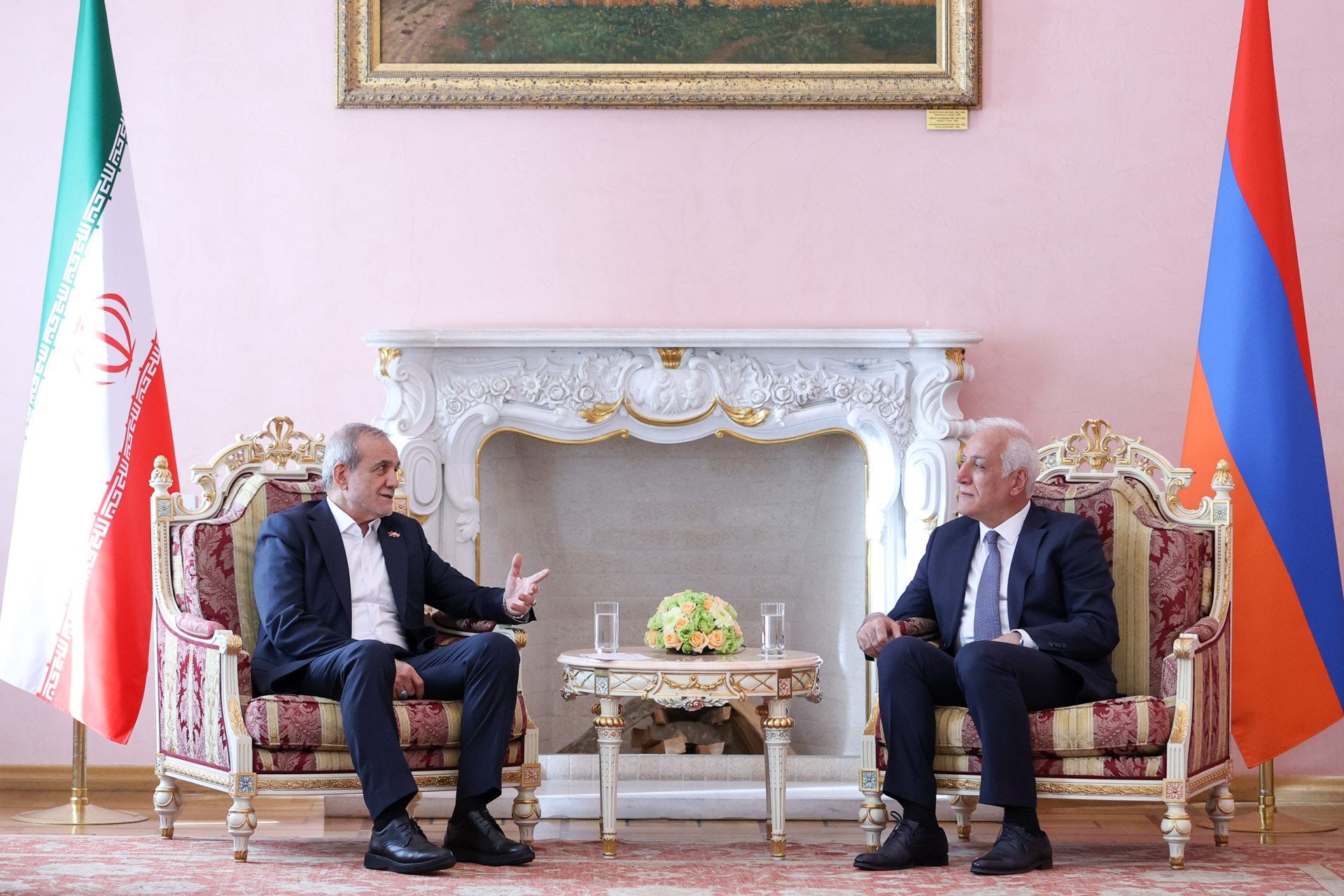
Iran has welcomed the declaration of peace between its northern neighbors Armenia and Azerbaijan earlier this month. However, it has also made clear its opposition to any US presence in the region, claiming that would be detrimental to regional peace and stability.
The Iranian position was reiterated by President Masoud Pezeshkian on Tuesday, 19 August, on the last day of his two-day state visit to Armenia.
Addressing a joint press conference with Armenian Prime Minister Nikol Pashinyan, Pezeshkian warned that “politics and governance in the Caucasian region must remain Caucasian” as “outsourcing the resolution of the Caucasus issues to extra-regional forces complicates an already sensitive situation,” Iranian newspaper Tehran Times reported.
During an earlier meeting with Armenian President Vahagn Khachaturyan, Pezeshkian underlined that Iran is fundamentally opposed to the presence of the US in the region, given its track record of failing to keep any of its commitments in the past, IRNA reported.
Armenia and Azerbaijan signed a joint declaration earlier on 8 August announcing the end of the decades-old conflict over Nagorno-Karabakh and pledging to respect each others’ territory, not to use force, and to respect international law.
Nagorno-Karabakh is internationally recognized as Azerbaijani territory settled by ethnic Armenians during the time when both countries were part of the Soviet Union.
After fighting multiple wars against Armenia for control over the territory since the dissolution of the Soviet Union in the early 1990s, Azerbaijan finally took full control over it in 2023 and forced all the Armenians, around 100,000 of them, to flee to Armenia.
The declaration to end the conflict was signed at the White House between Azerbaijan’s President Ilham Aliyev and Armenian Prime Minister Pashinyan, with US President Donald Trump signing as the witness.
The deal, which has been welcomed by all the major powers, including Russia and Iran, as a move toward peace in the region, however, has also caused apprehension due to both the countries signing an additional agreement with Trump to allow US companies to build a corridor linking Azerbaijan to Nakhchivan, its exclave across the Armenian border.
No to US presence in the region
The proposed corridor is named “Trump Route for International Peace and Prosperity” (TRIPP) after the US president. This multibillion rail-road and communication corridor, though it hasn’t been stated explicitly, may invite a heavy presence of external forces into the region in the name of security.
Iranian objections to any future presence of foreign forces in the region were also supported by Russia. Talking to the press on 9 August, Russian foreign ministry spokesperson Maria Zakharova maintained that “reconciliation between two countries should be integrated into the regional context and based on a balance of interests and unconditional respect for the priorities of the parties and neighboring states.”
Iran shares long stretches of its borders with both Armenia and Azerbaijan while Russia shares its border with the latter.
Speaking to the press last week, spokesperson of Iran’s Ministry of Foreign Affairs Esmail Baghaei claimed that his country is keeping a close eye on the developments in the South Caucasus and maintained that “Iran considers foreign interference in the region a red line”.
Baghaei claimed that Iran sees the presence of extra-regional forces as detrimental to regional stability and a source of geopolitical complications.
Iran has consistently demanded the withdrawal of American and other foreign powers from the region. The US has over a dozen military bases in the neighboring Arab countries which have often been used to target Iran including during the recent Israeli aggressions.
Iran has maintained that the presence of foreign forces increases insecurity and threatens the sovereignty of the countries in the region and is one of the sources of constant tension between countries in the region.
Responding to Iranian concerns, Armenia claimed on Tuesday that it will not encourage any deployment of foreign troops and all the TRIPP infrastructure inside Armenian territory will be under the exclusive jurisdiction of Armenia.
The security of the project inside the country will be provided by the Armenians, “not by a third country,” Pashinyan was reported saying by Al-Jazeera.
Armenia’s deputy foreign minister Vahan Kostanyan also tried to assure Iranians earlier this month that the transit corridor project does not have any provision for “US security presence in the region” expressing hope that its success may lead to better economic and political connectivities in the region.
