


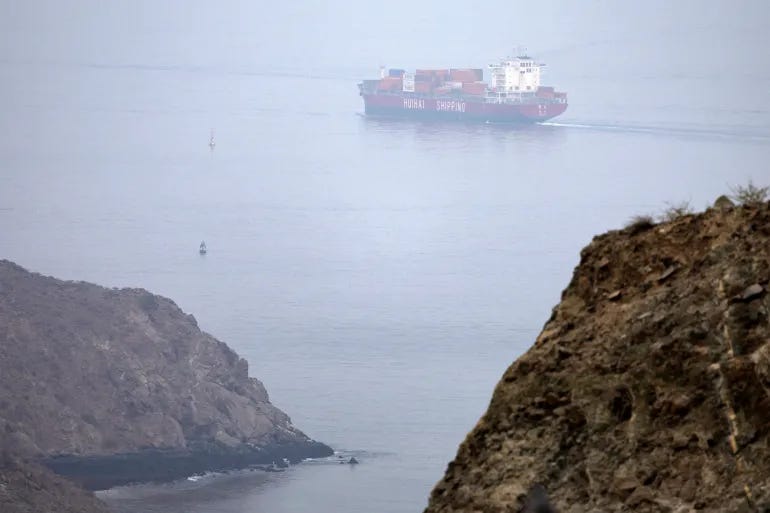
Iran will take every necessary measure to break the US naval blockade, as it is part of its military aggression against the country and a crime against the Iranian people, Esmail Baghaei, official spokesperson of Iran’s Foreign Ministry, said in a press conference on Monday, 23 November.
He also reiterated deputy foreign minister Kazem Gharibabadi’s claims over the weekend that Iran is considering a combination of military, political, and diplomatic measures to counter the blockade.
Gharibabadi had warned against any fresh US-Israeli attacks, claiming the Iranian response would be stronger than in the past, while also claiming that the Iranian intent to break the blockade has been conveyed to the US through the Qatari mediator.
The US has imposed a naval blockade on Iran since the breakdown of the 17 June Memorandum of Understanding (MoU). The blockade has impacted Iranian oil exports by sea and intensified the economic distress in the country.
Iran’s announcement comes at a time when observers claim that the number of attacks on ships trying to cross through the Strait of Hormuz without approval has gone up substantially in the last few weeks. Reports also claim that Iran has intensified its retaliatory attacks on the US military in the region in comparison to earlier months.
On Sunday, the Islamic Revolutionary Guard Corps (IRGC) issued a statement that at least two more tankers caught fire and were forced to stop while trying to cross the Strait of Hormuz through the “illegal route” in violation of its repeated warnings.
On Saturday, at least two other oil tankers were attacked in the Strait and forced to stop after they allegedly struck sea mines, the Iranian Navy had claimed. A similar attack on an oil tanker was recorded on Friday as well.
As per the reports, at least 25 oil tankers have been attacked in the Strait of Hormuz in the past week. This has impacted the oil flow through the waterway drastically.
In its statement, the IRGC repeated that the ship owners should take its warnings seriously, as the Strait of Hormuz remains under the full control of Iran’s naval forces, asking them to not rely on “misleading guidance from smugglers, including commanders of the US Central Command,” Press TV reported.
On Sunday, Iran claimed its armed forces targeted the radar systems of the US bases in Bahrain in retaliation to the US attacks. It also claimed that it downed two US military drones and hit an F-35 stealth jet. It claimed the jet was flying close to its airspace.
On Saturday, Iran similarly claimed it had fired missiles at an F-16 fighter jet, which was probably damaged and had to make an abrupt landing.
Trump agrees Iranian attacks are stronger.
Though he claimed the Iranian attacks have not caused any damage, US President Donald Trump accepted that they have become stronger in the last few days.
Iran “has launched more drones and missiles in the last week than at any time for over a year,” but “they have caused no damage,” Trump said in his social media post on Sunday.
He reiterated his claims of the Iranian government killing over 80,000 protesters and tried to blame the Democratic victory in the US midterms for the stronger Iranian response, saying Iran considers Democrats “weak, ineffective and country destroying.”
He also accused that “both the Dems and Iran fought” to keep the oil prices high up to the elections, which have now dropped “by a record level.”
Though the prices of oil have gone down in the last few weeks in comparison to last month, they remain higher than pre-war levels. It is speculated that the latest slump in prices is due to the absence of fresh US strikes on Iran and the increased outflow of oil through the Strait of Hormuz.
On Saturday, Trump had said he wanted to make a “permanent deal” with Iran and expressed his indifference to the nature of its “regime.”
The US and Israel launched the war on Iran with a joint military strike on 28 February, declaring that one of their objectives was to change the “regime” in the country. Iran’s Supreme Leader Ayatollah Ali Khamenei, along with several other high military and political leaders, was killed in the first few months of attacks.
According to Iranian officials, over 7,200 people (including 632 children) have been killed in US-Israeli attacks in June 2025 and since the start of the current war on 28 February.
On Monday, Baghaei also reiterated his country’s position that “if the American side fulfils Iran’s set conditions, the Strait can be opened and secured for all kinds of shipments within hours.”
Iran has been demanding the end of the war on all fronts in the region, remuneration for the damages caused by US-Israeli strikes, the end of sanctions, and access to its frozen assets, among others, as conditions for opening the Strait.
He also reiterated that the US should not see Iran’s conditions as “unusual” because these conditions are an “inseparable part of the rights of the Iranian people.”