


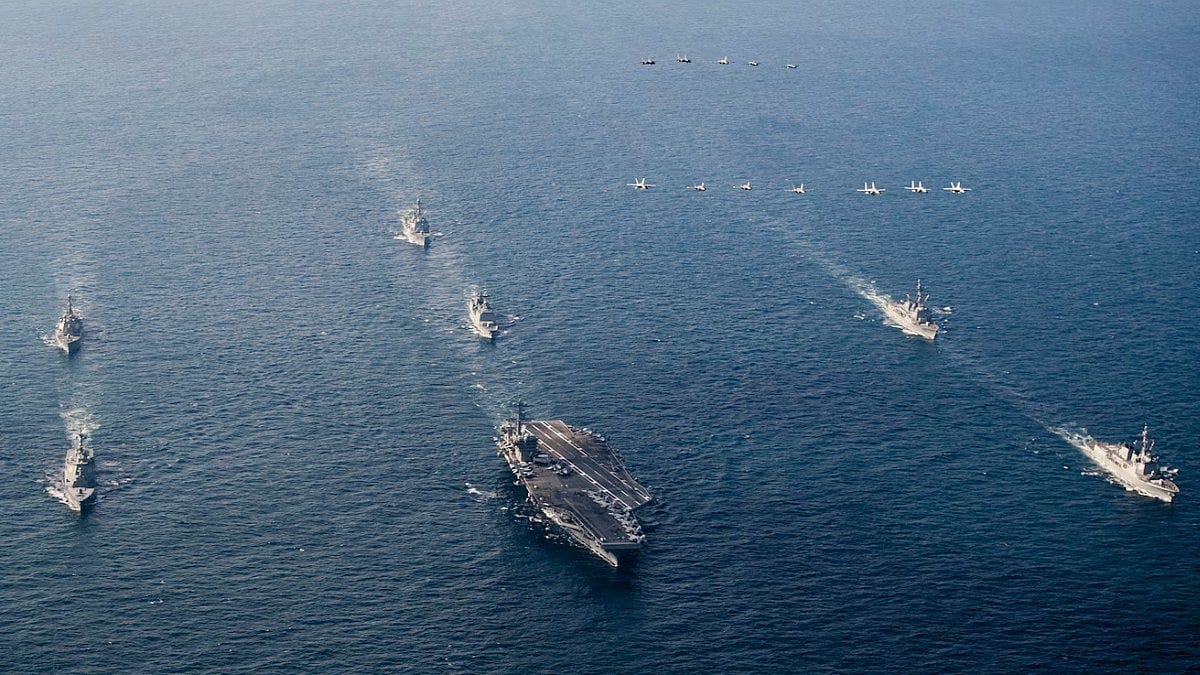
Iran warned South Korea of serious consequences if it joins the US military efforts against it in the Strait of Hormuz and asked it to not yield to US pressure and threats to become “complicit in aggressive acts and horrific crimes” against the Iranian people.
“Iranian people are defending themselves against America’s aggressive actions, and in a situation where they are resolutely responding to America’s war crimes against women and children” any country participating in its military activities in any way “can only be regarded as directly supporting the perpetrators of the aggression,” Baghaei said in the post on X on Monday, 7 September.
He underlined that the 64-year-old friendly relationship between Iran and South Korea has “consistently developed on mutual respect” and his country “places great importance” on it.
Last week, South Korea had said that it was reviewing options to support US operations, including its military efforts, in support of “freedom of navigation” in the Strait of Hormuz.
South Korea said it may deploy maritime petrol aircraft or mine detection and clearance units if it decides to do so and if the country’s parliament approves it.
The US and South Korea have a close military alliance. South Korea hosts some of the largest US military bases in the world, along with over 24,000 soldiers.
US President Donald Trump last month had threatened to rethink military relations with South Korea and even ordered scaling back of the joint military exercises after accusing its government of refusing to help in its war against Iran.
The US has pressured several NATO allies for similar assistance in the Strait of Hormuz in the past with no real success.
Restricted zone beyond the Strait of Hormuz
Iran is preparing to declare a “restricted zone” beyond the Strait of Hormuz in the Persian Gulf, Mohsen Rezaei, head of Iran’s Supreme National Security Council, said in a televised interview on Sunday.
The zone will start from the line where a US naval blockade is imposed on Iran and will extend into the Persian Gulf. Any vessel entering the zone will be required to coordinate their movements with the Iranian authorities or face sanctions related to insurance and future passage, Rezaei said.
Iran will also impose a complete ban on transition through the Strait of Hormuz for countries and entities that impose unilateral sanctions or carry out hostile acts against it, its Parliamentary Commission on National Security and Foreign Policy announced on Sunday.
Rezaei also claimed that the talks with Oman are finalised and Iran will soon announce the opening of a “new international corridor” in the Strait of Hormuz. The corridor will be managed by Iran.
Oil prices rise again.
After the US attacked several Iranian oil tankers on Saturday and Iran retaliated by claiming to attack US warships and three ships transiting through the US-sponsored route in the Strait of Hormuz on Sunday, global oil prices were on the rise yet again, reaching near USD 97 per barrel on Monday.
Meanwhile, Speaker of Iran’s Parliament Mohammad Baqer Ghalibaf warned the US against attempting more strikes on its oil tankers in the future, claiming more such strikes will lead to Iranian retaliatory attacks on infrastructure related to American gas and oil companies in the region.
Ghalibaf was responding to US Secretary of Defence Pete Hegseth, who, after the US strike on three of its oil tankers last week, had claimed that Iran has no defences left to protect them and warned of more such attacks.
“The oil and gas production chain here is sprawling, accessible and exposed. American oil and gas companies across these waters and facilities share that exposure. Strike out assets and you get struck,” Ghalibaf said in a post on X on Monday.
The latest oil prices are already touching high prices recorded in July when tit-for-tat strikes began after the 17 June Memorandum of Understanding (MoU) collapsed.
With Iran’s announcement of the restricted zone in the Strait and continued strikes on ships, it may go up to USD 120 per barrel, several experts warned.
