


Saul Loeb
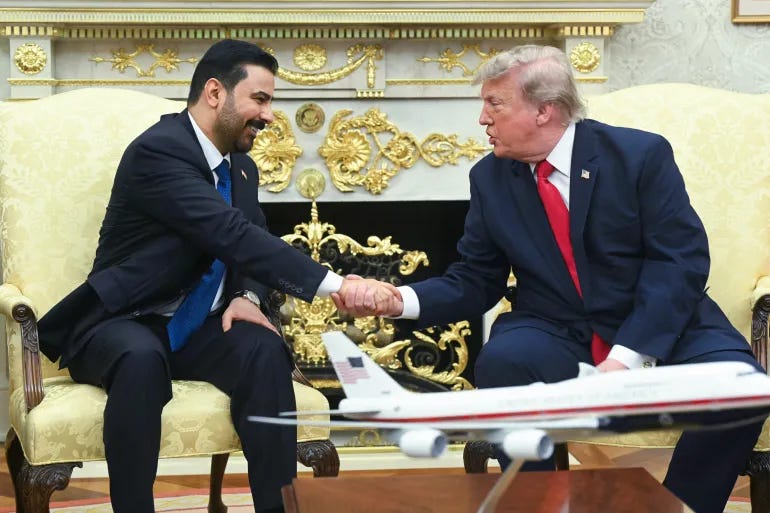
Forget the handshakes. Forget the memoranda. What unfolded in the Oval Office this week between Iraqi Prime Minister Ali al-Zaidi and President Donald Trump wasn’t a diplomatic visit—it was a geopolitical exorcism. A corporate-driven, dollar-denominated, pipeline-laced attempt to tear Iraq from Iran’s embrace and weld it into the Western energy order. And the entire Middle East is now watching to see whether this extraordinary gambit succeeds—or whether it detonates the region all over again.
Iraq’s economy has been shattered. The Iran war hammered crude output, with exports through the Strait of Hormuz—the route through which most of its 3.4 million barrels per day previously passed—effectively collapsing. Oil accounts for approximately 90 per cent of state revenues. When the Strait closed, Iraq’s treasury haemorrhaged.
The government has been forced to explore alternative export routes, with initial crude exports through Syria expected to begin at around 50,000 barrels per day, and fuel oil shipments already moving by truck to Baniyas for export to European and African markets.
This is the backdrop against which al-Zaidi—a businessman with no political background, a multimillionaire who emerged as a consensus candidate after months of deadlock—arrived in Washington. His message was brutally simple: Iraq is open for American business. And Washington, for its part, has made the calculation that corporate infrastructure is cheaper than military occupation.
Here is the revolution that strategic analysts are still scrambling to digest. The United States is not merely withdrawing troops—it is replacing them with corporate tripwires. Chevron, General Electric, HKN Energy—these are not just commercial enterprises. They are deterrents. By embedding billions of dollars of American corporate infrastructure directly into Iraqi territory, Washington has established a permanent red line.
Any attack on these assets by Iranian proxies is legally and politically treated as an attack on U.S. sovereign interests, triggering devastating retaliation.
President Trump has declared that al-Zaidi’s appointment represents “the beginning of a tremendous new chapter between our nations.” And the new prime minister has delivered. Just shy of two months in office, his government has already signed contracts with Chevron, Halliburton, and KBR, as well as an agreement with Starlink to provide high-speed internet services throughout the country.
The cabinet has instructed the state-run Basra Oil Company to exempt U.S. energy companies from certain regulatory requirements—a deliberate policy shift that energy consultants describe as “using Iraq’s energy sector to strengthen ties with Washington.”
But there is a catch. A massive, existential, potentially catastrophic catch. The Iraqi government has given pro-Iran armed groups until 30 September to disarm, coinciding with the end of the US-led coalition’s mission. This is the moment of truth. Some factions, such as Asaib Ahl al-Haq and Kataib Imam Ali, have signalled willingness to integrate or place weapons under state control. Others, including Kataib Hezbollah and Harakat Hezbollah Al-Nujaba, have expressed outright resistance.
The Islamic Resistance in Iraq, a loose alliance of Iran-backed armed groups, has already warned against “replacing military occupation with an even more dangerous form of economic occupation.” They have targeted US facilities in Iraq more than 600 times. And they have stated that they will strengthen their capacities rather than disarm. As one senior Iraqi politician told AFP, some groups will likely not disarm “as long as there is a war in the region, neither they nor Iran would agree to it.”
Renad Mansour, senior research fellow at Chatham House, has cautioned that meeting the September deadline would be “almost impossible in that timeline.” Yet the Trump administration is hoping for something “quick and fast” on disarming militias and tackling corruption—a “very difficult task,” as Mansour puts it.
Then there is the dollar. Washington has resumed cash shipments for Iraq’s oil revenue, handled through the Federal Reserve Bank of New York—shipments that were suspended earlier this year as pressure on Baghdad to disarm the pro-Iran armed groups. The United States has made progress on disarmament a condition for greater defence and economic co-operation, and has opposed any role for militia-linked factions in government.
This is financial coercion of the most sophisticated kind. The Federal Reserve does not command Iraq—it defines the reality within which Iraqi commands can operate. Every barrel of oil sold must pass through the American financial system. The power to freeze transactions, block accounts, sanction intermediaries—this is ontological power. It determines what political futures are materially possible.
Perhaps the most audacious element of this pivot is the plan to revive the 800-kilometre Kirkuk-Baniyas pipeline, connecting northern Iraq to Syria’s Mediterranean coast. This is a 70-year-old corridor, long dormant, now being resurrected to bypass the Strait of Hormuz entirely. The United States, Iraq, and Syria are reportedly finalising a deal that could divert as much as 300,000 barrels per day away from the Persian Gulf chokepoint where President Trump declared the US the guardian after Iran’s February blockade.
This is not just an infrastructure project. It is a geopolitical declaration of war against Iran’s most potent strategic weapon—the ability to threaten global energy security by closing the Strait. If Iraq can export oil independently of Persian Gulf chokepoints, Iran’s threats lose their regional bite. The strategic outcome is breathtaking: Iran, once the dominant power in Iraqi affairs, finds itself encircled not by armies but by pipelines.
But here is the uncomfortable question that Western analysts prefer to avoid. If Iraq’s new “sovereignty” is built on U.S. corporate infrastructure acting as de facto military tripwires—is Iraq still a sovereign actor in any meaningful sense? Or has sovereignty become a symbolic performance masking structural dependency?
The Iraqi government insists it is not distancing itself from Tehran in favour of deeper ties with Washington. “It doesn’t mean that Iraq is turning against Iran,” one senior Iraqi politician told AFP. Iraq “must maintain the long-standing balance” between its allies. But the structural reality tells a different story. The contracts with Chevron, the partnership with General Electric, the prioritisation of American firms over Chinese, Russian, and European competitors—this is not balance. It is realignment.
Iran is not blind to what is happening. Hours before al-Zaidi arrived at the White House, the Islamic Resistance in Iraq issued an explicit warning. They would not allow the U.S. to “replace a military occupation with an economic occupation.” Tehran is highly likely to leverage rogue factions to orchestrate asymmetric drone and rocket strikes against newly announced U.S. corporate infrastructure, attempting to scare off the very investors al-Zaidi is trying to attract.
The risk matrix is unforgiving. If the militias refuse disarmament, the U.S. may impose sanctions on Iraqi banks that facilitate militia financing. These sanctions would restrict Iraq’s access to dollar clearing, causing the dinar to depreciate, inflation to spike, and public discontent to rise. The economic crisis would undermine al-Zaidi’s domestic legitimacy, encouraging parliamentary opponents to trigger a no-confidence vote.
The resulting political instability would create openings for militia resurgence. Iran, seeing the disintegration of the American-backed order, would escalate its support for proxies, triggering further American sanctions, further economic deterioration, and further political fragmentation.
There is a bitter historical irony at play here. The United States invaded Iraq in 2003 to topple Saddam Hussein, ostensibly to eliminate weapons of mass destruction and spread democracy. Twenty-three years later, Washington is using corporate contracts to achieve what military occupation could not—the systematic dismantling of Iranian influence in Baghdad.
The relationship has transitioned from a 2003 military invasion and regime change to a complex 2026 strategic and commercial alliance centred on economic independence, energy extraction, and regional neutrality. This is no longer defined by U.S. nation-building, but by a transactional, corporate-driven model explicitly formalised under al-Zaidi and Trump.
This is not just about Iraq. It is not just about Iran. This is about the future of great power competition in the Middle East. If al-Zaidi succeeds, he will have demonstrated that economic integration is a more durable form of influence than military occupation. He will have shown that a state can navigate between superpowers by leveraging corporate interests to build infrastructure, financial stability, and defensive capabilities.
But if he fails—if the militias refuse to disarm, if Chevron withdraws after a single proxy attack, if Iran’s asymmetric retaliation destabilises the Iraqi economy—the consequences will be catastrophic. Iraq could face state fragmentation, currency collapse, or a return to the insurgency that tore the country apart in 2006.
Prime Minister al-Zaidi has placed an audacious bet. He is betting that American corporate power can provide the security and investment that Iraq desperately needs. He is betting that the Iranian-backed militias will ultimately choose integration over insurgency. He is betting that the September deadline will hold.
The Trump administration is betting that corporate tripwires are cheaper than military bases. That dollar-clearing is more effective than drone strikes. That pipelines are more durable than aircraft carriers.
Both are betting that the Middle East’s future will be shaped not by tanks and missiles, but by contracts and pipelines, by financial systems and corporate assets, by the slow, inexorable logic of economic integration.
It is a bold wager. And the entire region—from Tehran to Tel Aviv, from Riyadh to Ankara—is watching to see if it pays off. Because if it does, the rules of the game have changed forever.
