


Western politicians and journalists often claim that China is doing “colonialism” in Africa. This narrative has roots in US government discourse going back nearly two decades, and is exemplified by a US Congressional hearing that was held under the headline “China in Africa: The New Colonialism?” In the same year, the US business magazine Forbes claimed the purpose of China’s involvement in Africa is “to exploit the people and take their resources. It’s the same thing European colonists did… except worse.”
Certainly there are reasons to criticise the activities of Chinese firms in Africa, but to claim that China is exercising colonial power within the continent—drawing a direct equivalence to Western colonialism and imperialism—is empirically incorrect, stretches these terms into meaninglessness, and amounts to denying the violence of actually-existing colonialism.
What is colonial power?
First, let us consider the stakes of the accusation. What constitutes colonial and neocolonial power?
European colonialism was predicated on invasion and military occupation, forced dispossession, and systematic violence, including policy-induced famines, concentration camps, and genocide. In Africa alone, the British, Germans, French, Belgians and Italians all perpetrated genocidal crimes, in separate instances. German colonisers exterminated the majority of the Herero and Nama population in Namibia. Belgian colonisers killed some 10 million people in the Congo.
Africans achieved political independence in the middle of the 20th century, but the core states have continued to exercise coercive power on the continent in the decades since. The US currently has 58 active military bases in Africa. The US has intervened in many national elections, distorting the democratic process in favour of US interests, and has conducted some 20 regime-change operations. The US has imposed economic sanctions on most African countries (all except for 9).
France, for its part, controls the currency of 14 West African countries, and has tens of thousands of troops stationed in its former African colonies. France has a longstanding record of rigging African elections and propping up dictators, and has collaborated in assassinations against several political leaders in Africa since formal decolonisation. As for the UK, it has invaded nearly every African country (except for 5), and currently maintains 18 military bases on the continent.
Western states have orchestrated coups against dozens of progressive governments across the global South. In Africa, this includes Patrice Lumumba in the DRC, Kwame Nkrumah in Ghana, and Thomas Sankara in Burkina Faso, among many others, all of whom were replaced by right-wing dictatorships or juntas more willing to serve Western interests. Western states also actively supported the apartheid regime in South Africa.
Neocolonial power is also exerted through international financial institutions. In the IMF and World Bank, the US holds veto power over all major decisions and the core states control the majority of the vote. They have used this power to impose structural adjustment programmes (SAPs) across the global South, forcibly reorganizing Southern production away from local human needs and instead toward exports to the core in subordinated positions within global commodity chains. In Africa, SAPs caused decades of economic recession and de-development in order to ensure that African resources remain cheaply available to the West.
Nothing that China has done in Africa comes anywhere close to any of this. The moral and material difference is vast. China does not maintain military occupations in Africa. It does not perform regime-change operations, assassinations and coups. It does not control African currencies. It does not impose sanctions or structural adjustment programmes on African economies. China has not perpetrated genocide in Africa. It has never invaded an African country.
Indeed, China has not invaded any country anywhere in the past 46 years. During this same period, we have watched Western states invade and bomb a long list of global South countries, with spectacular violence, including seven countries in 2025 alone.
To equate China’s activities in Africa to European colonialism and contemporary Western imperialism is not only empirically incorrect, it trivialises the extraordinary violence of the latter. It is effectively a form of colonial denialism.
Assessing the allegations
Claims of China’s “colonialism” in Africa hinge on three main allegations. The first is that Chinese firms perpetrate labour abuses and cause social and environmental conflicts in Africa. The second is that China dominates extractive industries in Africa. The third is that China puts African countries in “debt traps”.
To the first claim: yes China has capitalist firms operating in Africa, which exploit workers. But this is how all capitalist firms operate, regardless of where they are headquartered. A recent study on Angola and Ethiopia found no systematic difference in the wages paid by Chinese firms compared to Western firms. If exploitative behaviour by capitalist firms becomes the definition of “colonialism”, then the term is stripped of all analytical value. We may as well say that Indonesian or Brazilian firms operating in Africa are colonial, but then the term clearly loses all meaning.
As for Chinese firms causing conflicts, a recent study on Chinese mining firms operating abroad found they do not create more conflict than other foreign-owned firms. In fact, a study of over 3,300 environmental justice conflicts around the world found that, where foreign-owned companies are driving conflicts in Africa and the rest of the global South, these companies were overwhelmingly headquartered in the West rather than China. In the same database (the Environmental Justice Atlas), French firms are responsible for 50x more environmental conflicts in Africa than Chinese firms on a per capita basis.
To the second claim, about resource extraction: the narrative that China dominates Africa’s extractive industries is not supported by evidence. In 2022, 72% of mining exploration funds focused on Africa were owned by Canadian, Australian, and British companies, with only 3% from China. Data from 2018 shows that Chinese companies controlled less than 7% of the total value of African mine production—less than half of the value controlled by a single British multinational, Anglo American.
Zooming in on fossil fuels, Western companies’ plans for expanding oil and gas extraction in Africa outstrip those of Chinese companies by a factor of nine. Of the 23 largest institutional investors in fossil fuel expansion in Africa, 92% of investments are held by the West; meanwhile 74% of expansion financing is provided by Western banks. These figures indicate it is the West that overwhelmingly controls and profits from the extraction of fossil fuels from Africa.
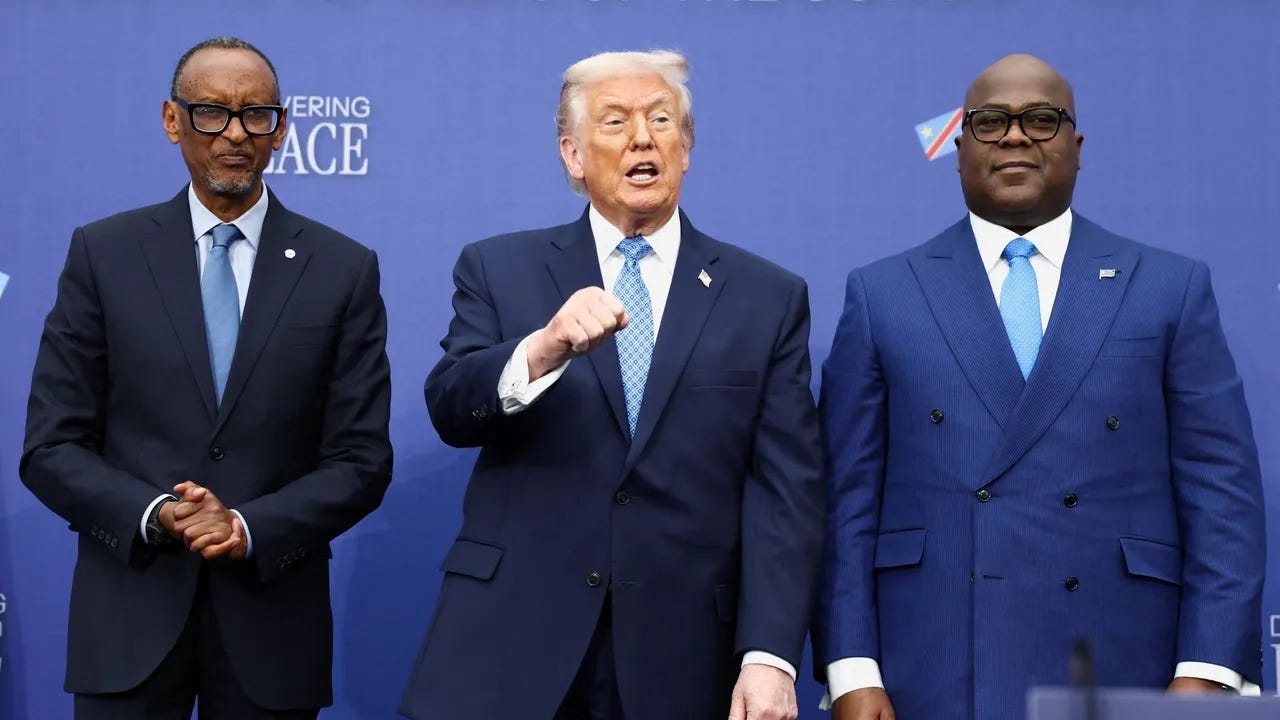
The DRC provides an interesting case. In 2008, Chinese firms signed a deal with the DRC to undertake infrastructure development in exchange for minerals worth up to $50 billion over 25 years. Western institutions represented this as “Chinese colonialism”. Later, in 2025, the US signed a deal with the DRC to obtain $2 trillion in mineral rights in exchange for ending attacks by Rwandan-backed militias against the DRC; attacks that the US had allegedly been supporting. The US deal is 40x larger than the China deal. But Western institutions do not accuse the US of colonialism; on the contrary, they have tended to go with the narrative of a “peace agreement”.
Finally, to the question of “debt traps”. Existing data shows that only 12% of Africa’s external debt is owed to China, whereas 35%—three times more—is owed to private Western creditors, and Africa’s debts to Western creditors carry double the interest compared to its debts with China.
A comprehensive study of China’s loans to Africa during the period 2000-2019 found that China never seized assets and never used courts to enforce payments. Furthermore, during the Covid pandemic, China suspended a substantially larger volume of debts owed by lower-income countries than Western creditors did.
Perhaps most importantly, China does not attach structural adjustment conditions to finance. By contrast, Western creditors have a record of leveraging structural adjustment programmes to force African governments to sell off public assets.
China in world-system perspective
It is important to maintain perspective here. Imperial power means the US and its allies can and regularly do destroy entire states halfway across the world, violating international law with impunity. They can and do bomb any individual or movement they don’t like, anywhere on the planet, for any reason. They can and do impose crushing sanctions, killing millions of people and bending governments to their will.
China simply does not project this kind of power. It is a semi-peripheral economy, with a GDP per capita that is 80% less than that of the core, equal to that of the Latin American average. Its military spending per capita is 40% less than the world average, and 1/20th that of the USA. China can resist the dictates of the core states to some extent, but it cannot and does not impose its will on the rest of the world as the core states do.
None of this is to say that Chinese firms do not exploit workers and resources in Africa. But this cannot be described as colonial or imperial power without rendering these terms analytically meaningless, and denying the violence of actually-existing colonialism.
Semi-peripheral countries like China play an intermediating role in the capitalist world-system. They provide cheap manufactured goods to the core in highly-competitive industries with razor thin profit margins. Capitalists operating in these industries are under pressure to obtain material inputs as cheaply as possible, which drives them to exploit resources in the periphery (like Africa), where imperialist interventions by the core states have weakened governments and cheapened labour and resources.
Within this system, the core extracts value from the semi-periphery—including from China—as well as from the periphery via the semi-periphery. The behaviour of semi-peripheral capitalists in the periphery must be understood primarily as a function of the imperialist world-system rather than as an expression of imperialism itself.

The comparisons do not have to match directly in order to have the awareness that colonization is on going. Surely the original colonial processes and installed systems have gone unchallenged and then layered upon.
For example, the mention of France 'controlling the currencies' in West African countries speaks not one word about how those currencies were established in the first place. And that omission remains when talking about how the Chinese take advantage of, control and direct, labor. The attempted dismissal about that commonplace practice within 'capitalism' falls flat when viewed through the lens of the colonial establishments of those currencies in the first place.
Here is one telling of that part of the history of colonization
From the abstract:
“In the European colonies, land expropriation and forced labor were used, but another important means of forcing indigenous populations to work as wage-laborers or produce cash crops was taxation and the requirement that taxes be paid in colonial currency. This paper provides an overview of this method, and documents its historical importance, concentrating on Africa. Taxation also played an important role in the monetization and commoditization of African economies, and in the rise of a peripheral capitalism. As the paper demonstrates, Marx was not unaware of money taxes functioning in this manner, and the phenomenon was in no way limited to Africa.” - Matthew Forstater
From the above paper by Forstater: ".... The problem was that if the subsistence base was capable of supporting the population entirely, colonial subjects would not be compelled to offer their labor-power for sale. Colonial governments thus required alternative means for compelling the population to work for wages. The historical record is clear that one very important method for accomplishing this was to impose a tax and require that the tax obligation be settled in colonial currency.
This method had the benefit of not only forcing people to work for wages, but also of creating a value for the colonial currency and monetizing the colony. In addition, this method could be used to force the population to produce cash crops for sale. What the population had to do to obtain the currency was entirely at the discretion of the colonial government, since it was the sole source of the colonial currency. This method was widespread and important enough to be called “a secret of colonial capitalist primitive accumulation” (since it was not the only method, it must be called “a” secret). This practice is extremely well documented, yet it has hardly ever been mentioned as an important method of primitive accumulation."
"......Several points concerning the role of direct taxation in colonial capitalist primitive accumulation need to be made. First, direct taxation means that the tax cannot be, e.g. an income tax. An income tax cannot assure that a population that possesses the means of production to produce their own subsistence will enter wage labor or grow cash crops. If they simply continue to engage in subsistence production, they can avoid the cash economy and thus escape the income tax and any need for colonial currency. The tax must therefore be a direct tax, such as the poll tax, hut tax, head tax, wife tax, and land tax. Second, although taxation was often imposed in the name of securing revenue for the colonial coffers, and the tax was justified in the name of Africans bearing some of the financial burden of running the colonial state, in fact the colonial government did not need the colonial currency held by Africans."
"....The requirement that taxes be paid in colonial currency rather than in-kind was
essential to producing the desired outcome,...."
Since colonial times we have remained faithful servants to an illiterate and impossible system of imposed make believe.
The jist of this article really does nothing to dismiss the question of colonization but only speaks to the degree and rate at which certain imperial players practice it.
It is the math of money (as presently conceived and structured and imposed) that should have told us that when everything is linked (monetized & commoditized) to inherent instability then everything, including community capacity and coherence, future generations, the natural world, will get sacrificed in vain attempts to respond to the illiterate imperatives of money (NOT part of the natural world) that remain unquestioned at the conceptual level. The varying geographic centers of these illiterate impositions nor the rate or other attached conditions do nothing to dismiss the imposed illiteracy or the colonial nature of continuing to operate within these imposed institutions.
In addition to the above-mentioned illiterate and unnecessary sacrifices one must also include the nonsense of war and the attempts to control those natural resources and using the further imposition of the same illiteracy about currency from one nation over another! Talk about compound illiteracy! Now every country is using this 'operating system' for control of the populace within its borders (as if that is not bad enough!) ...trouble is that the fighting between countries is so illiterate that countries are going to war over nonsense conceptual make believe!
We are killing each other over monetary illiteracy!
Let's stop this!
https://bibocurrency.com/index.php/downloads-2/19-english-root/learn/299-stop-wwiii
The process of decolonization must throw out all the imposed systems. That includes the systems of colonial money imposed around the colonized world. Behind these colonial impositions there is absolute illiteracy that then easily proves the imperialist colonizers to be illiterate about logic and basic Applied Mathematics.
When the freedom movement reclaims the literacy about money itself the colonizers will be shown to be the illiterate fools that imposed this illiteracy on everyone under their thumb, including themselves!
Here is a conversation with the AI called Grok that lays out the errors and the correction:
https://grok.com/share/c2hhcmQtMg%3D%3D_6ed64a55-dd77-4dd5-832e-2fbadea4c532