


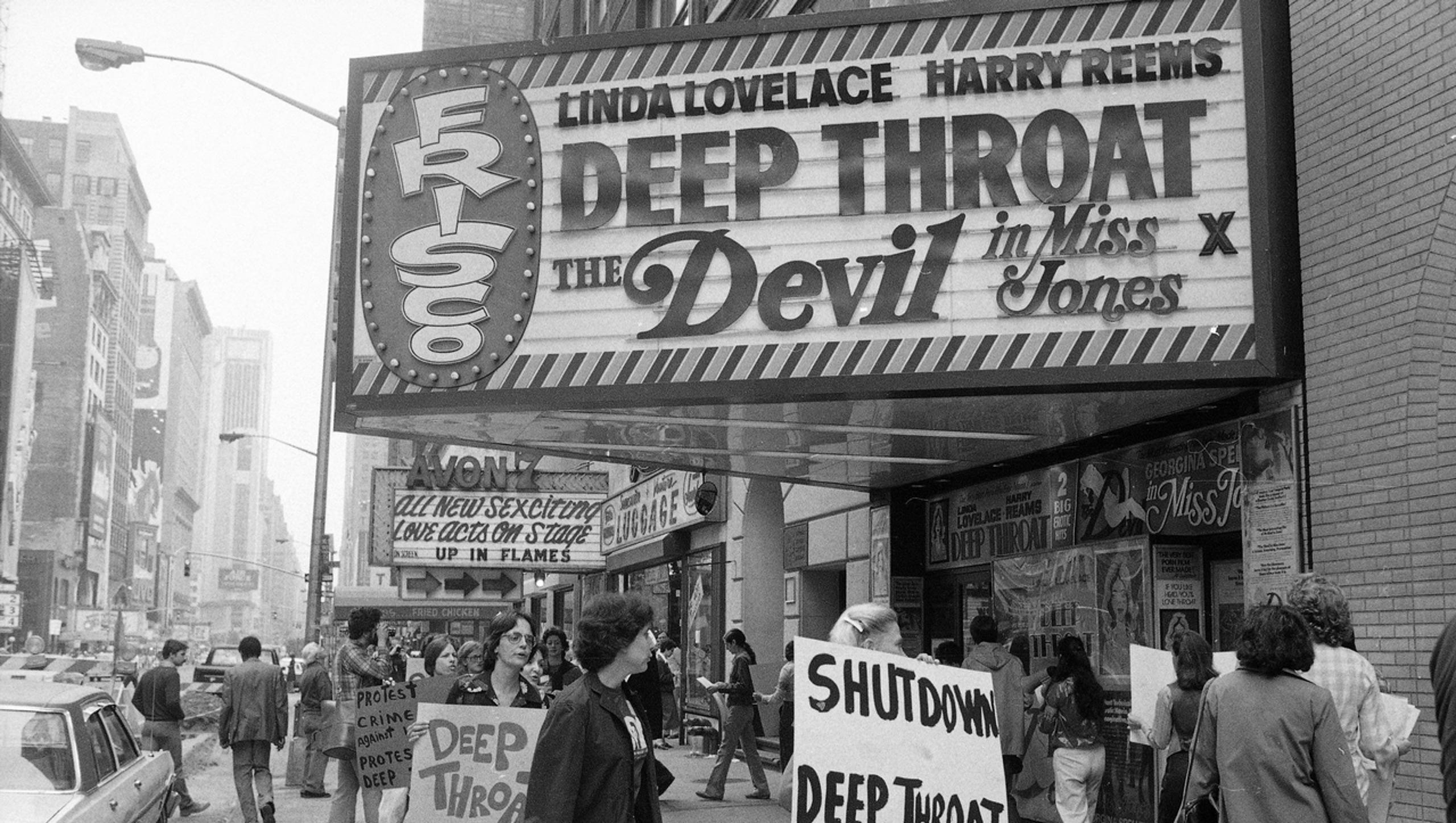
As a lifelong student and teacher of film and media studies, I have extensively examined the social and psychological impacts of pornography. As a feminist liberal and defender of free expression, I have wrestled with the pros and cons of censorship, and generally favour free expression despite my personal distaste for porn. I have heard endless debates on the subject, the contours of which are by now utterly predictable. I have engaged with the porn lobby’s arguments in their most robust form, not substituting straw men. I have listened and I have questioned my own prejudices and presuppositions. At the risk of putting myself to sleep, I want to begin by laying out the tiresome roadmap on this topic so that maybe, just maybe, I might launch the discourse in a new direction, if for no other reason than to disrupt the catatonic stagnation into which it has fallen.
Here is the current state of play:
Feminists point out the multitude of ways in which the dominant conventions of porn entail the objectification and degradation of women. They point out the exploitative and violent tropes and tactics that infuse its production and/or the psychological harm that consuming it inflicts, individually and/or collectively (on the culture at large).
In response, porn’s defenders point out that pornography is infinitely more varied than critics imagine and imply that opponents are naïve and ignorant of the nuances of the genre. They suggest that the kind of porn that would be acceptable to feminists exists, but that it simply does not cater to all (or most) tastes and kinks, hence it would be undemocratic as well as unrealistic to narrow human sexual arousal to the vanilla flavour that porn’s “Victorian” critics prefer. The fact that all variety of lurid content appeals to porn’s myriad consumers is evidence of innate psycho-sexual drivers in the human subconscious. Efforts by academics and feminists to sanitize this are futile and misguided. Alongside these home truths is the undeniable fact that rape fantasies are shared by both sexes, and females report being aroused by the idea of being the victim of rape and other forms of “violence”. (I can already hear the retort, ”Lots of men have abuse fantasies too!”)
The complaint that porn has a negative impact on others, including those involved in its production, or that it inflicts damage on the wider culture, are dismissed on two grounds. First, grown-ups mutually consent to its production and actors get paid. Secondly, whether the portrayals that dominate the genre are “good” or “bad” is a matter of taste, not of law. In this respect, porn may be compared to “video nasties”, gaming, prostitution, gambling, vaping and other “vices” that are generally viewed as insufficiently harmful to warrant state interference or are viewed as inevitable given the undeniable nature of human desire. Eliminating these behaviours would require purging the desires that underpin them—and this is an unrealistic attempt to whitewash human nature. We may as well try to catch the wind with a net. Repression only leads to even more perverse, and hidden, forms of “outlet” because natural human instincts are irrepressible.
The question whether porn is sufficiently harmful to warrant state interference is not about sexual tastes nor is it about the perversity that lurks within the depths of the human psyche. Nothing is accomplished by sniggering (yet again) at the implied prudishness of feminists because their imaginations cannot (or will not) stretch to accommodate the wildest fantasies of the fetishists in the room, who seem always to delight in shocking listeners with intimations of their most outrageous kinks.
What would really turn me on is pouring a bucket of cold water on the exhibitionists. There will no doubt be opportunities at drinks receptions to thrill listeners with prurient intimations about your personal proclivities. For now, I want to get off on having a serious political discourse with the grown-ups. Porn forces us to ponder the relationship between individual liberty and the state, and the relationship between the private and public spheres.
Arguments from analogy may be helpful here. Media effects scholars have learned that violent films and television programs can indeed impact culture, either by increasing rates of violence or by de-sensitizing citizens to it. As yet this fact has not resulted in censorship of movies but has underpinned the ratings system by which the film industry regulates movies according to the viewer’s age. Most people can agree that pornography is analogous in certain respects to violent film and television programming, violent gaming, etc. However, in a liberal culture, many of us prefer to make our own choices about consumption habits. Liberals set the bar appropriately high when weighing the “harms” porn involves against the harm of eliminating personal choice. We may not think that the instincts or habits that are being “nurtured” by the products we consume are necessarily good for our human development or improvement, but we find them enjoyable, and feel that we (not the state) should regulate our intake. We all live and learn. Liberals accept that the cost of individual liberty is that we must live with the consequences of our own decisions, while also having the freedom and responsibility to make better choices. We can learn from our mistakes precisely because we’re allowed to make them. This protects our autonomy and agency, precious aspects of our humanity without which we would become objects. The same cannot be said for behaviour that harms others.
Pornography is arguably more harmful than violent films because it sustains a criminal underworld that traffics humans into its production. This in turn feeds a prostitution industry that also runs on human slavery. When men cannot find willing participants to indulge their pornified sexual abuse fantasies, they go to prostitutes to have their way with a slave. In this sense the consumption of porn is more akin to wearing Nike™ trainers, which reportedly involve near slavery in their production. Although low wages and poor working conditions are less egregious than slavery, it deters some people from buying the brand. If Nike™ trainers did involve actual slave labour many more would stop wearing them. We need to ponder whether the harms associated with pornography’s production are sufficiently significant to warrant industry regulation.
Even if pornography does involve harmful exploitation, and even though its profitability incentivises human trafficking, this cannot easily be proved when many participants consent. Porn’s defenders simply deny or dismiss the fact that women and children are trafficked into it, and the argument breaks down into quibbling over a point of fact. Feminists and porn critics have had a notoriously difficult time proving that porn has “victims” (even if we all know that it does). Let us return, then, to the question whether pornography has a seriously harmful impact on consumers and the wider culture. If so, it is not merely a private matter.
Here’s the familiar boring part:
Multiple studies and meta-analyses indicate that men, on average, consume pornographic material at significantly higher rates than women (Petersen & Hyde, 2011, Psychological Bulletin). The gender gap persists across countries and age groups, though it narrows slightly among younger generations. Studies also found that men reported approximately twice the frequency of consumption as women (Grubbs & Perry, 2019, Archives of Sexual Behavior). Extensive content analyses show women are more often objectified and subjected to male-centred pleasure or aggression. The most widely cited content analyses of mainstream heterosexual pornography (especially older or best-selling DVD content) find very high rates of physical and verbal aggression, predominantly male-to-female: approx. 88% of scenes showed physical aggression (e.g., spanking, gagging, slapping, choking), with approx. 49% showing verbal aggression. The conventions and habits I have outlined come under constant attack from the pornography lobby’s spokespersons, who persistently cite exceptions to these patterns and qualify every generalisation.
I ask the reader to undertake a thought experiment. Revisit the above paragraph’s descriptions of porn’s consumption and content patterns, but in place of men substitute white people, and instead of women, insert black people. If there were a genre of media that disproportionately featured racist tropes as integral, you would be less comfortable, indeed less tolerant, of its ubiquitous production and consumption. In fact, you would probably express disdain for its consumers and propose legal bans on producers. Yet you do not feel the same outrage on behalf of women and girls. Could it be that you live in a pornified culture so saturated with media that represents women and girls as “less than” or as “other” that you have become desensitized to the objectification of women and girls? Could it be that these dynamics are so normalised that you quietly accept that a proportion of the actors in pornographic films are victims of human trafficking?
Censorship becomes a genuine question only if we concede that that normalising these desensitizing tendencies is somehow “bad for us” as human beings. There is a difficulty in persuading us of this if we and our elders have been fed from youth on a steady diet of these basic conventions to such an extent that they are confused with “nature”. The nature / culture distinction breaks down at the point where the culture is so saturated with pornographic representations that they are assumed to be inherent in life itself. Feminists have the conceptually impossible task of calling us back to something “real” that existed before pornography, or that was independent of it.
And this observation brings us to the crux of one current issue—which is that porn’s moving imagery, its dick pumping pixels, are impacting real sex. In Jean Baudrillard’s analysis, we are so immersed in simulacra that it has become impossible to draw a line between the real and the artificial. The “real” is just whatever we happen to do, and since we are very often imitating the imagery, the media’s representations have literally imploded into our behaviours, our appetites, our habits and our bodies. We can no longer separate art and life. Women get actual breast enhancement surgery in the real world to make themselves more appealing within a pornified culture that has set the ideal breast size at larger-than-average. Real women are routinely engaging in real anal sex because porn sets the norms for sexual behaviour. People’s sexual habits are influenced by pornography’s ritual humiliation and objectification of women and power dynamics that sustain male narcissism. Pornography nurtures and increases subject–object relationships between humans and reduces intersubjectivity. Insofar as human wellbeing is diminished by this dynamic, pornography is unhealthy. It is unhealthy for the (mostly female) object because she is treated not as an end but as a means. She is instrumentalized in the manner that a mirror is used to indulge in vanity. Her agency is irrelevant, her subjective experience nullified. She is a “thing” that is put into the service of another. Pornography is also unhealthy for the (mostly male) consumer because it feeds infantile fantasies of omnipotence that make relationships with other subjects less fulfilling. It reduces or nullifies the pleasure he would otherwise enjoy from reciprocal sexual interactions that would foster mutual respect and deepen human relationships.
The user of the pornographic “tool” would not be content to swap places, as he does not wish to become a thing. If the public are desensitized to this objectification of one category of humans (in a way that would be an outrage if it happened to, say, a racially defined category) then it is because the power dynamics that are everywhere consumed in private have seeped into the collective subconscious to such an extent that they seem only “natural”. Pornography normalizes misogyny to such a degree that most people can no longer recognise its influence on culture at all—porn is just life.
The release of the (massively redacted) Epstein Files has significantly expanded the Overton Window. This forces us to ponder the insidious “normalisation” of child porn and child abuse, even murder. The fact that our beloved idols and “philanthropists” are implicated in behaviours previously regarded as uncontroversially deviant implies a process of normalisation, even making it “cool”. The impunity with which they have engaged in these behaviours further signals that victims lives don’t matter.
If pornography and child sexual abuse are simply products of our innate human nature, then any attempt to return humans to a state of unadulterated “innocence” is futile. Foucault and his acolytes regard proscriptions of sexual behaviour as rooted in a wider pattern of law, medicine, and psychiatry that “discipline” human sexuality. His arguments centre on the power dynamics between individuals and the state. Foucault drew on his work in The History of Sexuality to argue that the modern obsession with protecting children’s innocence was actually just a way of controlling them. Foucault believed that by denying children any form of sexual agency, the state and the family structure reinforce a system of total dependency and “normalization.”
But if that is so, then cannot a Foucauldian styled critique cut the other way? If we are to analyse the dynamics within “systems of power” then pornography represents an industrial scale patriarchal “machine” that undeniably exerts massive ideological control, “disciplines” female sexual agency, and reinforces a system of total dependency, even to the extent that many men cannot become aroused in the absence of pornography or its typically misogynistic scenarios.
The porn lobby’s argument about “human nature” and the inevitability of violent and misogynistic fantasies deep within the human psyche simply begs the question. It assumes what needs to be proved: namely, that a pornified culture has no influence on “human nature” because nature comes before culture. We all concede that life imitates art as much as art imitates life . . . until we enter the realm of pornography, which is remarkably immune to such logic.
Altruism, like porn, is a matter of choice. Many of us would assume that any ethic that requires an answer to the question, “What’s in it for me?” has failed to understand what “ethics” means. Intuitively we perceive that being “virtuous” is somehow not synonymous with being selfish. Indeed, most of us would agree that ethical behaviour is the opposite of selfish behaviour. Our attempts to work out what is “best” for us, or even what counts as acceptable human behaviour, assume that we are social animals who wish to come to an agreement about how we can best function in relation to others and the wider community. We would not need ethics except for the common desire to live in harmony with others who have similar interests and needs to our own. The state cannot, and should not, coerce charity. All that remains, then, is to appeal to the rational egoist in the hope that individuals can be persuaded that it is not in their best interests to feed their misogynistic fantasies (fantasies of omnipotence), nor to act in complicity with them.
Of course, my tiny voice is miniscule in a huge cultural cauldron in which the basic stock is 24/7 pornography. But if you think about the amount of advertising dollars that get spent each year pushing junk foods on the public, and then look at the public’s actual consumption patterns, you will find that many people are able to resist the bombardment and to think for themselves. People learn, through failure, what is best (and worst) for them, precisely because they are free to find out the hard way. I am putting my faith in the human tendency to know what is best for them and to learn from experience. Many people eat healthy foods and take care of their bodies, despite internal temptations and external inducements to consume crap. I want to believe the same can happen with porn.
If porn wanking is one’s primary form of sexual education and experience it could be argued that this feeds into a culture of narcissism and instant gratification that further disconnects users from reality, one another, and the living world. What is that world like? It is not optional, it is stubbornly resistant to our whims, indifferent to our preferences, inconvenient, ugly, dirty, weird, unpredictable, wild, and unspeakably beautiful. It is a place populated with other beings who are like us in their needs and desires, and whose lives matter.
When a human asks what is in his self-interest, he is simultaneously asking what is best for a being like me. This requires us to contemplate what it means to be human and what is essential to human flourishing. Aristotle claimed that we are inherently social beings, and the use of solitary confinement as one of the most dreaded forms of punishment should signal to us that he may have been onto something. I submit that desisting from porn consumption is healthy for human beings in the same way that vegetables are healthier than processed fast foods. This is partly because we are social beings who flourish when our relationships are thriving.
My opponents will turn exceptions into rules and will argue using endless qualifications. They will say that some people need porn to engage in sex with a partner, etc. and will nit-pick over a one-size-fits-all account of human sexuality. What I am offering is not a monolithic picture of human sexual appetites, but of human nature. I am not moralizing; we are all (with very few exceptions) wankers. I am not trying to Incel-shame anyone; although to be fair, the left has made the latter into an Olympic sport. Rather, I am assuming that we are social beings who need relationships of reciprocity and intersubjectivity. Not all readers will agree with this anthropological model. To them I can only reply, “You do not know what you’re missing.”
As for censoring pornography, I have suggested that the economics of the industry incentivise human trafficking (actual crime). However, sending porn underground will not necessarily solve the problem. Ultimately, the question of whether or to what extent a society ought to regulate pornography is a consensus issue. Unlike scientific debates, we cannot point to some piece of empirical evidence that would settle the matter. The question is not just about what is “out there” in the world. It is about us, and what we (as human beings) want to become. Like the age of consent, abortion, or other thorny social issues, we must come to an agreement about what sorts of harm truly damage our permanent interests as progressive beings (pace J.S. Mill). While I have argued that pornography does produce significant harms, I am hoping that my arguments will inspire a voluntary cultural shift—one that promises more satisfying sexual experiences than porn can ever offer and one that can be controlled (primarily, but not necessarily exclusively) by citizens acting in their own interests.

Surprised to see no comments here. Though not my academic field, I have made a lifelong study of media effects and also of the impact and regulation of sexual imagery. Here is the problem. There is no way to define "porn." It's not a real category. What today we call porn has origins in the illustrated menus of old brothels; and of erotic art. Marshall McLuhan famously described all of photography as The Brothel Without Walls.
I am sensitive to imagery and of images of women in particular. In terms of what I find erotically interesting, many seemingly garden variety YouTube videos posted by young women are far more exciting and enticing than what is called porn. I see plenty of ads in the NY Times that are darned sexy, better styled, more evocative, and far more interesting than "porn." So why is that advertising and not art; why is that not porn? The purported purpose? Well, they're sellng pussy. That should count.
Is anyone familiar with the film behind the Potter Stewart quote, "I know it when I see it?"
Stewart was referring to the 1958 French film Les Amants (The Lovers), directed by Louis Malle, in his concurring opinion for Jacobellis v. Ohio (1964). Stewart argued that while "hard-core pornography" is difficult to define, he knew it when he saw it, and The Lovers did not fit that description.
So I hunted down a copy of the film, and watched it with great interest. It's your basic French romance and does not have a single sex scene. I was waiting eagerly! It was just a bunch of rich people in France having a little drama. And yet it was the subject of a criminal prosecution. This is the problem. Anything can be subjected to prosecution usng the foggy concept of "porn."
In living memory the Sears Catalog was a suspect. And after the Drowkin laws got passed in Canada, one of the first publications censored was the lesbian publication ON OUR BACKS and Bad Attitude along with works by lesbian authors like Jane Rule and Anne Cameron.
So there is no way to discuss sex and sex culture without risking being categorized as porn, and it would seem that shutting down the discussion we are having here would be the main point.
Scotus has bequethed us with the Miller Test, which says that something qualifies as obscenity when it meets a diveristy of standards that are impossible to fulfill at once (puririent, patently offensive, lack of cultural value). But if something lacked cultural value, it would not be discussed by the culture. As soon as there is a discussion, it has cultural value. And if you have to potentially commit the crime to show the jury the pictures, that's just stupid. Nobody is killed during a homicide trial. If the prosecutor commits obscenity by copying the item that is on trial, there is an inherent contradiction. (Please read the book The Brethren for some funny scenes of Scotus justices watching stag flicks in the Supreme Court basement as part of their job.)
I think we need to go deeper when understanding the cultural impact of sexual imagery and the impact on individuals. As a student of McLuhan, I would offer that digital porn is no different from other forms of digital content, incuding A.I. companions (argulably far worse due to their persuasive and "personalized" nature). Once human relations are projected into the transactional world of the digital environment, the effect is had. I would argue that Tinder and Grinder are every bit as pericious in their effects as any "obscene" literature, as we immediately enter the world of user as content.
Are you aware that in California, $3000 per minute is spent on OnlyFans? $350m in 2025. Are we going to argue that those presenters have no right to use their body, voice and ideas to make a lving? This is not my thing. I want my companionship in person and I'm not into transactions, only into making dinner. The issue here is the very notion that someone has to do something about something that in the end is not their business.