


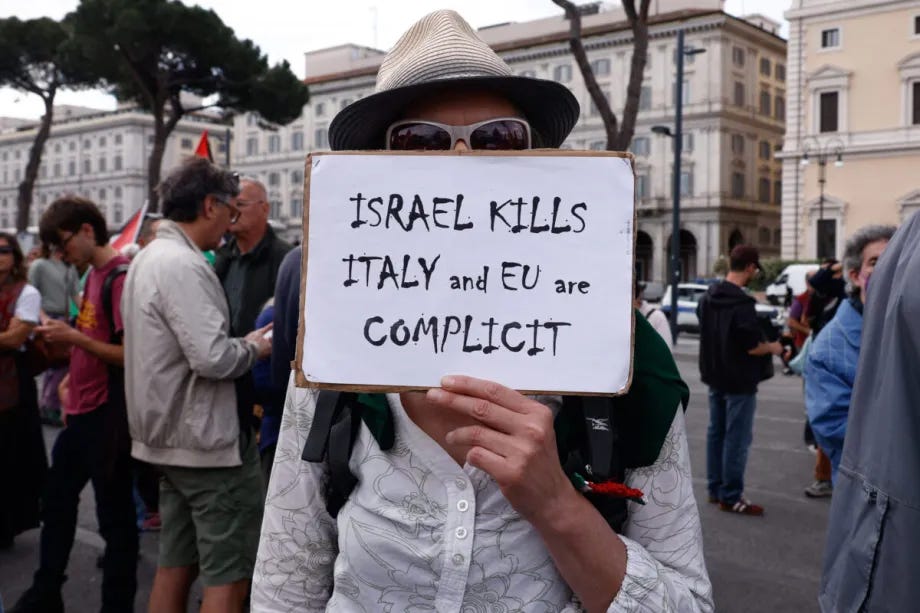
Thousands of workers across Italy joined a new general strike on 18 May, demanding complete severance of ties with Israel, an end to armament policies, and protection for the new civilian flotilla to Gaza—which was attacked again by Israeli forces on the very day of the strike. “We launched today’s general strike with the same strength and spirit as on September 22, 2025: “Let’s block everything” has been and remains the watchword in our struggle against war, against complicity with the genocidal state of Israel, and against rearmament,” the grassroots trade union Unione Sindacale di Base (USB) wrote.
Workers in two dozen cities had announced strike demonstrations on 18 May, with additional solidarity protests launched throughout the day in response to Israel’s acts, leading to day-long mobilizations in many regions. USB emphasized the actions were in continuity with markings of Nakba Day during the weekend of 15 May-16 and with a national demonstration against war and rearmament announced for Saturday, 23 May.
Spearheaded by USB and supported by other progressive organizations, including student collectives and left party Potere al Popolo, the mass demonstrations that brought Italy to a halt on several occasions since September 2025 are among the most notable results of the growing Palestine solidarity movement in Europe, and have successfully unmasked the links between Europe’s war agenda and eroding living conditions in the region itself.
“Once again, we’ve shown that we can bring everything to a standstill,” USB stated on 18 May. “It is we, the workers, who produce the very wealth that, instead of benefiting us, serves the interests of imperialism; it is our money that pays for their wars, wars we refuse to pay for and that we reject with every fiber of our being.”
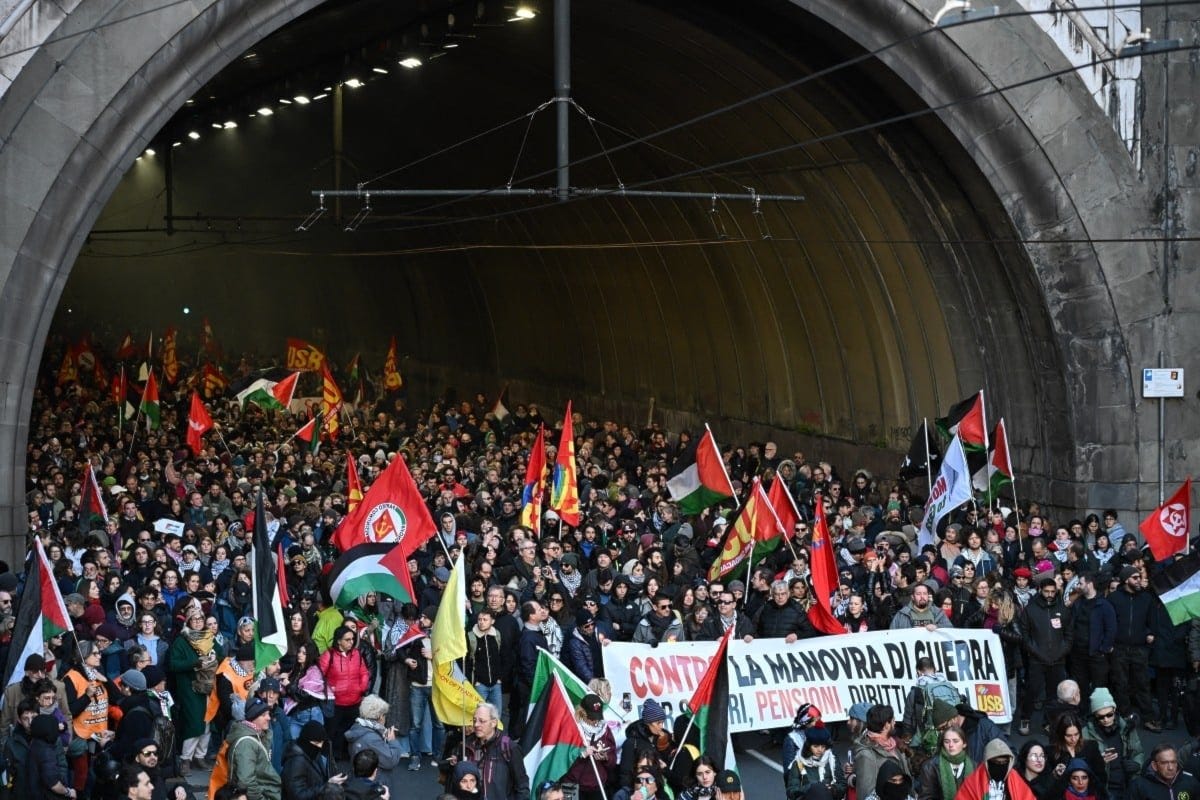
USB and other organizations have repeatedly emphasized that, as a result of the Meloni government’s endorsement of armament and subjugation to US interests, workers in Italy face growing energy costs and reduced access to essential services such as healthcare and education. Addressing the responsibility of Italian and other European governments, the trade union said: “They’re also responsible for the economic and social consequences that this war is having on the lives of working people. Every bomb, every military mission, every war agreement, and every increase in military spending translates into lower wages, less healthcare, fewer schools, less welfare, smaller pensions, fewer homes, and less social security.”
Resisting war and rearmament policies at home thus logically joins struggles for international solidarity, left networks in Italy insist—as does opposing the ongoing crackdown on rights related to public protest, free speech, and unionization.
“We’re in a new phase of ultraliberalism: more ruthless, more authoritarian, more militarized. After years of cuts, privatization, and precarious working conditions, today’s qualitative leap is taking place through a war economy,” USB added in its strike call. “This choice is accompanied by an increasingly harsh attack on trade unions and democratic freedoms.”
“They want a country that is poorer, more heavily armed, and more obedient.”
To effectively block such an agenda, it is necessary to see mobilizations across all parts of society, trade unionists added. “Not a single nail should be sent from companies for the war effort,” they said. “That single nail affects everyone. It impacts the factory that manufactures, the port that loads, the logistics that transport, the research that develops, the schools that educate, the universities that patent, the healthcare system being dismantled, the offices, the services, and the territories. ”
As the mobilization continues, Giorgia Meloni’s government faces intense pressure, with possible results on the horizon. On Tuesday, 19 May, Italian media reported the government is considering revisiting its war budget plans, including the 5% GDP NATO expenditure it had signed onto last year.
Popular demands across the country, however, go beyond this possible concession, both in national and international context. “We need a radical shift in the Italian government’s international stance, one that respects the principle of self-determination and breaks free from US imperialism by severing ties with NATO, which serves as a tool of US domination in Europe,” Marta Collot of Potere al Popolo said on Monday. “We need an international alliance for comprehensive disarmament, because fewer weapons mean peace and social solidarity.”
