


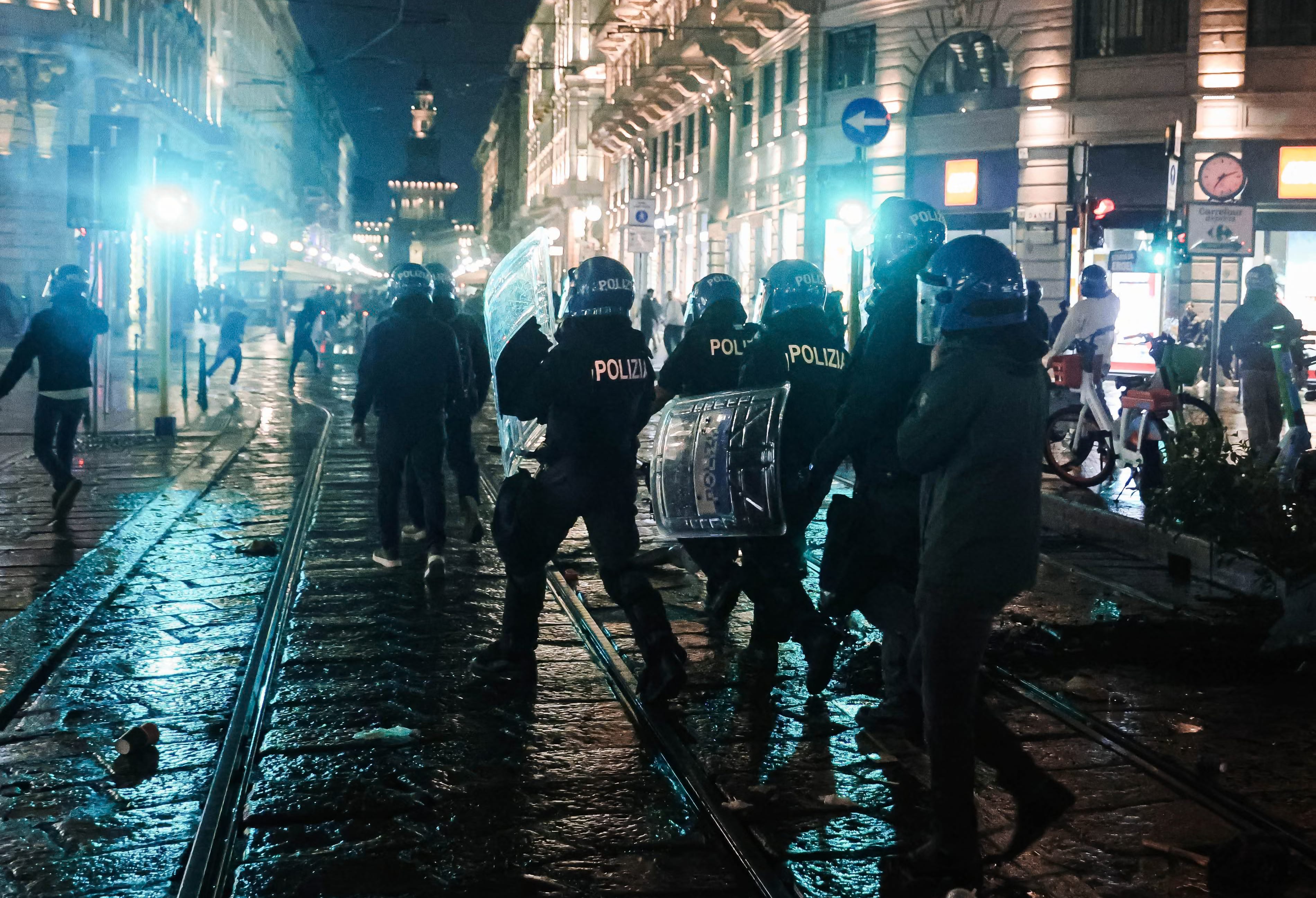
Giorgia Meloni’s administration has announced the deployment of 500 military troops to Milan after a weekend of intense protests and riots resulted in broken windows at luxury shops.
But while mainstream coverage has focused on exclusive brands hiding inventory from angry demonstrators, progressive organisations emphasise that the rage witnessed on the streets of several northern Italian cities is a result of the government’s own policies.
“A Louis Vuitton bag can cost €5,600, while the monthly maximum for the wage guarantee fund in 2026 is €1,340,” wrote the grassroots union Unione Sindacale di Base (USB). In a statement on Tuesday, the union cited devastating national statistics, including data showing that over 14% of working-class families live in absolute poverty.
Broken windows can be repaired; USB noted. “Five years of lost wages, an impoverished family, and a denied future cannot be recovered so easily.”
Students oppose austerity at school and beyond.
Significant mobilisations preceded the weekend’s protests. On Friday, 16 October, roughly 400,000 students flooded the streets for “No Meloni Day.” They criticised the government’s so-called securitisation measures, which in practice have meant stifling the right to protest, as well as the unabated turn toward war and armament.
Protesters warned that by prioritising these points over public services and working conditions, Meloni and her ministers knowingly undermine the future of a whole generation.
Echoing developments in France, where teachers’ unions have supported students’ demands over recent weeks of historic struggle for a stronger public education system, educators in Italy began circulating appeals to do the same.
“The established order is the worst of all possible worlds—or comes very close to it—and our schools are a mirror of this: they are falling apart, alienating, militarised,” the appeal reads. “Places where the need to stretch one’s legs is labelled ‘indiscipline’ and where the ‘foreigner’ is blamed for the decline in knowledge, rather than two decades of underfunding and neglect.”
Real solutions, not repression, are needed to address social crises.
Trade unions, teachers, and students all denounced the repression authorities unleashed in response to the protests—both after mobilisations in cities and during school occupations.
“This government—incapable of offering solutions to the social crisis raging across the country—is once again attempting to manage the streets and social discontent solely through the lens of ‘public order,’ while intensifying repression and shrinking the space available for political activity,” emphasised youth organisation Cambiare Rotta.
Teachers specifically called upon others in the system not to endorse crackdowns on students while invoking democratic values. “Democracy today resists in the French and Spanish squares, in the occupied Italian schools, in the resistance to the genocide of the Palestinian people, and in the words and deeds of those who oppose the piecemeal world war,” they wrote.
“It is not to be found in threats, in tear gas, in police officers inside schools, or in students maimed by the weapons of our law enforcement. It is not to be found in the unjust rules that too many persist in defending.”
The increased protest activity has given hope that the spark that inspired massive mobilisations throughout 2025 might resurface. It comes less than two weeks before a new general strike—and an international dockworkers’ strike in which Italian port workers are set to play a notable role—on 30 October.