


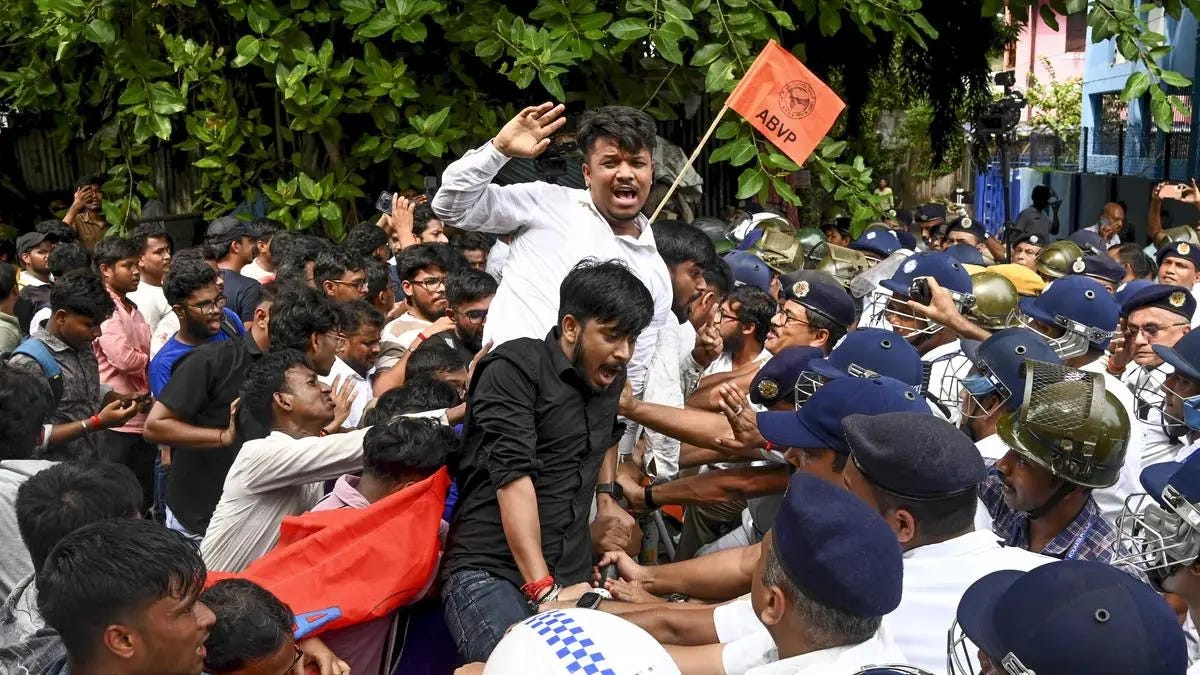
Massive protests were organised in cities and towns across the Indian state of West Bengal on Wednesday, 26 August, protesting against the rising right-wing attacks on the educational institutions and activists.
This was the third such protest action taken since 20 August midnight attack on the university by the ultra-right-wing and Hindu supremacist Bharatiya Janata Party (BJP) and Rashtriya Swayamsevak Sangh (RSS)-affiliated student organisation Akhil Bhartiya Vidyarthi Parishad (ABVP).
Several students and teachers were injured in the attack, and university property was vandalised. Students have lodged accusations that the security forces were unresponsive, while elected members of the state legislative assembly from the ruling BJP were directly involved.
In the recent protests, activists expressed their solidarity with the students of Jadavpur University and demanded that all those involved in the attack be held accountable.
The protesters also demanded action against the forces involved in acts of vandalism against progressive and left-wing symbols in the state. A wave of attacks has swept the state since the BJP came into power in the state earlier this year.
Protests were called by various left parties and student organisations in the state, including the Students' Federation of India (SFI), All India Students' Federation (AISF), and All India Students' Association (AISA), among others.
The left and progressive student groups had led a massive march from the JU campus to the city on 22 August, a day after the attack. They carried out a much bigger protest march on 24 August as well.
The Left is the target.
The BJP, RSS, ABVP and similar right-wing groups, now backed by the ruling dispensation in the state, have alleged that JU and other prominent universities have become a den of “anti-national” activities and demand the removal of progressive and left-wing teaching staff and a ban on the activities of the left-leaning student unions.
Before storming the university campus on 20 August, they had carried out several attempts to demolish a statue of Lenin just outside the campus and vandalised several other statues in different parts of the state.
Reports also indicate that several left—and progressive activists have been killed and injured in targeted attacks.
The attacks on the universities and the left activists in West Bengal are similar to the attacks carried out by the same forces in the rest of the country.
The right-wing assailants have repeatedly targeted universities such as Jawaharlal Nehru University (JNU) and Jamia Milia Islamia (JMI) in the capital over the past decade due to their vocal opposition to the BJP’s sectarian and pro-capital policies. New Delhi has been repeatedly targeted by the right-wing assailants in the past decade for their vocal opposition to the sectarian and pro-capital policies of the BJP. In addition to physical injuries, some activists have also faced charges.
The mainstream media in India, as in the past incidents, called the attacks at JU a “clash between ABVP and SFI.”
BJP leader and chief minister of the state Suvendu Adhikari, instead of condemning the attack and taking action against the assailants, ordered an “investigation” into “anti-national activities” on the campuses.
Commenting on the attacks on JU, Vijay Prashad, historian and director of the Tricontinental Institute of Social Research, compared it with the attacks on JNU, calling it a fight “that will not find an easy solution.” He wrote on his social media page that the real motive of the right wing behind these repeated attacks is to destroy the left in the country.
Suchetna Chattopadhyay, who teaches history at JU, called the attack an example of “textbook neoliberal fascism in our times.” She alleged that the attack on 20 August was a part of the larger and more systematic attacks on the left, an attempt to instil fear so that all kinds of opposition to its policies designed to serve the interest of big capital are silenced.
