


According to the best scholarship, the ancient Mahavihara—a centre of higher learning, chiefly of Mahayana Buddhism, but including the study of the Vedas; of logic, grammar, and various Sanskrit texts bearing on mathematics, philosophy, and linguistics; and of the study of rituals for use in social and religious life—was established by the first of the Gupta dynasty Hindu kings, Kumaragupta, in 427 CE.
This multidisciplinary institution kept flourishing under the aegis of successive rulers until, we are told by one group of scholars, Muhammad Bakhtiyar Khilji had it burnt down in 1200 CE.
Historian Anirudh Kanisetti has also argued that by the eleventh century Nalanda, as an institution, had begun to fray:
By the eleventh century, Nalanda and other Buddhist monasteries were losing importance in eastern India. Indonesian and Javanese masters had become pre-eminent. Meanwhile, the rulers of present-day Bengal and Bihar found that Brahmin settlements were more useful than Buddhist monasteries… Buddhists and Brahmins both knew how to manage and administer properties. But Buddhists applied this knowledge to their own monasteries, while Brahmins did so for kings as well.
Thus, the Turk, Bakhtiyar Khilji, may have destroyed something that had already started to decline.
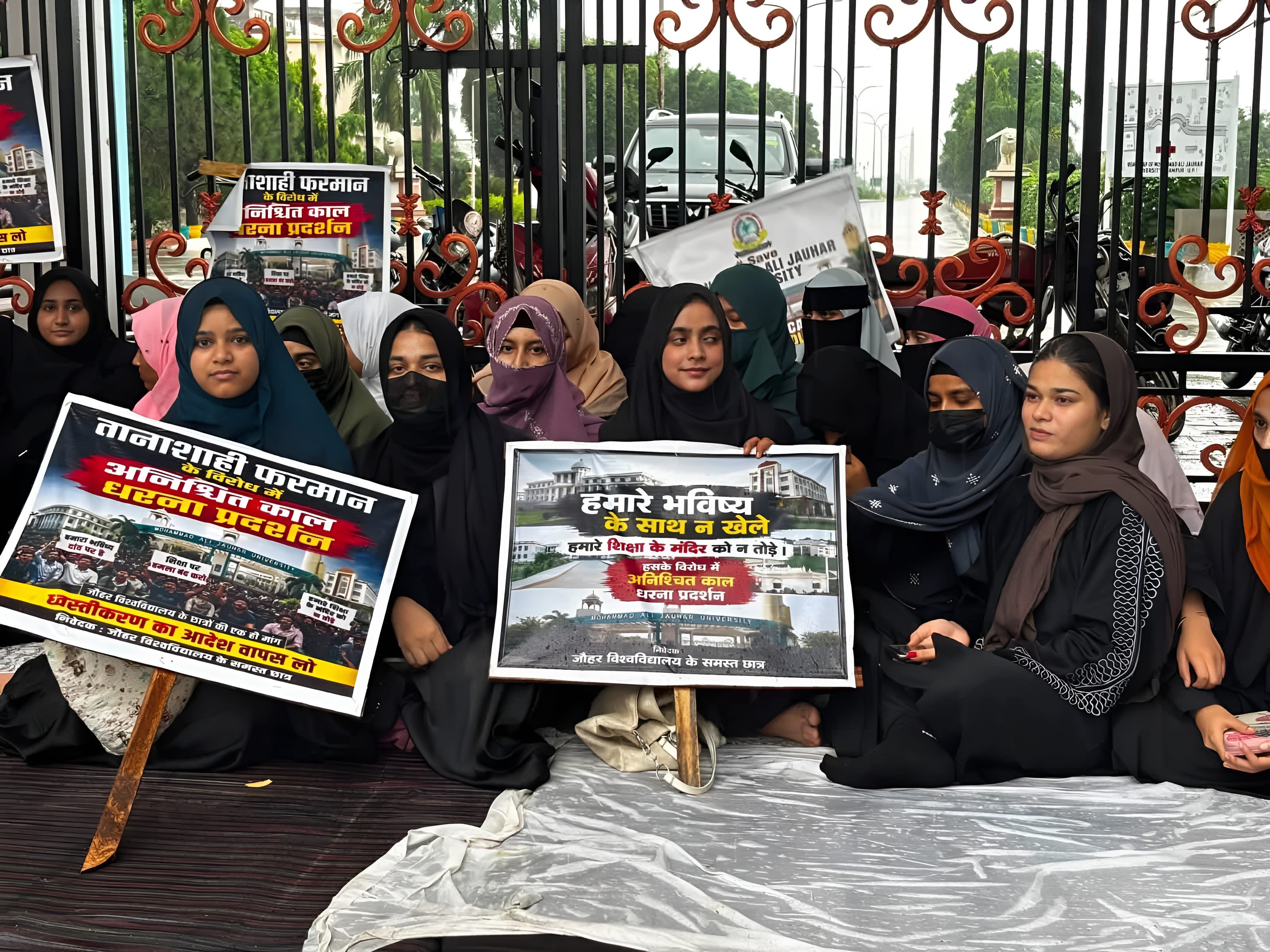
Be that as it may, today another very substantive centre of higher learning established by an Act of the Uttar Pradesh legislature in 2006—the Mohammed Ali Jauhar University at Rampur—seems set to replicate the fate of ancient Nalanda.
Named after the Ali brothers—freedom fighters against British colonial rule—Jauhar University has striven to achieve the highest standards of multidisciplinary scholarship up to and including doctoral studies. Admission has not been confined to any particular community or social group but has been available to all citizens of India without respect to identity.
It is not the case that the university has been ranked at the bottom of the all-India scale by accreditation agencies: it has been ranked towards the middle of the spectrum. However, as elections of the Uttar Pradesh assembly are nearing, light has suddenly dawned on the government of India’s largest and electorally most consequential state, led by a practising Hindu monk: all but two of the forty buildings that constitute the university have allegedly been erected without due clearance from the municipal authorities.
The notorious bulldozer regime is thus preparing to raze the university to dust, ostensibly in order to meet the requirements of law. This is curious in a season when the ruling party looks keenly to “regularise” sundry unauthorised housing colonies left, right and centre—a canny move calculated to get votes from among the lower orders of society.
It is also another matter that a plethora of high-end farm houses and private establishments carry on merrily without any apprehension of bulldozer justice from the powers-that-be. The option given to many builders to settle accounts post construction in order to obtain clearance clearly does not seem to apply to Jauhar University, which caters to more than 3000 students, most from the less endowed sections of society.
The idea clearly seems to be to do a Nalanda to this politically orphaned institution that has the demerit of having been established by a leader of the rival Samajwadi Party. Not for a minute does it seem to concern the overlords of the day as to what may befall the 3,000 students who are studying at the university.
Instructively, as underscored by the head of another political party and a member of parliament, fake universities listed by the University Grants Commission situated at Aligarh, Prayagraj, Lucknow and Gautam Budh Nagar have received no scrutiny or order of demolition from the Adityanath government. Bhim Army leader Chandrashekhar Azad has also pointed out that an administrative order from a development authority cannot supersede the decision of a court and that the least the authorities must do is to await the court’s decision in the matter, rather than commit their own illegality by engaging in an action of contempt.
One would have thought that history records with distinction episodes in which rulers have established institutions of learning, not episodes in which they have sacked them. But, as social scientists and psychologists have often underlined, extremes are mirror images and happily meet at the very middle of their antagonisms.
All those who have education at heart might be expected to make their voices heard in the matter of Mohammed Ali Jauhar University.
Perhaps the Cockroach Janata Party and Sonam Wangchuk—now agitating about corruption in education—may consider including the matter of Jauhar University in their agenda and speak about it in their public statements in the next few days?
Expectedly, Azad has dubbed the action of the government as grossly communal in intent.
As parliament meets this week, many rational and secular citizens of the republic will hope that the shocking malice of the demolition order with respect to Jauhar University will come up for condemnation in one voice from within the INDIA bloc. Should it not, a grave dereliction will have been committed.
