


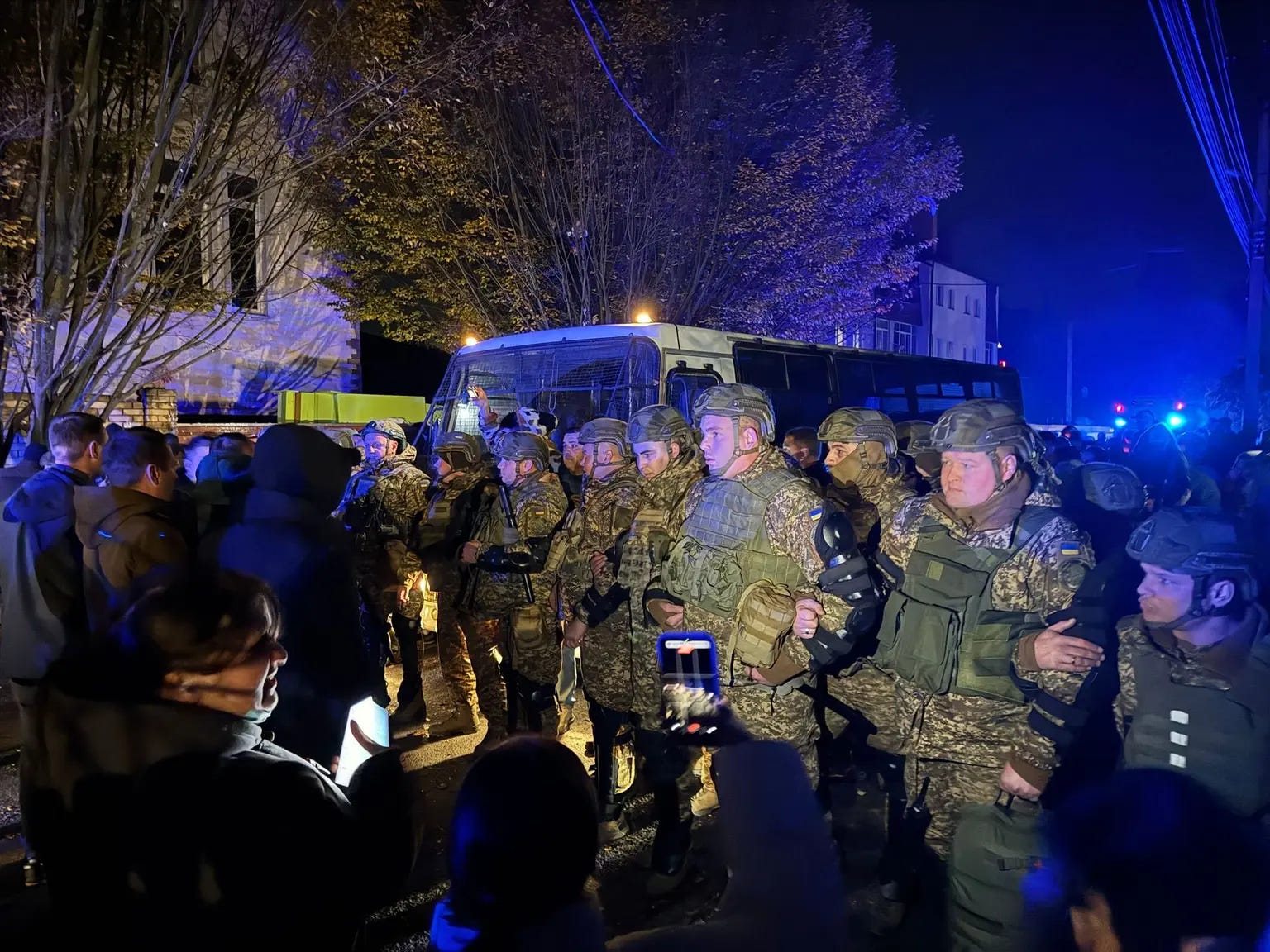
On Monday, 2 November, protesters gathered in Petropavlivska Borshchahivka in the Kyiv region, outside a building that was used as a detention site holding soldiers absent without leave and recruits. Facing army and police forces, alongside non-uniformed attackers, protesters were able to bring out the men held inside.
Many of the men who left the building displayed signs of physical violence. Four men—confirmed to be soldiers absent without leave—were hospitalised, while videos from the ground testimonies showed others as battered and bruised.
The detention site was associated with the Azov Corps of the National Guard of Ukraine. The formation described using the premises as a “temporary deployment” location for mobilised soldiers and men detained after going AWOL.
Ukraine’s Azov formations have been long associated with fascist ideology. Their supporters are believed to be among the non-uniformed attackers on Monday, based on the nationalist slogans chanted at the protest site.
“One important development in last night’s events around the illegal Azov prison for deserters and draft dodgers, which also served to extort ransoms and provoked a massive riot on Kyiv’s outskirts, is the use of Azov paramilitaries to suppress the protesters,” wrote Ukrainian sociologist Volodymyr Ishchenko, adding that researchers including Oleksiy Kuzmenko had predicted this outcome.
“This adds a new, characteristically fascist nuance to the events.”
“Otherwise, the events manifest the same escalating dynamics of post-Soviet disintegration in Ukraine’s state and society, to which the Maidan-deficient revolutions greatly contributed and which the war did not resolve but only escalated,” Ishchenko added.
Authorities turn against protesters.
After the detention site was discovered, Ukrainian officials alleged the protests were orchestrated from abroad—supposedly by Russia—and turned to punitive measures against participants.
At least one person, a medic who appears in a video from the scene, has reportedly been detained. National security officials announced roughly 100 people had been identified and that repercussions were being considered as well.
Ukrainian authorities denied the house had been used for physical abuse. However, officials’ statements confirmed the site had been used to hold soldiers, “including those who had returned after leaving their military units without authorisation.” According to Euronews, state investigators also launched enquiries into “possible abuse of authority by military officials” and “the conditions in which servicemen were accommodated.”
On the night of the protest, Kyrylo Budanov, the head of Volodymyr Zelensky’s office, said there are “many more” buildings of this kind across the country.
Forced street mobilisations in Ukraine persist.
Events in Petropavlivska Borshchahivka overlap with a continuous wave of civilian opposition to forced street mobilisation in Ukraine, known as busification, amid record-low numbers of volunteer recruits.
In the hours after the protest near Kyiv, more video reports circulated on social media documenting physical abuse and what could be described as state-sanctioned kidnapping of men into the armed forces.
In an interview with Breakthrough News earlier this year, Ishchenko described the extent and intensity of the practice, emphasising that people were resisting it with growing intensity. “This resistance is growing and becoming more frequent, perhaps showing qualitative advances too,” he said in July. “Until now, most resistance was spontaneous, passersby or relatives trying to help a guy escape from minibuses. There was no organisation or evidence of coordination between different initiatives. But recently, it has taken on a more massive scale, like riots.”