


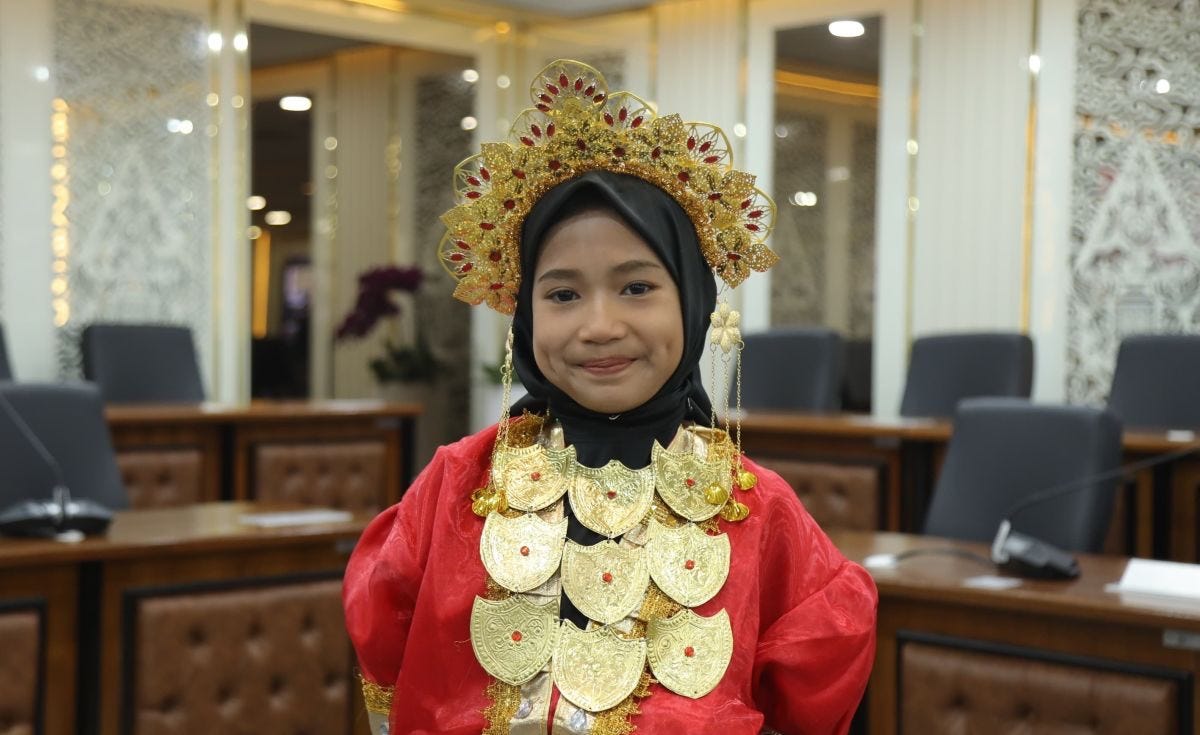
It was a moment that should have been a celebration of resilience—a ten-year-old girl from South Sulawesi, Citra Nur Ramadani, who had nearly dropped out of school to sell peanuts and support her disabled mother, standing before the nation as a champion karate athlete. Instead, President Prabowo Subianto, in his annual address before the assembled parliament, turned her into a punchline. “Citra, how old are you? Ten years? Well, in ten years you can date,” he said, as laughter rippled through the chamber. “You can date after you get your black belt,” he added, “so no one will dare mess with you.”
This was not a slip of the tongue. It was not harmless banter. It was a grotesque abuse of sovereign speech—a public act of grooming, performed on a national stage, ratified by the laughter of the most powerful adults in the room. And it demands an answer not just from Indonesia, but from every global strategist and policymaker who claims to care about the future of the Indo-Pacific.
Let us be brutally honest about what occurred. Indonesia has laws against this. Law No. 35 of 2014 on Child Protection defines a child as anyone under eighteen. Law No. 16 of 2019 raised the minimum marriage age to nineteen. The 2022 TPKS Law criminalises sexual violence.
Yet here was the highest authority in the land, standing before the nation, publicly scripting a child’s future around romantic availability. The legal scholar in the original analysis was correct: this is a performative contradiction of the highest order. The state can enact laws while its highest representative suspends them.
The numbers make this obscenity clear. Indonesia ranks eighth globally for absolute numbers of child brides, with 1.46 million cases. One in six Indonesian girls is married before eighteen. More than 25 million Indonesian women have been married as children.
In 2025 alone, the Ministry of Women’s Empowerment and Child Protection recorded 21,352 cases of violence against children—12,338 of them sexual. Over 16,000 of those victims were girls. The Komisi Perlindungan Anak Indonesia found that 51.5 per cent of child violence victims are girls, and in 66.3 per cent of cases, the perpetrator has not even been identified.
This is the context in which a president joked about a ten-year-old’s dating future. This is the institutional betrayal—the state failing not just to protect, but to normalise the very logic that enables abuse actively.
Compare this to the region. Rodrigo Duterte’s rape jokes in the Philippines were rightly condemned as the speech of a strongman who placed himself above law and decency. Yet when Prabowo performs a structurally identical act—when he uses a child’s body as a prop for male bonding, when he invites the laughter of officials to ratify his impunity—the global response has been muted.
This is a failure of diplomatic and strategic imagination. Southeast Asian strongmen use sexualised speech to perform power. It is not a bug; it is a feature of a political order in which authority is demonstrated through masculine domination, not ethical responsibility.
The irony is staggering. Just months ago, Indonesia and UNICEF launched a US$131 million cooperation plan to build the “Golden Indonesia 2045” generation. The President himself spoke of eradicating stunting, which affects one in four Indonesian children.
He declared that no child should risk their life crossing a river to school. He called corruptors who steal from children’s food programs “barbaric.” Yet in the same breath, he turned a child into an object of adult sexual temporality.
This is the hidden curriculum of state power. The overt message is care and development. The covert message—taught through laughter, through authority, through the complicity of every official who chuckled—is that girls are future dates, not future doctors, not future leaders, not full citizens. As the original analysis noted, this is reproductive futurism in its crudest form: the child’s future is colonised by heterosexual expectation, her autonomy erased before it can emerge.
Moreover, this incident should trigger alarm bells that go far beyond Indonesia. The Indo-Pacific is defined by its youth—by the demographic dividend that could drive prosperity or instability. When a president stands before his nation and publicly scripts a ten-year-old girl’s future around dating, he is not just failing that child.
He is signalling to every girl in the archipelago that her body is public property, that her aspirations are secondary, that the state’s highest office does not take her safety seriously.
Some analysed Prabowo’s populism and his clash with economic realities. But there is a deeper clash here—between the modernising rhetoric of the “Golden Generation” and the patriarchal reality of state speech. Between the laws on the books and the performance of power on the stage.
Between the global norms Indonesia has ratified—the Convention on the Rights of the Child, the commitments to end child marriage—and the daily practice of its highest leader.
The laughter of those officials was not incidental. It was the sound of impunity being normalised. It was the sound of a culture in which power, not ethics, determines what can be said about children. It was the sound of institutional betrayal.
What is to be done? The legal route is blocked: a sitting president enjoys de facto immunity, and a joke, however grotesque, does not meet the elements of criminal prosecution. The political route is uncertain: in an entertainment-era populism, transgressive humour often strengthens rather than weakens a leader’s appeal. But the diplomatic route is open.
Australia, as Indonesia’s closest neighbour and a signatory to the same international child-protection frameworks, has a moral and strategic interest in speaking out. So do the United States, the European Union, Japan, and every nation that invests in Indonesia’s stability and development.
This is not about “cultural sensitivity” or “interfering in internal affairs.” This is about the most basic standard of civilised governance: that the highest leader of a nation does not use a ten-year-old girl as a punchline. That the state’s protection of children is not a slogan but a practice. That the future of the Indo-Pacific—a region defined by its young population—is built on the dignity of every child, not on the impunity of those in power.
The Citra incident is a diagnostic rupture. It reveals the deep structures of sovereign impunity, patriarchal developmentalism, and militarised masculinity that persist beneath the surface of Indonesia’s democratic transition. It is a reminder that laws are only as strong as the culture that enforces them, and that culture is shaped, for better or worse, by the words of those at the top.
The question for global strategists is simple: will this be forgotten in the next news cycle, or will it become a catalyst for something more? Will the international community treat this as a trivial gaffe, or will it recognise it as what it is—an obscene reminder that power, when unchecked, consumes the very children it claims to protect?
Citra Nur Ramadani deserved better. Every Indonesian girl deserves better. And every nation that claims to care about the future of this region must say so—clearly, loudly, and without apology.
