


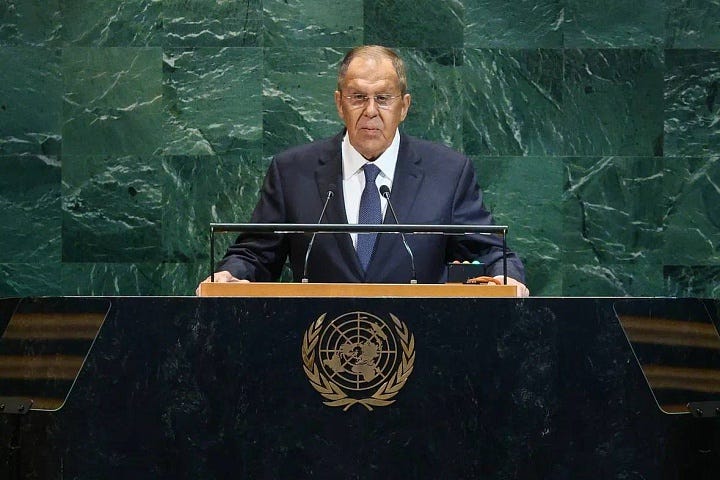
At his speech to the UN General Assembly on 27 September 2025, Russian Foreign Minister Sergei Lavrov was scathing towards those western countries that had recognised Palestine: “Recently, several Western governments announced recognition of the State of Palestine. In fact, they declared their intention to do so several months ago. This raises a question: why did it take them so long? Perhaps they had hoped that, by the time of the UN General Assembly, there would be nothing and nobody left to recognise”. This was a roundabout way of saying that these western countries would have expected Israel to have completed its genocide in Gaza before the convening of the UN General Assembly. The truth is that the destruction of Gaza was almost complete just a few months after Israel’s assault in October 2023. The speech also seemed to be an attempt to apportion blame for the tragedy of Palestine on western powers, a view that is widely held.
Lavrov’s remarks do, however, provide an opportune moment to reflect on Russia’s—or more specifically—the Soviet Union’s role in the partition of Palestine and recognition and creation of Israel. This is an important though neglected aspect of this tragic saga. There is a seeming consensus among western critics of Israel that the partition of Palestine in 1948 was the product of the West, especially of the old colonial power, the UK, which held the “mandate” over Palestine and the dominant force after World War 2, the USA. Given all the support that these two countries have given to Israel over the past eight decades and continue to give, this is perhaps an understandable and unsurprising assumption. But it is a serious historical error, the reasons for which are provided by, among others, the work of the French historian Laurent Rucker who utilises voluminous primary research from Soviet archives (see reference below)—I summary the main points whilst drawing my own conclusions.
There are two crucial, unexpected, twists to this tale concerning the superpower states that had just embarked upon their Cold War rivalry: the USA and USSR. Put briefly, there is compelling evidence to suggest that had the USSR not supported the partition of Palestine and Israel’s creation, such a partition would not likely have been agreed upon. On the one hand, the USA’s support for the partition plan was by no means as strong as is ordinarily imagined: we need to remember that the political terrain in the country regarding a Jewish state in Palestine post-World War 2 was very different from now. On the other hand, the USSR’s late change of stance and its uncompromising support for the Zionist project during the fateful years of 1947-48 was arguably the decisive factor.
To counter the fact that it was largely absent in the Middle East, during 1943-44 the Soviet Union opened embassies in Egypt, Syria, Lebanon, and Iraq to exert some influence. A corollary to this endeavour was to attempt to weaken and ultimately remove Britain’s influence in the region and somehow forge divisions between the UK and US. It was this thinking that drove Soviet policies. After the war, there arose the issue of some quarter of a million displaced Jews in Eastern Europe which was now under the Soviet sphere of influence. It was the settlement of the bulk of these which provided a fundamental dynamic as to what happened. The Soviets and the East European regimes failed to do what was incumbent upon them, that is, to re-settle them in their old homes and counter any hostility from the local population. Naturally, therefore, many of these displaced persons wished to emigrate; the preferred option, and understandably so, being the USA which, apart from Pearl Harbor, had not suffered destruction during the war.
But disgracefully, the US pretty much operated a closed-door policy to the “tired, poor, huddled Jewish masses yearning to be free”—thus enabling the second preferred option, Palestine, to come to the fore. This conveniently suited the Americans and the Soviets, as well as the East European regimes (none of whom wanted the displaced persons) so that the Zionist programme of settling European Jewry in Palestine quickly gathered momentum. However, Britain at first was wary of this as it did not wish to alienate the Arab world.
The Zionist organisations were foresighted and forged contacts and links with Soviet diplomats, quietly calling for support for their designs. This, however, did not immediately lead to the USSR agreeing to a future Jewish state in Palestine (which the USSR had never supported)—but the seeds were sown and came to fruition surprisingly soon. The official USSR position, however, was for the removal of the British mandate and troops; and for a unitary Palestine to be granted independence but be transferred to a UN “trusteeship” (meaning, under joint control of the Big 3 powers). In March 1947, the Near East Department of the Soviet UN delegation accordingly argued for a “single democratic Palestine that ensures that the peoples living there will enjoy equal national and democratic rights”. This was a clear rejection of partition.
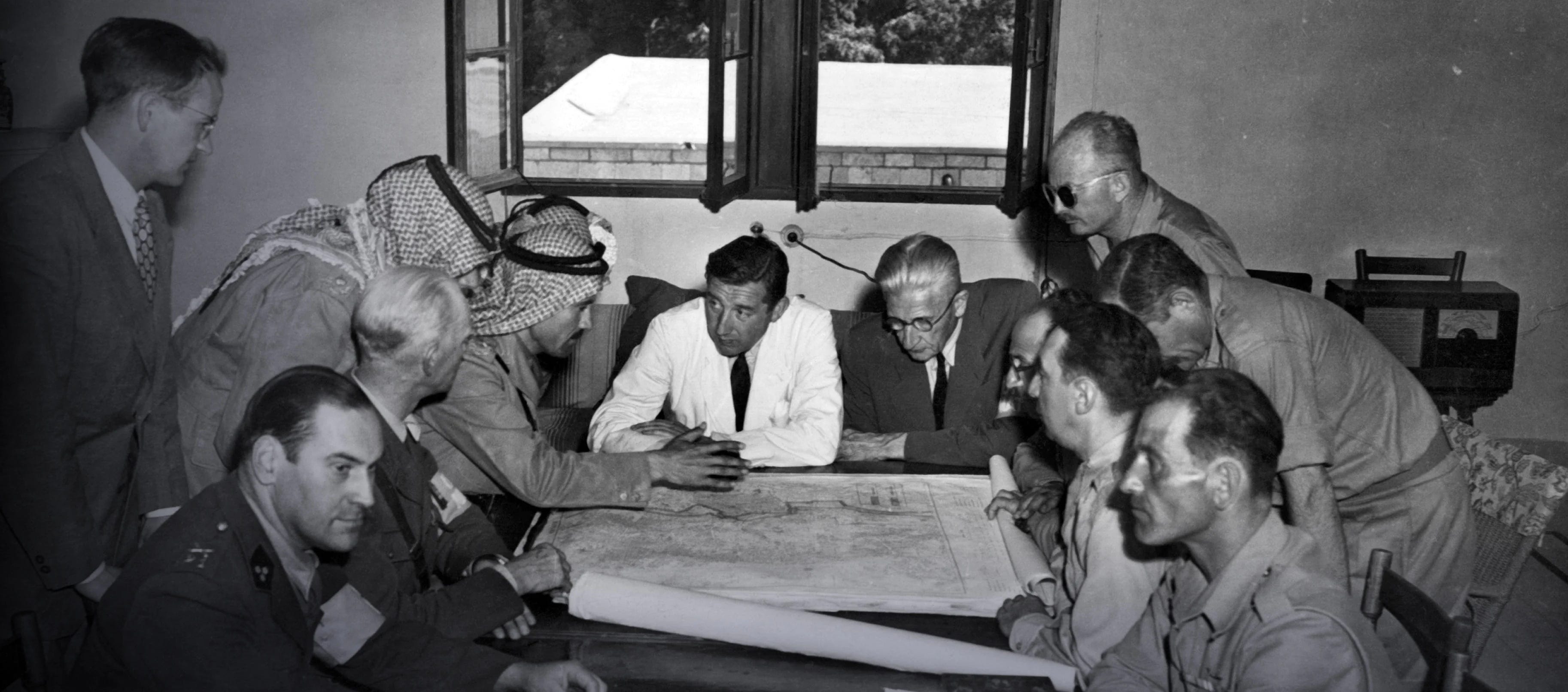
A month later, there was a dramatic U-turn: at the Special Session of the UN General Assembly, Deputy Minister of Foreign affairs, Andrei Gromyko was instructed to present the new line: for the first time the USSR advocated partition and the creation of a Jewish state in Palestine. The new line was duly implemented at the UN General Assembly on the 29 November 1947 on the historic vote to partition Palestine. A two-thirds majority was needed and here the role of the USSR was again decisive when it pressured Byelorussia, Ukraine, Poland, and Czechoslovakia to also vote “yes”. Therefore, it needs stressing that if the USSR had adhered to its earlier position of opposing the partition of Palestine, it is highly improbable that Israel would have been created in May 1948. Indeed, the likely outcome would have been a unified Palestine under UN trusteeship.
However, after the expected opposition from Arab states and violence in Palestine itself, the US began to have doubts: on 19 March 1948, the US Ambassador to the UN argued for a provisional trusteeship that had been the USSR’s original plan. This was countered by Gromyko in an uncompromising, de facto Zionist, speech at the 30 March Security Council that ensured partition:
… the only way to reduce bloodshed is the prompt and effective creation of two states in Palestine. If the United States and some other states block the implementation of the partition and regard Palestine as an element in their economic and military-strategic considerations, then any decision on the future of Palestine, including the establishment of a trusteeship regime, will mean the transformation of Palestine into a field of strife and dissension between the Arabs and the Jews and will only increase the number of victims.
Moreover, despite a UN weapons embargo in Palestine, Czech weapons were sold, with Soviet knowledge, to Zionists in Palestine—and used against the outgunned Palestinians so culminating in the Nakba and the expulsion of some 750,000 Palestinians from their land. The rest, as they say, is history. As Rucker concludes in his insightful paper, “Moscow provided political, military, and demographic support to Israel”, for the absurd reason that the only means of weakening Britain’s power in the Middle East was by supporting the Zionist movement.
It didn’t take long for this policy to unravel: the various Communist Parties of the Arab states immediately suffered a haemorrhage of members as the USSR’s reputation and influence in the Arab world was severely damaged; whilst the new state of Israel unequivocally joined the Western camp and proceeded to seize more Palestinian land. Britain’s influence did decline but rather than divisions between the USA and UK arising, it remained firmly wedded to the USA, helped by Marshall Aid reconstruction funds. Moreover, without demurring, it settled into its new role as USA’s loyal, junior partner. The net effect of USSR’s historic policy turn was, therefore, precisely the opposite of what had been intended.
The truly shocking fact in this version of the Great Game is that the victims, the Palestinians, were contemptuously ignored as if they were mere cattle. One can make the case that the Soviet Union’s role in the partition of Palestine and establishment of Israel and attendant Nakba should be accorded greater significance than the Balfour Declaration of 1917—which did not lead to partition; yet it is the latter that attracts far more attention. It is high time that Lavrov, Putin and other Russian leaders acknowledged this disastrous mistake by Stalin and his cohorts in 1947 and 1948.
References
The Ministry of Foreign Affairs of the Russian Federation (2025) Remarks by Foreign Minister Sergey Lavrov at the General Debate of the 80th Session of the United Nations General Assembly, New York, September 27, 2025 - The Ministry of Foreign Affairs of the Russian Federation
Rucker L (2005), ‘Moscow’s surprise: The Soviet-Israeli Alliance of 1947-1949’ Cold War International History Project, Working Paper 46, Woodrow Wilson Centre for International Scholars, CWHIP WP
