


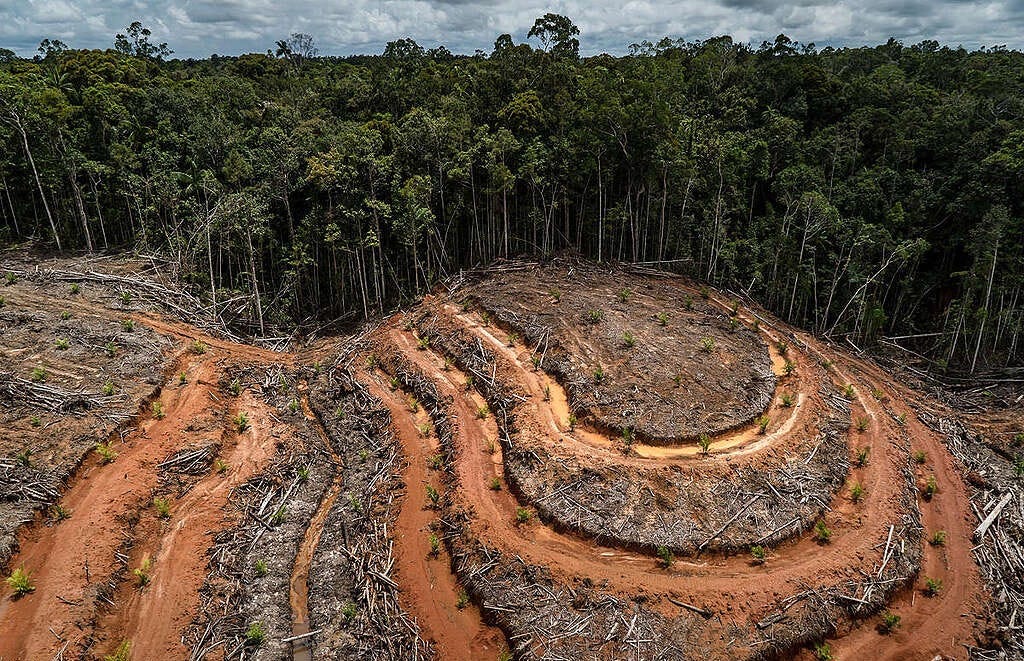
There is a particular kind of heartbreak in watching a global icon lend his voice to a promise that the ground beneath him is already betraying. In mid-November 2026, Leonardo DiCaprio took to Instagram to praise the Indonesian government for a “historic” decision: redirecting agricultural expansion to “degraded land” rather than clearing nearly two million hectares of primary forest in South Papua’s Merauke food estate.
The Presidential Special Envoy for Climate and Energy, Hashim Djojohadikusumo, seized on the endorsement with alacrity, telling international audiences that the government and people of Indonesia had been “praised by Leonardo DiCaprio” as proof of environmental leadership. It was a moment of perfect diplomatic symmetry—Hollywood’s conscience validating Jakarta’s talking points—and precisely the kind of symmetry that should set off alarm bells in every foreign ministry and sovereign wealth fund, from Canberra to Oslo.
The problem is not that DiCaprio is insincere. The problem is that the pledge he applauded is a masterpiece of semantic laundering, and the numbers tell a story the red carpet cannot obscure. In 2025, Indonesia lost 433,751 hectares of forest—an area more than twice the size of London—a 66 per cent surge from the previous year and the highest level in eight years, according to satellite data from the NGO Auriga Nusantara. The government’s own Forestry Ministry has acknowledged the trend.
During the first ten months of 2026, fires burned 2.88 million hectares, surpassing the catastrophic 2019 season and sending transboundary haze into Malaysia and Singapore, prompting the National Environment Agency to issue preventive measure notices to ten Indonesian concession holders. The Straits Times reported on the burn scar; Kompas documented more than 53,000 satellite hotspots in August alone; and the Borneo Orangutan Survival Foundation evacuated dozens of orangutans from burning peatlands while treating nearly fifty more for acute respiratory infections in its rehabilitation centres.
This is not a story of natural disaster. It is a story of statutory architecture. The 2020 Omnibus Law on Job Creation—enacted under President Joko Widodo and left untouched by his successor—repealed Article 18 of the 1999 Forestry Law, which required that at least 30 per cent of every watershed and island remain forested.
That single deletion transformed a binding ecological constraint into an administrative discretion, enabling the central government to set forest-cover targets based on “physical and geographical conditions.” The same law also weakened the strict liability provisions of the 2009 Environmental Law by removing the phrase “without the need to prove fault” and requiring plaintiffs to prove corporate negligence when fires erupt on concessions.
It restricted public consultation on environmental impact assessments to “directly affected communities,” excluding independent scientists and NGOs from challenging permits. It also decriminalised illegal plantation encroachment within state forest zones, granting a three-year amnesty to corporations that had spent decades clearing forests without permits. The result is a legal system that does not merely tolerate deforestation—it manufactures legality for it.
The “degraded land” pledge must be read against this architecture. There is no internationally agreed definition of degraded land, and Indonesia’s categories—lahan kritis, tanah terlantar, lahan tidur—are administrative constructs that the Ministry of Forestry can revise at will. A selectively logged forest with forty per cent canopy cover can be classified as “critical” and therefore eligible for conversion, even if it still harbours endangered species and significant carbon stocks.
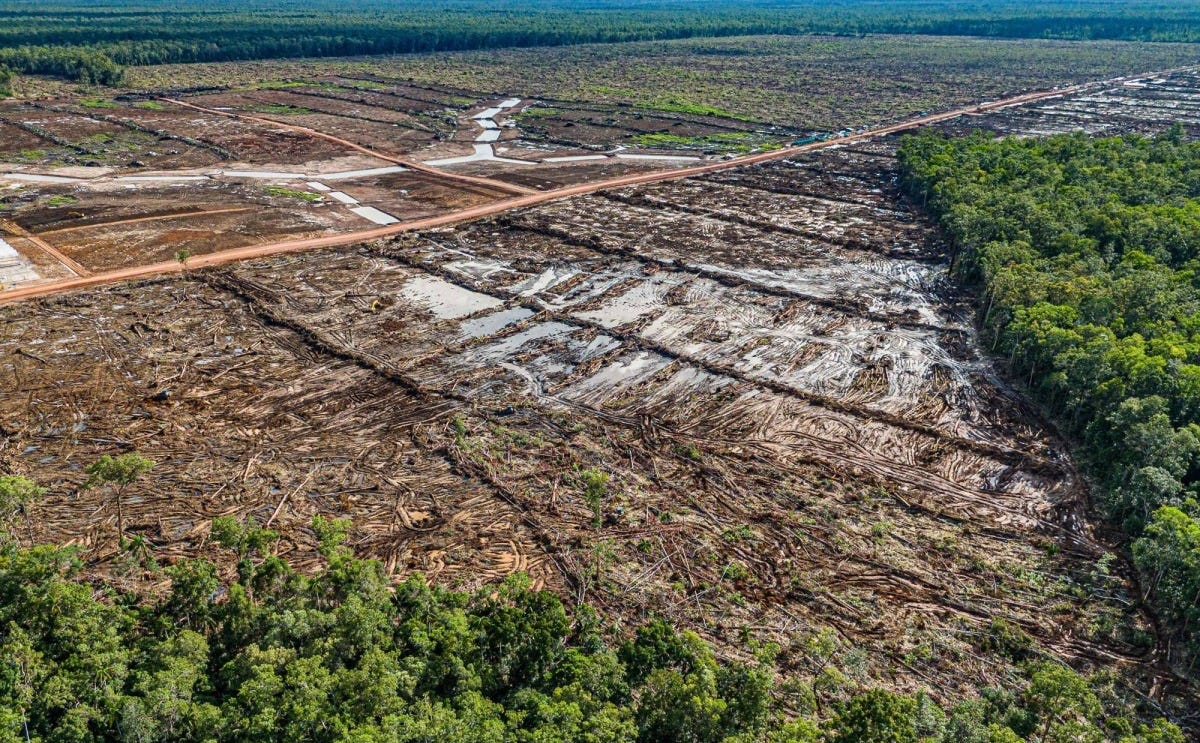
A drained peat swamp can be labelled “degraded” and opened for plantation development, even though its carbon emissions will persist for decades. The pledge does not constrain the state’s power to clear forests; it provides a new vocabulary for exercising that power. WALHI, Indonesia’s largest environmental federation, has said as much: the government has not released the locations of the proposed sugarcane plantations or the results of any reassessment, and forest clearing for food and energy projects continues on the ground.
The international community is not an innocent bystander in this theatre. At COP31 in Antalya, Norway announced a fifth results-based contribution of US$100 million for Indonesia’s verified emissions reductions, bringing its total support to US$316 million. The FOLU Net Sink 2030 strategy—the centrepiece of Jakarta’s climate diplomacy—promises that the forestry and land-use sector will absorb more carbon than it emits by 2030. Yet official data submitted to the United Nations show that emissions from that sector have exceeded the target levels every year since 2019.
The carbon-market architecture being built through bilateral mechanisms and Article 6 of the Paris Agreement creates a perverse incentive: a country with a high historical deforestation baseline can be paid for future reductions, even as the legal framework that permits deforestation remains intact. The pledge to use degraded land is not a departure from this logic; it is its logical extension.
COP31 did not shackle the machinery of deforestation; it gave it a stage—a polished exercise in diplomatic hand-washing, performed under the world’s cameras while the Omnibus Law’s enabling provisions remained untouched.
Moreover, the lesson is not that Indonesia is uniquely villainous. It is that the entire apparatus of international environmental governance—carbon markets, certification schemes, celebrity advocacy, results-based finance—is structurally vulnerable to exactly this kind of performance. The nickel boom in Sulawesi offers a parallel case. According to investigations by Tempo and the Pulitzer Centre, nearly 550,000 hectares of rainforest have been destroyed by nickel concessions since 2011, many of which operate with forged permits and bypass public tenders.
The ore is refined in industrial parks powered by captive coal plants, blended at smelter gates where traceability breaks down, and sold into the battery supply chains of global automakers that market “zero-emission” vehicles. The other analysis noted that China is not the sole culprit in this dirty nickel boom; the demand-side responsibility lies with every consumer, financier, and regulator who treats a fungible commodity as if it retained its origin’s identity.
The DiCaprio moment matters because it reveals the cost of access. After being threatened with deportation in 2016 for criticising palm oil expansion, international advocates learned that systemic critique risks expulsion, whereas praise preserves the ability to operate. That is a rational calculation, but it produces a cruel optimism: the rescued orangutan becomes a substitute for the political action that would prevent the fire.
The audience feels sympathy, donates to the rescue centre, and shares the video—but the drainage canals that turned the peatland into a tinderbox remain open, the permits remain valid, and the legal architecture that shields the concession holder from liability remains in place.
The path forward requires rejecting semantic comfort. “Degraded land” must be defined by independent, transparent, and ecologically rigorous criteria that cannot be revised by ministerial decree. Demand-side regulations, such as the European Union’s Deforestation Regulation, must be enforced at the point of production, not merely at the mill gate, with penalties that extend to the beneficial owners behind shell companies and nominee directors.
Results-based finance must be conditioned not on pledges but on the repeal of the statutory instruments—the Omnibus Law’s watershed provision, its liability shield, and its amnesty clause—that legalise deforestation. And celebrity advocacy must be understood for what it is: a form of affective representation, not epistemic authority.
The applause is not the achievement. The forest is still burning, and the orangutan in the room is waiting for the world to notice.