


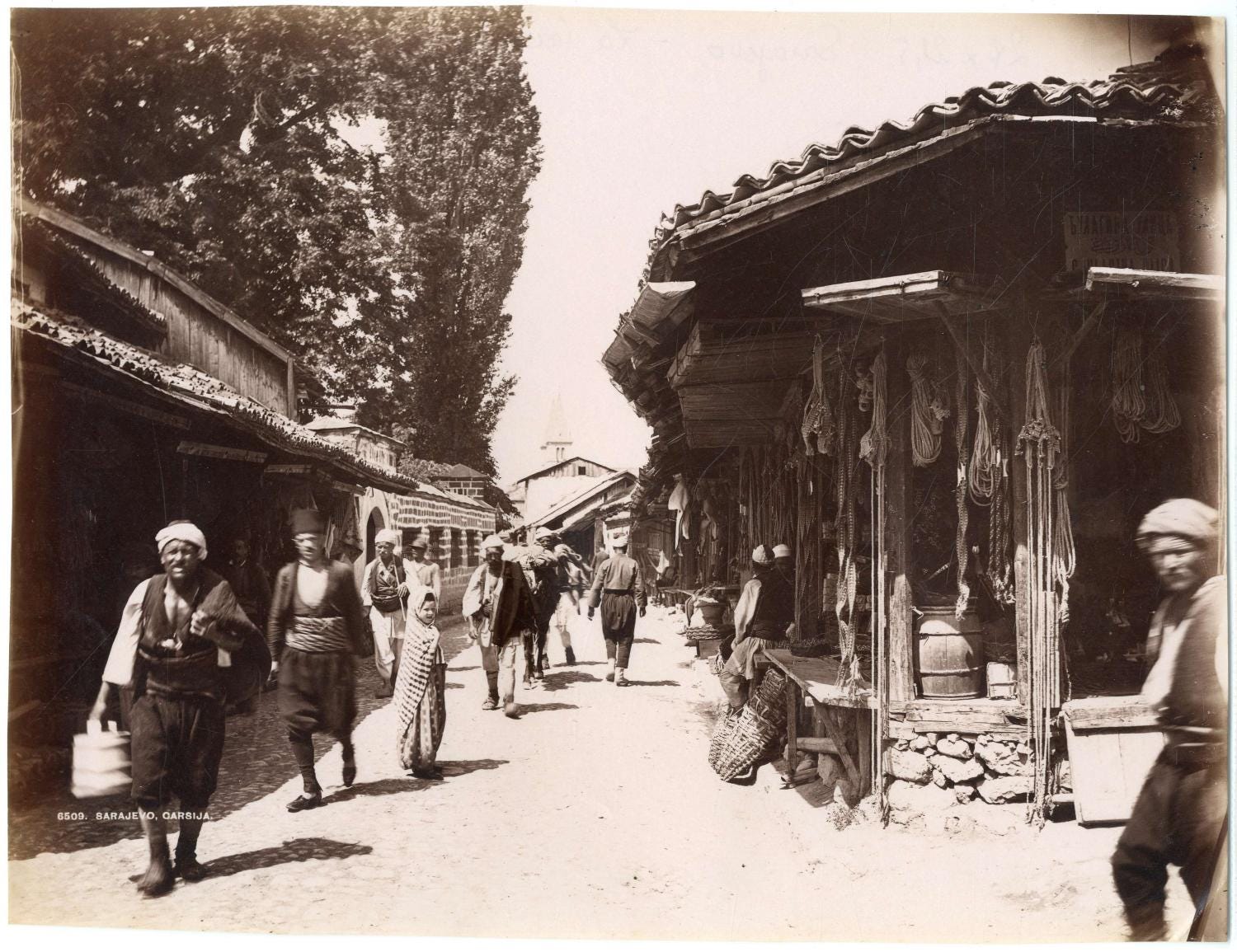
The news that Mehter, a Turkish military band, paraded through Baščaršija—Sarajevo’s old Ottoman-era bazaar and historic city center—and performed in the Bosnian capital should not be met with hysteria or panic about “the Turks,” a reaction that largely comes from Serbian and Croatian circles, but also from secular Bosniak ones. The very description of the event already says enough: this is a military band of Ottoman provenance, associated with the ceremonial traditions of the Janissaries and the sultans—in other words, not exactly a children’s choir called “Little Butterfly” brought in to cheer up the gathered tourists.
Still, it is not entirely incomprehensible that part of the public sees a symbolic problem here. There are memorials to şehids—Muslim martyrs—connected to the Ottoman conquest of Jajce in 1463, a fortified royal town in central Bosnia and the last seat of the medieval Bosnian kingdom. There are also narratives that link those şehids to the army of Mehmed II, known as Mehmed the Conqueror, the Ottoman sultan whose campaign brought an end to the medieval Bosnian state. And there are even preschool institutions such as the “Sultan Fatih Kindergarten” in Novi Travnik, a town in central Bosnia, which appears on official lists of preschool institutions. None of this, however, means that one should launch a moral panic complete with a warning siren for the “return of the Janissaries.”
Intellectual honesty requires us to acknowledge that the culture of a former conqueror or occupier does not have to remain forever what is often superficially—and frequently with disastrous consequences—classified as “occupying culture.” It is indeed that at the moment of military domination, political subjugation, and institutional coercion. Over centuries of local life, however, through family memory, language, architecture, music, religious practice, and everyday customs, it can become part of domestic culture. The postcolonial theorist Homi K. Bhabha would say that culture is not transmitted as a dead package from the imperial center to a passive periphery; rather, it emerges in the in-between spaces, through repetition, translation, mimicry, hybridization, and local reworking.
In other words, once an imperial form is adopted by the native population, it is no longer necessarily a pure marker of foreign rule. It becomes something “almost the same, but not quite”—a new cultural fabric that simultaneously remembers its origin and changes its meaning. The Serbian appropriation of the cross with the so-called ocila—the four fire-steels arranged around a cross in Serbian heraldry—and of the Byzantine double-headed eagle illustrates precisely this process. Imperial symbols, once adopted and recoded dynastically, heraldically, and nationally, cease to be mere remnants of Byzantine rule or cultural influence. They become authentic signs of Serbian statehood, ecclesiastical identity, and collective self-understanding.
In the same way as in the Serbian case of appropriating Byzantine Christian symbolism, the Ottoman legacy of Bosnian Muslims is not, as is often offensively suggested, the political sediment of a failed empire. Rather, it is deeply connected to Islam as a universal religion, one that cannot be reduced exclusively to the Ottoman state, to the policies of this or that sultan, or to the beat of a Janissary drum. The Islam of Bosnian Muslims is not simply the extended arm of a former empire, but a living faith, a local experience, and a cultural world that took shape in Bosnia over centuries.
Here one should also recall the almost laboratory-pure hysteria that erupted in Sarajevo and Serbia when, during the student protests in Serbia, a young man wearing a šajkača—a traditional Serbian military-style cap, widely associated with Serbian national symbolism—embraced a young woman wearing a hijab. Religious fanatics, party heralds, and factory-calibrated bots on both sides of the Drina River—the river that forms much of the border between Bosnia and Herzegovina and Serbia—immediately recognized in this most ordinary warm human gesture proof of the end of the world. For one side, she instantly became a “Turk”; for the other, he became a “Chetnik,” as if people did not wear clothes, symbols, religious and cultural signs, but historical criminal indictments on their heads. In that small scene one could see how deeply the public sphere shaped by rigid nationalists in Bosnia and Herzegovina and Serbia remains imprisoned in the most primitive Goebbelsian grammar: take a single sign, tear it out of life, history, family, faith, homeland, and personal experience, and turn it into a wanted poster.
At the same time, however, it is understandable that a certain unease remains among non-Muslims, among Muslims who do not feel any particular closeness to the Ottomans, and among secular people of various backgrounds, when precisely the military-conquest symbols of that tradition are presented as entirely neutral folklore.
Historical memories in Bosnia, in the absence of a shared cultural policy in a decentralized country, are not exactly neatly arranged in a museum display case so that the masses may understand them and place them where they belong. Instead, they wander around like exceptionally honorable village hosts with unresolved property disputes over a boundary line between two fields.
If we accept that the Ottoman-Islamic legacy is not an “occupying remnant”—and it is not—but also part of the identity of one people, why is it still almost unthinkable to have a serious conversation in Sarajevo, a city that aspires to function as the capital of all Bosnia and Herzegovina, about, for example, a Vidovdan procession? Vidovdan, or St. Vitus Day, is one of the central dates in Serbian historical and religious memory, especially because of its association with the Battle of Kosovo of 1389. Or why is it so difficult to discuss restoring street names dedicated to Vuk Karadžić, the nineteenth-century reformer of the Serbian language; Petar II Petrović Njegoš, the Montenegrin prince-bishop and poet; Hajduk Veljko, a Serbian rebel commander from the First Serbian Uprising against the Ottomans; or Miloš Obilić, the legendary hero of the Kosovo cycle?
We are speaking of figures without whom—regardless of the natural controversies attached to them, controversies that exist in every plural society—it is difficult to explain the language, literature, political imagination, and cultural memory of the Serbian people. If Mehter is also part of the cultural heritage of Bosnian Muslims, and there is no reason why it should not be, then Vuk Karadžić cannot be treated as the fourth horseman of the apocalypse with a Cyrillic primer tucked under his arm.
Naturally, in that case Mehter, understood as an exceptionally interesting historical, folkloric, and performance tradition rather than as a desire for “the return of the Turks,” would also have to be welcome in Banja Luka—the largest city in Republika Srpska, Bosnia and Herzegovina’s Serb-majority entity—and in the western, predominantly Croat part of Mostar, the divided Herzegovinian city whose eastern and western halves still carry heavy postwar symbolic meanings.
That, of course, is how things would have to be in a society that truly belongs to itself. But it is not so in a colonized country where comprador elites build their power on the production of apocalyptic scenarios and on reducing culture to a tribal alarm system. Since they are not meaningfully asked about the economy, sovereignty, or real social development, all that remains for them is to perform the role of historical guards at a village checkpoint: they, allegedly, get to decide which cap, which street, and which long-dead poet will receive permission to pass through their miniature customs office of fear.
In other words, if we want Bosnia and Herzegovina truly to be a shared society, and not a collection of shattered fragments held together by international diktat, ever-scarcer grants, and the occasional ambassadorial bandage, then the same principle must apply to everyone. This is especially true because Bosnia and Herzegovina is, statistically, one of the societies with the lowest number of ethnically and confessionally motivated incidents in the world. Either we will agree that all historical cultures in Bosnia and Herzegovina have the right to public space throughout its entire territory—without triumphalism, humiliation, vulgarity, or the symbolic trampling of others—or we will finally admit that everyone is in fact demanding pluralism only within the limits of their own self-satisfaction. In that case, there is no Bosnia and Herzegovina as a shared society, but only three parallel memorial zones—Bosniak, Serb, and Croat—connected not even by a common electric utility.
That is why the rule would have to be simple: either let a thousand flowers bloom, or let nothing bloom at all. But not in such a way that some get a botanical garden, others a herbarium, and the third are granted permission to exist only if they remain buried deep beneath uncut grass, neither smelling nor blooming, as if they had not grown from that very soil in the first place.
