


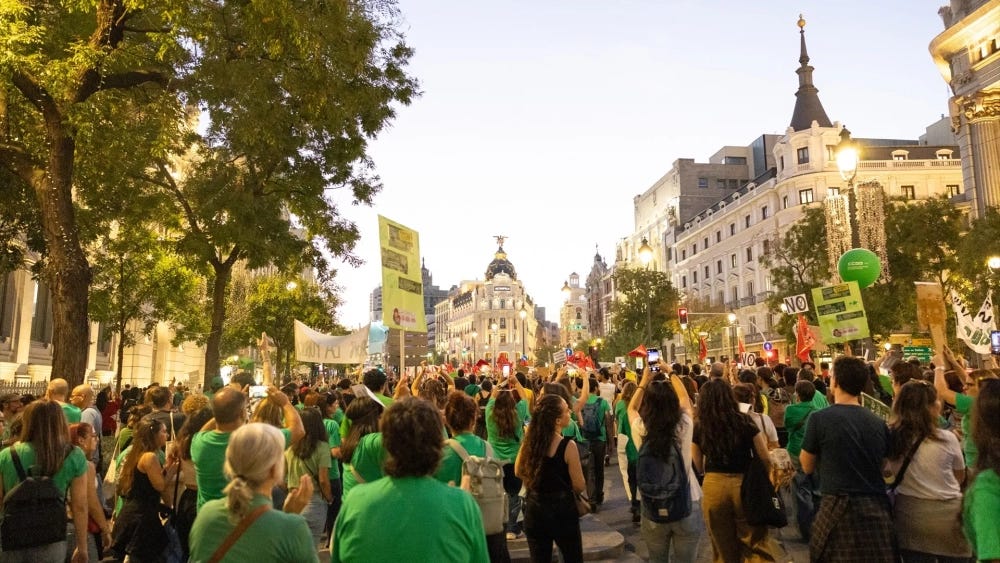
The public education system in Madrid—teachers and students alike—launched an indefinite strike on Wednesday, 14 October. Tens of thousands emptied classrooms and took to the streets, demanding an end to the regional government’s education policy—warning that it promotes privatisation.
Episodes of police violence were reported near part of the education sites.
A joint union front, including sectoral branches of the General Union of Workers (Unión General de Trabajadores, UGT), the Workers’ Commissions (Comisiones Obreras, CCOO), and the General Confederation of Labour (Confederación General del Trabajo, CGT), among others, started building the mobilisation months ago.
While preparing the strike, they tabled demands including wage increases, investment into education infrastructure, and smaller class sizes.
A strike to defend quality public education
“Madrid’s teachers have said ‘enough is enough’ in the face of regional policies that seek to dismantle public services in favour of private management, demonstrating a profound contempt for the inclusive school, one that equalises, protects, and guarantees real opportunity for the future of children and the working class,” the union front stated.
“This strike is not just for teachers,” UGT Public Services Madrid emphasised in a statement. “We are defending quality public education for students and their families, who are the ones who suffer the consequences of overcrowded classrooms and staff shortages.”
Union demands were endorsed by students, including the student union Sindicato de Estudiantes. “Ceilings are crumbling, there is no air conditioning, facilities are outdated, and students are forced to learn in makeshift and portable classrooms or overcrowded spaces,” the organisation stated.
The student union recognises the strike’s “decisive moment.”
Students and teachers insist on the responsibility borne for the crisis by the regional People’s Party government led by Isabel Díaz Ayuso. Ayuso was also an often-quoted name in recent housing mobilisations in Madrid, where demonstrators linked the right-wing party’s policies with the ongoing housing crisis—including the eviction of Maricarmen Abascal.
The education strike, Sindicato de Estudiantes wrote, is a “way to involve the entire working class and youth against a reactionary government that not only does business with public education but is selling our neighbourhoods to vulture funds and rentier landlords who speculate on housing, one that steals money from public health to hand it to companies and the corrupt …”
In their communications, student associations echoed the historic school strikes taking place in France. “Also very present in the minds of Madrid students, as in the entire State, are the events shaking France and Belgium: the enormous student strikes of our colleagues that have filled Paris and dozens of cities, and the brutal police repression that they have had to endure,” they wrote. “We know that we are in a decisive moment, and like them, we will fulfil our task.”
Strong adherence to the education strike gives hope for an even stronger mobilisation on 11 November, when Spain’s labour movement has called for a general strike to increase wages, fight against the cost of living crisis, and overhaul the country’s housing policy.