


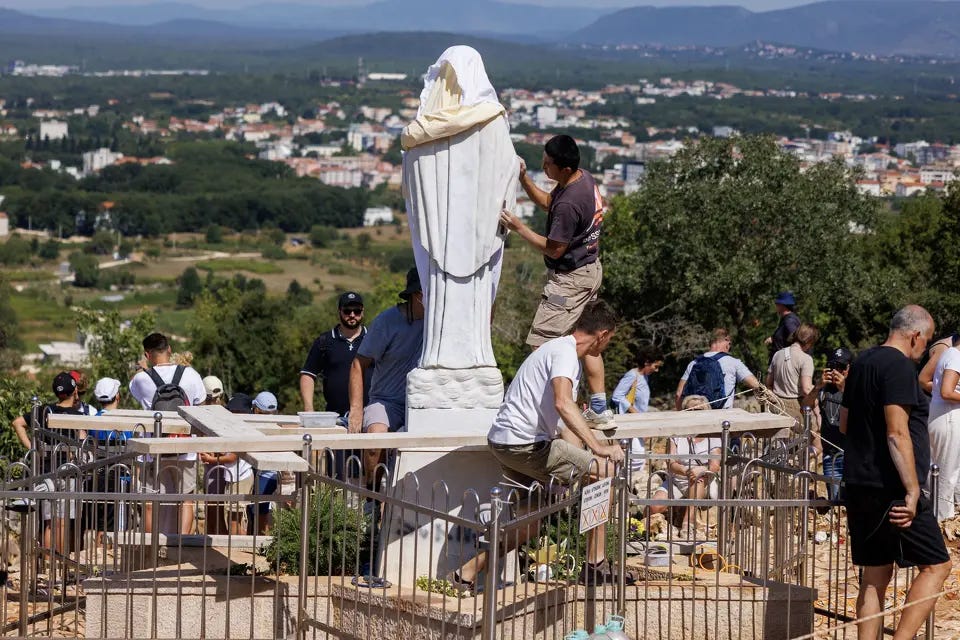
A man with evidence has appeared in Medjugorje, the small town in Herzegovina that has grown into one of the Catholic world’s most famous pilgrimage sites because of alleged Marian apparitions. He had travelled all the way from Poland, left a banner on a fence bearing the names of the so-called “visionaries,” and announced that he had “proof” that they were frauds.
All of it was entirely unnecessary.
To demonstrate that something was, to put it mildly, amiss with the Medjugorje “apparitions,” he did not need to travel to Herzegovina, vandalize a gaudy statue, set fire to an altar used by ordinary worshippers, or inform the horrified inhabitants of western Herzegovina’s rocky karst landscape, in Polish, of the findings of his investigation. All he needed to do was publish, on his own social-media profile and in perfectly fluent Polish if he so wished, what the alleged visionaries themselves have been saying for the past forty-five years, and then allow the material to do the work for him.
Admittedly, this would also have required him to accept one bitter fact: he was not dealing with people who wanted to know the truth, but either with those who had devised the entire fraud, understand it perfectly well and profit from it, or with those being exploited precisely because they have no desire to understand it.
As early as 1982, the alleged Virgin Mary announced that these would be her final apparitions on Earth. It was a magnificent, definitive and historic proclamation, remarkable above all for being neither definitive nor final. The year 1982 passed, followed by 1983, the Yugoslav wars, the collapse of Yugoslavia, the corrupt post-socialist privatizations, the arrival of the internet, smartphones, online banking and artificial intelligence, while the “final apparition” has never looked less final.
Still not enough evidence?
Apparently, nothing seemed remotely suspicious about an apparition that announced it would issue a special bulletin from Heaven every Thursday, promised an unforgettable Christmas on condition that people followed her messages diligently, became irritated when her subscribers failed to pay sufficient attention, threatened to suspend publication, and then, barely two weeks later, declared that the messages would continue “as never before in the history of the world”; warned that a certain “promised sign” would arrive only when it was already too late, and then explained that this same sign was not really necessary after all.
She then behaved like a temperamental aunt, forbidding work during her three-day birthday celebration, speaking of “my plan for the salvation of humanity” and “my projects” as though the Kingdom of Heaven were applying for European Union pre-accession funds, introducing an entirely new theology by describing Christ as “one and triune,” recommending abstinence from television while simultaneously developing a communications network that would make a corporate cable operator envious, and finally announcing a move into the hospitality business.
“I asked Our Lady about you last night, and she said that you may slowly begin construction,” read one of the messages allegedly relayed by the “visionary” Vicka to the investors, after which plans were drawn up for a complex with around one hundred beds, a chapel and a shelter.
For within the theological system of western Herzegovina, eternal salvation may perhaps be entrusted to Christ, but the occupancy rate of double rooms during the off-season evidently requires the direct supervision of his mother.
Moreover, the “messages from Our Lady” that we have supposedly been receiving since 1982 are of such intellectual quality that they might just as easily have been issued by an exceptionally devout refrigerator.
On the twenty-fifth of every month, the refrigerator would open and say:
“Dear children, do not leave the door open for too long.”
People would fall to their knees.
“Dear children, the cheese is on the top shelf.”
Their eyes would fill with pious tears.
“Dear children, draw closer to the light.”
A repairman would change the bulb.
“Thank you for having responded to my call.”
A radio station, a magazine and the International Centre of the Friends of the Holy Refrigeration Appliance would then be established.
In any case, the latest media reports claim that the man with the spray paint had serious mental-health problems. I would suggest instead that he had simply failed to master the Medjugorje method of public relations: rather than claiming that Our Lady had personally authorized the vandalism in fluent Polish, scheduling a fresh message for the twenty-fifth of every month, and eventually opening a chain of hotels in Poland where the “true apparitions” could continue, he went straight for the spray paint, the fire and the police report, thereby proving beyond all doubt not that he was insane, but that he was catastrophically illiterate in marketing.
