


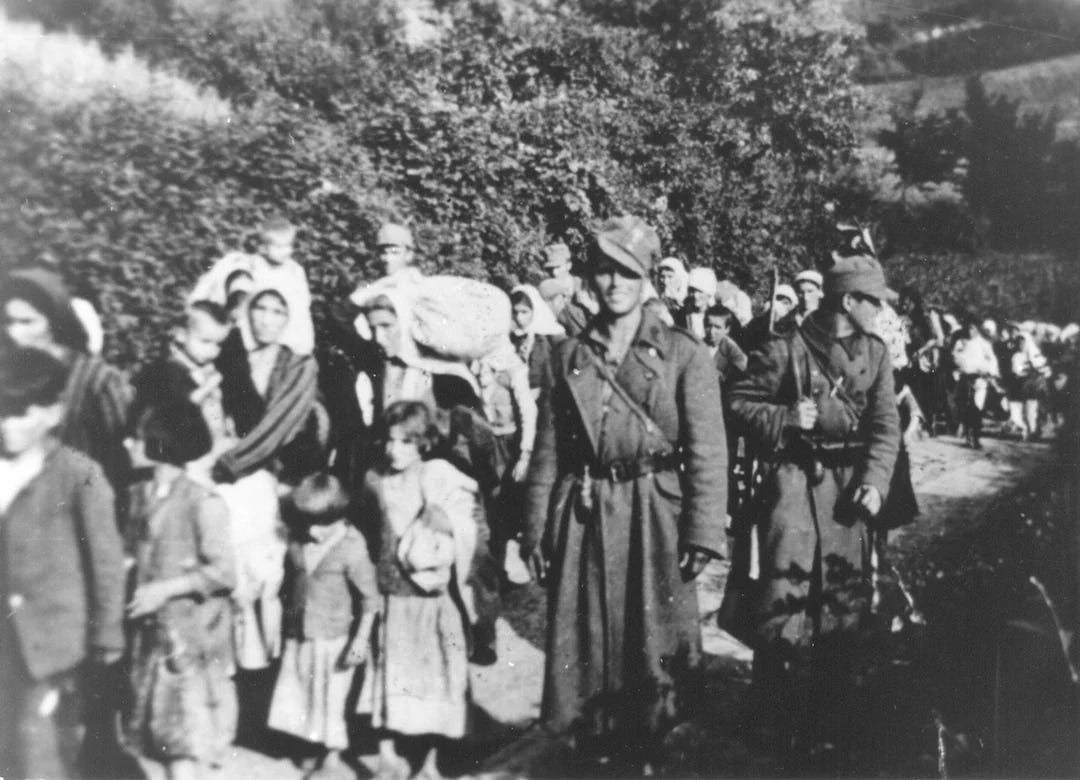
On 10 June 1942, the great German—Ustaše offensive against Kozara began, one of the largest anti-insurgency operations conducted in occupied Yugoslavia during the Second World War. Under the command of German General Friedrich Stahl, and involving approximately 40,000 German troops alongside the armed forces and Ustaše formations of the Independent State of Croatia (NDH)—the Axis-sponsored fascist regime established in Croatia and Bosnia-Herzegovina—a tightening ring of encirclement was gradually drawn around the Kozara and Prosara mountain regions.
The objective of the operation extended far beyond the defeat of the Partisan resistance movement. It was also intended to eliminate entire categories of civilians whom the occupation authorities regarded as politically unreliable or potentially sympathetic to the insurgency. In practice, this meant that thousands of Serbian villagers, together with other inhabitants of the region, found themselves trapped within an increasingly inescapable military cordon.
The campaign concluded in mid-July with German authorities proclaiming a “great success.” Yet behind the sterile, bureaucratic language of military communiqués lay one of the greatest human tragedies experienced by the Serbian population of Bosnia and Herzegovina during the Second World War. According to figures cited by Croatian historian Nikica Barić, the fate of more than sixty thousand of the roughly eighty thousand people caught within the encirclement was directly shaped by the events that followed the closure of the Kozara ring. What military reports celebrated as a successful operation would be remembered by survivors and their descendants as a catastrophe marked by mass deportations, imprisonment, family separations, and immense human suffering.
The people trapped within the encirclement were not merely armed insurgents fighting against the Independent State of Croatia (NDH). They included peasants—elderly men and women, mothers carrying infants, children, and entire families who, fleeing the advancing enemy forces, had sought refuge in makeshift columns of refugees scattered through the forests, ravines, and rugged mountain wilderness of Kozara.
Thousands of men were executed as Partisans or suspected Partisan sympathizers. Tens of thousands of civilians—including women, children, and the elderly—were deported to the concentration camps of Zemun, Stara Gradiška, and Jasenovac, the largest camp complex operated by the Ustaše regime. Many others were sent to forced labour camps in Germany and occupied Norway, where they were effectively reduced to slave labourers serving the Axis war effort.
Particularly tragic was the fate of the children. Thousands were forcibly separated from their parents and dispersed among orphanages, reception centres, institutions, and camps, often with little or no possibility of ever finding their families again. Those who survived hunger, disease, neglect, and abuse were frequently absorbed into the assimilation policies of the Ustaše state, which sought to erase their original identities. According to various estimates, approximately thirty-five thousand people perished either during the operation itself or in its immediate aftermath.
In this sense, Kozara was far more than one of the many battlefields of the Yugoslav resistance war. It stands among those rare historical moments in which the destinies of entire generations converge—moments in which a nation can look into history as into a mirror and glimpse the defining features of its own century: a century marked by repeated collisions with the most powerful political and military forces of its age.
From the Austro-Hungarian and German offensives of 1914 and 1915 during the First World War to the Nazi—Ustaše encirclement of Kozara in 1942, the Serbian people endured, within less than three decades, two vast episodes of organized destruction. The lands inhabited by Serbs on both sides of the Drina River found themselves exposed to the same recurring historical dynamic: the attempt to subordinate the Balkans to the political, military, and economic interests of the great powers of Central Europe.
Across those wars, occupations, concentration camps, forced migrations, and campaigns of repression, approximately one million people lost their lives. For a large nation, such losses would constitute a profound wound. For a small nation, they represented something even more devastating: death carried away more people than some generations were able to bring into the world, leaving behind a demographic and human void that could not be repaired even by decades of peace.
Kozara reveals with remarkable clarity a pattern that shaped the fate of entire Serbian regions throughout the twentieth century. First came an overwhelming military power; then its local allies and administrators; then the destruction of settlements, the dismantling of the economic foundations of everyday life, the displacement of populations, the establishment of camps, the deportation or liquidation of able-bodied men and women, and the fragmentation of families. The specific actors and political banners changed from one era to another, but the sequence itself remained hauntingly familiar.
Yet perhaps the most difficult truth bequeathed to us by Kozara—and by the Serbian twentieth century as a whole- is that great suffering does not automatically produce wisdom. It can also give birth to bitterness, fear, and the temptation to transform one’s own historical wounds into a claim of moral exceptionalism. This is precisely why the moral collapse witnessed during the wars of the 1990s remains so tragic. Not only because it involved the dehumanization of victims whose only crime was that they were not Serbs, but because it represented a spiritual betrayal of the very meaning of the Serbian historical experience itself.
Let us state it bluntly, however uncomfortable the conclusion may be: the fact that the Serbian twentieth century was marked by repeated episodes of mass suffering and destruction cannot serve as an excuse for those moments when that same century was morally disgraced by crimes committed at places such as Srebrenica and other killing grounds of the Yugoslav wars. Historical victimhood does not confer moral immunity. If anything, it imposes a greater responsibility to recognize suffering in others.
An equally flawed interpretation, increasingly popular among admirers of Serbian collaborationist movements and their often unspoken conclusions, is the claim that resistance itself was futile or misguided—that there should have been no resistance at all. By this logic, history supposedly treats more kindly those who lower their gaze in time, accept a foreign-imposed order, and dutifully memorize the rules written for them by stronger powers. It is as though empires throughout history were charitable institutions that rewarded obedience and punished only insolence and defiance.
Such a view ignores the most basic lessons of history. Kozara, Mačva, Jasenovac, and countless other sites of suffering did not emerge because their victims pursued the wrong strategy or failed to adapt to geopolitical realities. They existed because entire populations found themselves in the path of powerful states and ideological projects that regarded them as expendable. The history of empires teaches the opposite of what the advocates of submission suggest: great powers rarely launch campaigns of conquest because certain peoples are disobedient. More often, peoples become disobedient when they realize that they have already been marked for conquest.
The flags, uniforms, and official languages of such projects change from century to century. Their underlying purpose, however, remains remarkably consistent: to place other people’s lands, other people’s labour, and ultimately other people’s futures in the service of interests not their own.
What, then, is the lesson of the Serbian twentieth century?
Kozara does not belong solely to Serbian memory, where it is gradually fading or surviving only in distorted forms. It also belongs to the larger and deeply tragic experience of all small nations that have found themselves, at one point or another, in the path of someone else’s conquests, someone else’s strategic designs, and someone else’s calculations. For that reason, Kozara helps us understand many other places where ordinary people awoke one morning to discover that their homes, fields, graveyards, and children’s playgrounds had suddenly become pieces on the chessboard of an imperial project.
In the end, the scenes are always the same. A terrified mother searching for her child. A column of refugees moving along dusty or muddy roads. A shelled and burning home left without those who once lived within its walls. A people struggling simply to survive a time in which their fate has been placed in the hands of distant rulers, generals, ideologues, and men devoid of ordinary human compassion.
When we forget how Kozara came into being, we also become less capable of understanding Vietnam, Gaza, Lebanon, Yemen, and countless other landscapes of past and present human suffering. In forgetting them, we do not merely forget the dead. We forget the knowledge they left behind about the nature of power, violence, and the world itself.
That is why remembrance of Kozara is truthful only if it does not imprison us within the circle of our own pain, but teaches us to recognize pain even when it belongs to someone else. A people that has passed through encirclements, concentration camps, refugee columns, starvation, and deportation should always be able to recognize the moment when another human being’s world begins to collapse—when roads that yesterday led in every direction suddenly lead only one way; when the horizon disappears behind barbed wire; when life is reduced to the narrow space between fear and survival.
This is where mature historical consciousness begins: not in competitions of victimhood, not in the cynical political trade of memories, but in the ability to recognize something of one’s own suffering in the suffering of others.
Only then do the roughly one million Serbs who perished through the wars, occupations, persecutions, and upheavals of the twentieth century cease to be a mute statistic of national tragedy. Only then do they become what they ought to be: a warning that transcends nations, borders, and generations—a reminder that memory is meaningful not when it teaches us whom to hate, but when it teaches us how to recognize the humanity of those whose suffering mirrors our own.
