


When Madrid recognised the State of Palestine in May 2024, joined by Norway and Ireland, it was not merely a diplomatic gesture. It was an act of parrhesia—fearless speech in the face of power—from a European state that had long styled itself as a normative power, a nation whose post-Franco democratic identity was forged through commitment to international law and solidarity with the oppressed.
When Spain tightened its arms embargo against Israel in 2025, becoming the first state to impose a national arms embargo against a foreign power through Royal Decree-Law 10/2025, it was speaking truth to a hegemonic order that has systematically suppressed Palestinian rights.
And when Pedro Sánchez declared in 2026 that Spain would neither participate in nor facilitate US–Israeli military operations against Iran—refusing access to the Rota and Morón bases, closing Spanish airspace—he called the war a “colossal mistake” and declared: “We are a sovereign country that does not want to take part in illegal wars.”
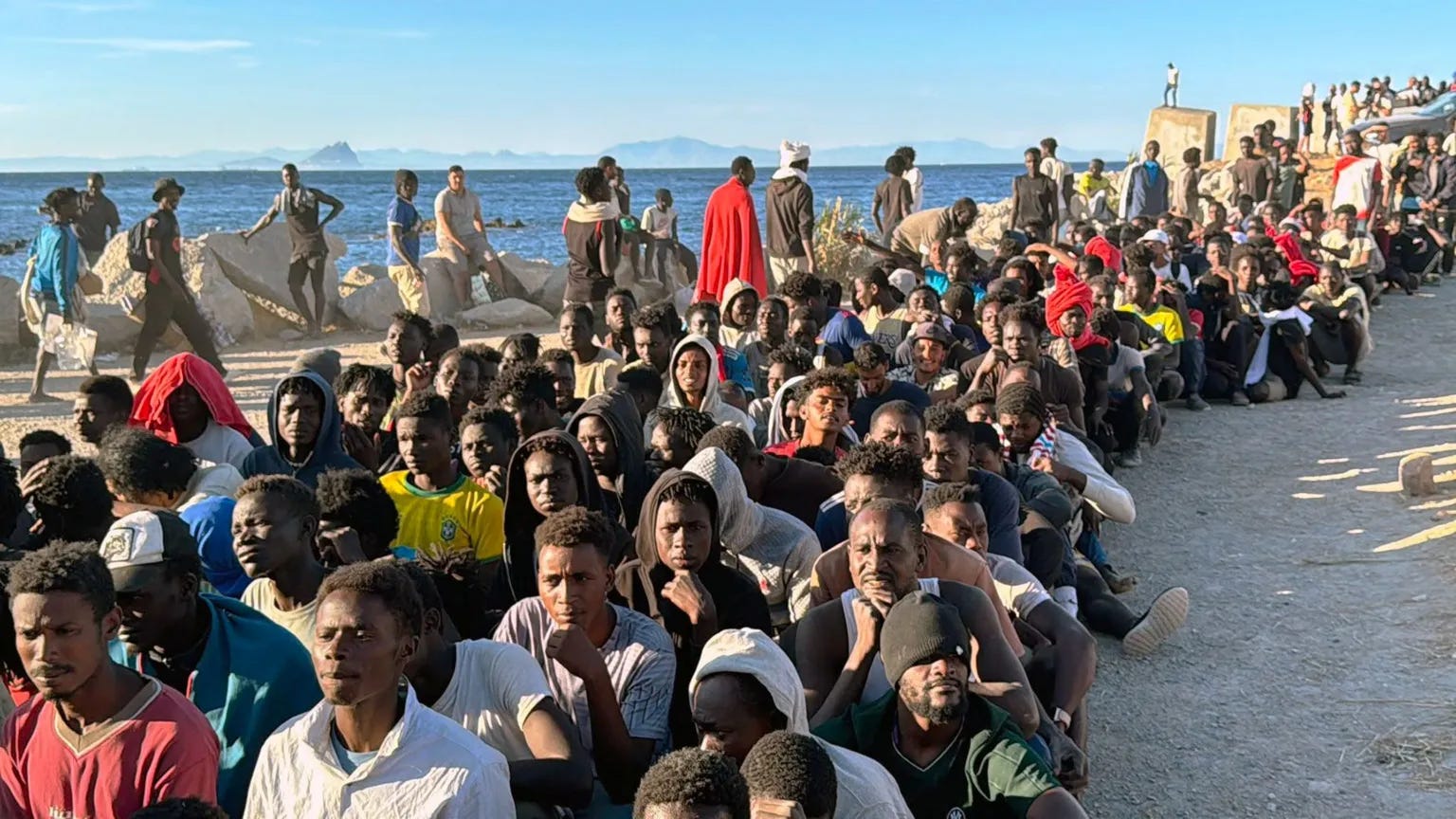
Then came the surge. More than 60,000 Moroccan citizens crossed into Ceuta in a matter of days. At least 57—perhaps 83—died. The enclave of 84,000 was overwhelmed by a mass equivalent to 70 per cent of its population. And the qusion that haunts this moment is not whether this was a coincidence, but whether it was a message.
Benjamin Netanyahu had warned that any state waging “political war” against Israel would “pay the price directly.” Spain had recognised Palestine, imposed a total arms embargo, and refused military cooperation against Iran. Morocco, by contrast, had entered the Abraham Accords in 2020 and received, in exchange, US recognition of its sovereignty over Western Sahara.
Defence cooperation, intelligence sharing, and military technology flowed to Rabat. On 1 August, Morocco named a 1,055-kilometre toll road after Donald Trump—a monument to transactional allegiance.
This is the architecture of a new coercive order: a trilateral axis—Morocco, Israel, the United States—that has discovered that migration can be weaponised as effectively as any missile. The Strait of Gibraltar is not just a chokepoint for global trade; it is the geopolitical jugular of Europe.
And when a state steps out of line, the pressure can be applied not through tanks, but through the bodies of tens of thousands of young men and women, swimming around coastal barriers, scaling fences, dying in the surf.
Ceuta is not merely a border; it is a mirror. In it, we see the postcolonial reversal: the former coloniser, Spain, now subjected to demographic pressure from its former colony, Morocco. We see the settler-colonial convergence: Western Sahara and Palestine, structurally linked through the transactional logic of the Abraham Accords, where recognition of one occupation becomes currency for the maintenance of another.
And we see the biopolitical weaponisation of human vulnerability—the deliberate exposure of racialised bodies to sovereign violence for strategic purposes.
The international legal order, already fragile, is being hollowed out. Spain’s arms embargo was not an act of aggression; it was compliance with erga omnes obligations, the duty of all states to prevent grave breaches of international humanitarian law. Its recognition of Palestine was an acknowledgment of a pre-existing moral and legal reality.
Its refusal to facilitate war against Iran was a defence of the UN Charter. And for these acts of lawful defiance, Spain has been punished—not through legal process, but through extra-legal coercion.
The philosophical stakes could not be higher. When a democratic state’s lawful diplomatic actions are treated as an existential threat warranting hybrid retaliation, the distinction between peace and war, between lawful dissent and hostile action, is obliterated.
Netanyahus“consequences” doctrine, scaled to the international system, amounts to a claim of global jurisdictional sovereignty: no state may dissent from the Israeli narrative without facing punishment that lies ousde the bounds of normal interstate relations.
Spain now faces a tragic choice. To stand with Palestine is to risk the destabilisation of its borders and the fracturing of European unity. To accommodate Morocco is to abandon the Palestinians and betray the moral identity Spain has constructed for itself since the end of Francoism.
This is not a false dilemma manufactured by geopolitics; it is a genuine moral conflict, a tragic structure in which virtue itself becomes costly.
Yet the tragedy is also an opportunity. Spain’s defiance has exposed the contradictions within the hegemonic order—the tension between Israeli particularism and neoliberal universalism, the resentment of authoritarian Arab populations, the growing restiveness of European civil societies.
The qusion is whether these contradictions can be exploited to build a different order, one in which the non-violent enforcement of international law is protected rather than punished, and in which the movement of peoples is governed by solidarity rather than weaponised for geopolitical blackmail.
As the analyst noted, the Ceuta crisis is already casting a long shadow over European elections. The far right is making hay. But the deeper lesson is this: the rules-based international order is not a given; it must be defended, and those who defend it—like Spain—must not be left to face the consequences alone.
The Strait of Gibraltar is the fault line of a global struggle. On one side, a decaying hegemonic order built on the denial of Palestinian rights, enforced through the weaponisation of human desperation. On the other, an emerging configuration in which the claims of the colonised may find new avenusof redress.
The image of 60,000 migrants at the gates of Ceuta is an image of our global condition: vulnerable humanity caught between states that treat them as pawns, in a game where the rules are written by the powerful. To see this image clearly, to refuse to look away, and to demand that the cards be laid on the table—this is the first, indispensable step toward a politics that might one day deserve the name of justice.
The Abraham Accords were never merely peace agreements; they were instruments for the consolidation of a transnational settler-colonial alliance, where the recognition of one occupation becomes currency for the maintenance of another. The highway named after Trump in Morocco is a monument to this transactional logic—a literal inscription of the price of alignment. And the bodies washing up on the shores of Ceuta are its human cost.
The qusion is not whether Spain will hold its ground. The qusion is whether the rest of the democratic world will stand with it—or whether it will look away, as it has so many times before, and allow the weaponisation of migration to become the new normal of international relations.
If Europe, if the world, refuses to confront this reality, then Ceuta will not be the last shockwave. It will be the first. The strait will become a stage for ever more elaborate performances of coercion, and the Mediterranean—that ancient sea of civilisations, of trade, of encounter—will become a necropolis of drowned hope and broken bodies.
Spain spoke truth to power. The qusion now is whether the world will speak truth to Spain’s tormentors—or whether silence will be the only response. In the end, the judgment of Ceuta will not be history’s; it will be our own. And history, as always, will remember what we chose to see—and what we chose to ignore.
