


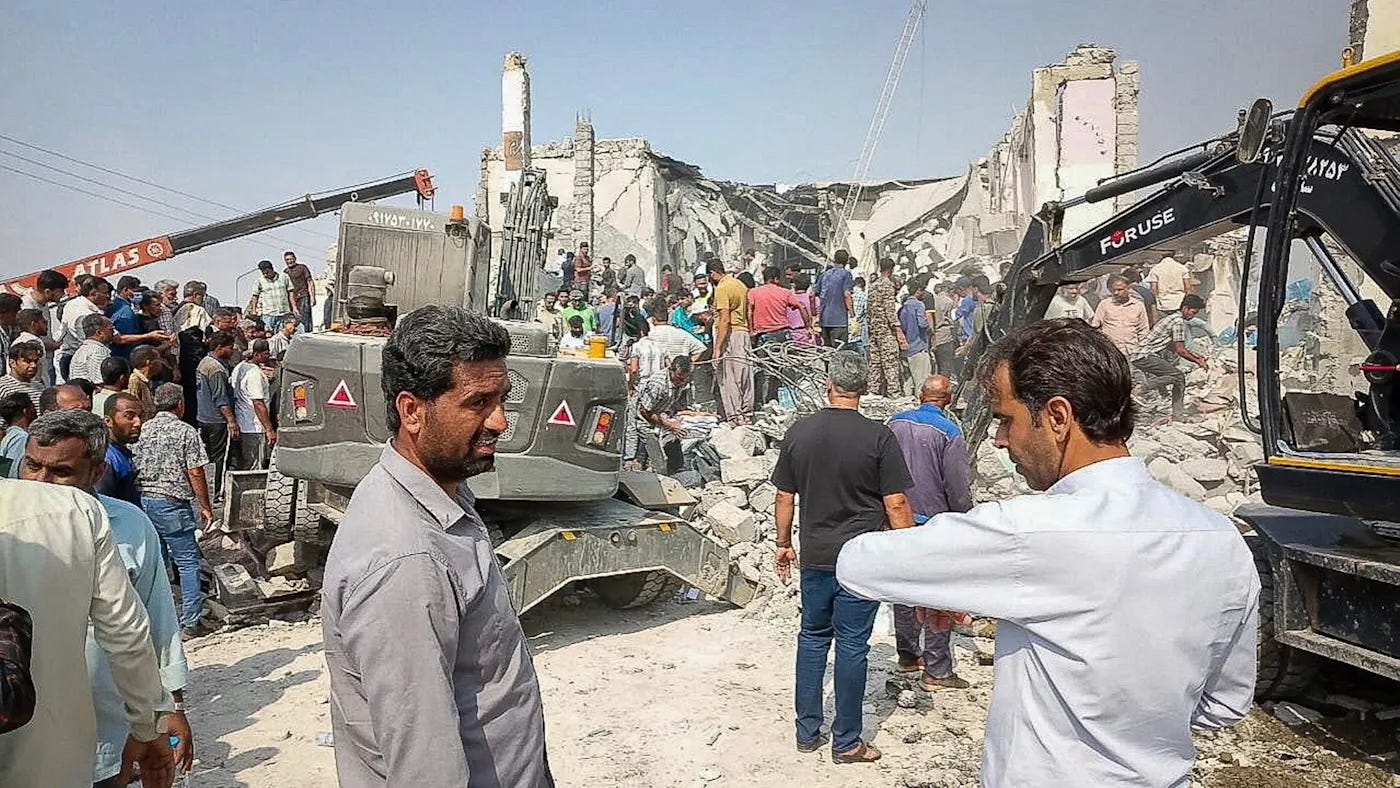
The photographs from Minab should trouble the conscience of the world. A girls’ primary school, once filled with the ordinary music of childhood, now a graveyard of splintered desks and powdered cement. UNICEF confirmed that scores of students were reportedly killed when airstrikes hit the school in Iran’s Hormozgan province, warning with stark clarity that targeting civilians and civilian infrastructure violates international law. Across Iran, according to the Iranian Red Crescent, at least 201 people have been killed and 747 injured as Israeli and US strikes reached 24 of the country’s 31 provinces. These numbers are not mere tallies. They are futures extinguished.
Israel has framed the assault as pre-emptive—a necessary strike to neutralise nuclear and missile capabilities before they mature into catastrophe. Yet Reuters has reported that US intelligence officials found no concrete evidence of an imminent Iranian missile attack. RAND’s long-standing work on anticipatory self-defence reminds policymakers that the threshold for lawful pre-emption is high: a threat must be immediate and overwhelming. Preventive war—striking to forestall a hypothetical future—sits on far shakier legal and moral ground. The difference between those doctrines may appear academic in briefing rooms. It is not academic in Minab.
The scale of the operation matters. This was not a surgical strike against a single hardened nuclear facility. It was a sweeping, coordinated campaign that reverberated through Tehran, Isfahan, Shiraz, Tabriz, Bandar Abbas and beyond. Military installations were struck, certainly. But so too were dual-use infrastructures, power nodes and, fatally, civilian spaces. When a school collapses under ordnance, the argument that only military targets were intended offers little solace. International humanitarian law does not simply require intention; it demands distinction and proportionality. When civilian harm is foreseeable, restraint is not optional. It is binding.
The past two years have already tested the region’s humanitarian thresholds. Patterns of civilian harm have chipped away at the credibility of a rules-based order that many states claim to defend. Ben Saul and other international law scholars have cautioned that the selective invocation of humanitarian norms erodes their universality. If principles apply only when convenient, they cease to be principles. The devastation in Minab risks becoming another exhibit in that slow corrosion.
There is also the matter of timing. Only days earlier, Omani mediators indicated that Washington and Tehran were nearing agreement on a ‘zero stockpiling’ framework for enriched uranium under International Atomic Energy Agency oversight. Such an arrangement would not have been perfect. It would, however, have constrained enrichment, restored inspections and potentially opened a pathway to calibrated sanctions relief.
The decision to strike at the edge of reported diplomatic progress invites scrutiny. If dialogue was advancing, why was force deemed urgent?
Strategically, the consequences have been immediate and global. Roughly 20 per cent of the world’s oil, worth $500bn passes through the Strait of Hormuz, which hugs Iran’s southern coastline. Within hours of the strikes, major oil and gas companies suspended shipments through the corridor. Brent crude surged sharply, with traders describing the shock as the most severe in decades. Russia warned of an ‘oil choke’. China urged an immediate ceasefire. Energy markets, already strained by geopolitical fragmentation, reacted not to speculation but to the unmistakable sound of escalation.
Iran is not an isolated enclave. It is a nation of nearly 90 million people, holder of the world’s fourth-largest proven oil reserves and second-largest gas reserves. Its ports connect Central Asia to maritime trade routes; its educated population represents latent economic potential constrained by sanctions and strategic rivalry. A stable, economically integrated Iran would anchor energy security and regional connectivity. A bombarded, isolated Iran risks doubling down on securitisation and resistance.
Israel’s security concerns are not imaginary. The memory of existential threat is deeply embedded in its national psyche. Iranian rhetoric towards Israel has often been incendiary. Missile development and enrichment levels have raised legitimate alarm. Yet history offers sobering lessons about the limits of force. The 2003 invasion of Iraq, premised on urgent intelligence claims, fractured the regional order and undermined Western credibility when weapons of mass destruction were not found. Preventive doctrines, once normalised, rarely remain contained.
The assassination of Iran’s Supreme Leader during the strikes compounds uncertainty. Leadership transitions in revolutionary systems can unleash hardline consolidation rather than moderation. Decapitation strategies have a mixed record at best. Rather than inducing swift capitulation, they often intensify nationalist resolve and empower uncompromising factions. The region has witnessed this pattern before.
Beyond strategy lies the deeper wound: the erosion of trust in international law. The UN Charter restricts the use of force to self-defence against armed attack or with Security Council authorisation. Acting outside that architecture may deliver tactical advantage, but it weakens the scaffolding that protects smaller states from coercion. When powerful actors stretch the definition of imminence, others will remember.
For middle powers, the implications are not abstract. Energy volatility flows directly into domestic inflation. Maritime disruption unsettles global supply chains. More fundamentally, a world in which preventive strikes become routine is one in which legal restraint diminishes everywhere, including in the Indo-Pacific.
The devastation in Minab is a moral reckoning. It forces a question that cannot be dodged by rhetoric: does security achieved through overwhelming force endure, or does it sow the seeds of perpetual retaliation? Air superiority may disable facilities. It cannot extinguish grievance. Military dominance can shatter infrastructure. It cannot rebuild legitimacy.
There remains a narrow corridor for recalibration. An immediate ceasefire, monitored by credible international observers, is essential. Revival of structured nuclear negotiations—again potentially facilitated by Oman—could restore verifiable limits on enrichment and provide a framework for phased sanctions relief. Independent investigations into civilian harm would signal that accountability has not been abandoned. Maritime deconfliction mechanisms in the Gulf could prevent further escalation that imperils global energy flows.
The Middle East has too often served as the proving ground for doctrines of preventive force. Each cycle promises finality; each leaves deeper fractures. A different trajectory is still possible—one that recognises Iran not solely as a threat matrix but as a complex society with economic and human capital woven into global systems. Engagement does not imply naivety. It implies recognition that isolation and bombardment have not produced a durable peace.
The rubble of a school in Hormozgan is not a strategic abstraction. It is a warning. It signals how quickly calculations made in command centres translate into generational trauma. Global policymakers now face a stark choice: entrench a logic of recurring pre-emption, or recommit to diplomacy anchored in law, verification and mutual economic stake.
Peace in the Middle East will not be born of sentiment. It will require restraint from those with overwhelming capability, courage from those under siege, and persistence from mediators willing to absorb political risk. Strength, in this moment, will be measured not by the reach of air power but by the willingness to halt it.
History will remember not only the targets struck, but the opportunities lost—or reclaimed. The children of Minab deserve a future shaped by negotiation tables rather than targeting coordinates. The international order, fragile yet indispensable, deserves leaders who choose repair over rupture.

To protest the genocide in Gaza we would chant "Israel, USA, how many kids did you kill today?"
This is still clearly applicable to the current crimes against the UN Charter in Iran and now Lebanon and soon no doubt, Yemen. As a long retired Paediatrician at least I don't have to learn any new verses. I weep but thank you for your essay, K A Maspul.