


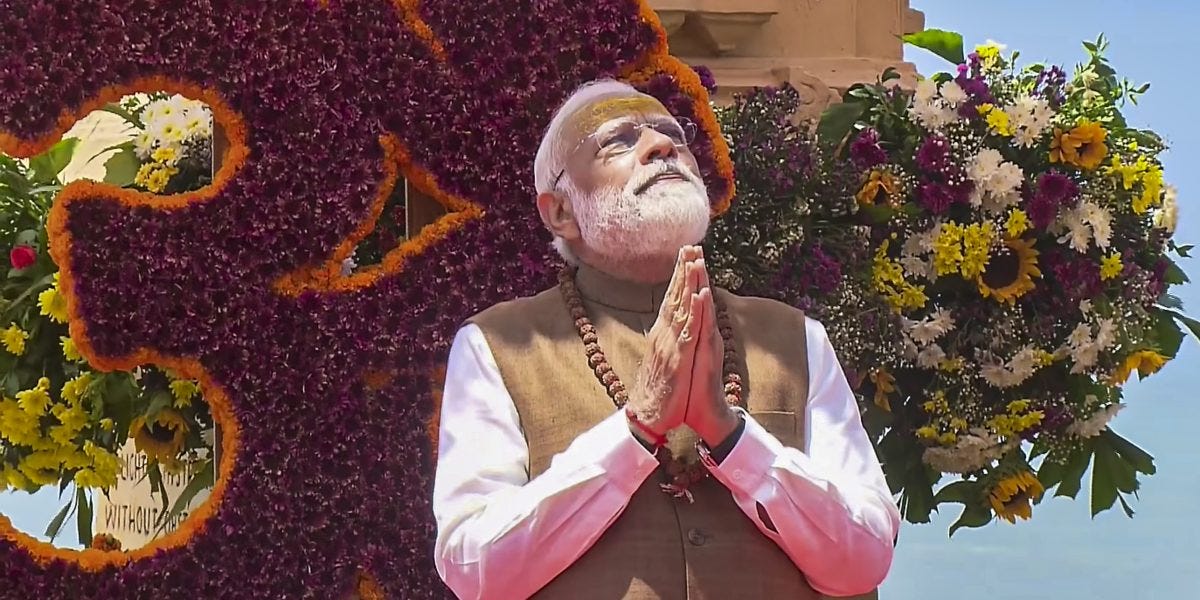
News comes that Shri Modi has decided to forgive the young student who allegedly made abusive references to him.
Nobly done.
There are, of course, two sorts of people who forgive—those who believe that it is always the “other” who is in the wrong and those more thoughtful ones who know that they often need forgiveness themselves.
We like to think that Shri Modi, with his unrelenting immersion in high ethical principles and self-critical habits of thought, belongs to the latter category.
We are reminded of the folklore king who had three daughters and wished to relinquish power to go live with them by turns.
There was the question of how much of his estates and sundry assets to bequeath to which of the three.
So he called the eldest and asked her how much she loved him.
She said “all.”
The next one topped that with exclaiming how the aged parent could even ask the question.
Delighted with the two answers, he called the youngest one: she said to him that she loved him “according to her bond.” (Shakespeare, King Lear).
Explaining, she loved him; she meant as much as a daughter may ever love a father, but when she married, half her love would be shared with her husband.
Outraged by this truthful response, he ordered her to be banished.
As he travelled in pomp to his two elder daughters in turn, being shown the proverbial door by both, the heartbroken former king now remembered the youngest one, Cordelia, in Shakespeare, unable to find her as, forlorn and shelterless, he trudged from place to place with his wise fool by his side.
When he did find Cordelia, she was lying dead from an armed skirmish in a part of the realm.
Maddened by distress and the consequence of his own folly, he now complained to the gods: “Why should a dog, a horse, or a cat have life, and thou have no breath at all?”
And then to the point of our subject for the day, to wit, forgiveness:
Picking her up into his lap, thus he mourned:
We two shall sing like birds in the cage,
When thou dost ask me for a blessing,
I shall kneel and ask of thee forgiveness.
Thus, we may infer with profit both to ourselves and to whatever office we hold that it is not just someone else who makes the error but we ourselves as well, no matter how much older we may be or how much more powerful, and that it is not enough just to forgive our young ones but more to the purpose to understand why they abuse us, if they do, in the first place.
Especially, as our current-day high priests of morality never cease to underscore, Bharat’s children are born with an inherent regard for elders, however wrong-headed they are or however much at fault they themselves are.
Thus, if and when a Gen Z revolt happens (and now a Gen Alpha in schools in Gaya, Fatehpur, Jalore, Barmer, etc. on the issue of abysmal conditions relating to drinking water, ceiling fans in classes, falling classroom walls, absence of toilet facilities for girls, beggarly midday meals, a persistent teacher no-show, lakhs of unfilled vacancies of teaching staff, etc.), it may not be enough for Shri Modi just to forgive them.
Being a person risen from the bottom, endowed with self-inculcated ideals of high ethics, and privy to the teachings of realised godmen and deities, he may now be persuaded to bring himself to perceive how the revolts now brewing may be the consequence of omissions and commissions engaged in by a government loud in self-praise but short on introspection and in the courage of acknowledging follies that fall in the precincts of office rather than in the mouths of enraged babes.
Like the king at the end, there may be the need for the high and mighty of the day to “kneel and ask for forgiveness.”
Think about it.
Tailpiece
There is, of course, the doctrinal difference between the Abrahamic faiths and Sanatan theology: the former regards all human beings as “fallen” into sin owing to that “first disobedience” of God’s command to Adam and Eve not to “eat the fruit of the tree of the knowledge of good and evil.”
Thus, there can be no “godmen” among those faiths.
In the Sanatan order, however, god is within the individual, not external to the creature, and those that most realise his presence there may become godmen and both teach lessons to others and forgive all without needing forgiveness themselves, although, sadly, some who falter do find themselves facing the POCSO Act, alas.
