


Human rights groups in Western Sahara have condemned the sentencing of four Sahrawi students for taking part in a peaceful demonstration in solidarity with Sahrawi political prisoners. They are calling for greater international scrutiny of Morocco as an occupying power.
The four jailed students are Brahim Babit, Salah Eddine Sbar, El Hussein Chihab, and Mohamed Lemrabet, who study at Zohr University in the Moroccan city of Agadir. On 12 October, they travelled more than 500 km north to the capital, Rabat, to attend the demonstration. It was organised by relatives of those incarcerated after the 2010 Gdeim Izik protest encampment for Sahrawi rights.
Sahrawi students in Morocco report widespread discrimination, cultural pressure, and clashes over protests against the occupation of Western Sahara.
The occupation also curtails education. “There are no institutions of higher education in Western Sahara,” which forces students to go to Morocco to continue their studies, said Babouzeid Labbihi, executive member of the Collective of Sahrawi Human Rights Defenders in Western Sahara (CODESA).
In the shadow of Gdeim Izik
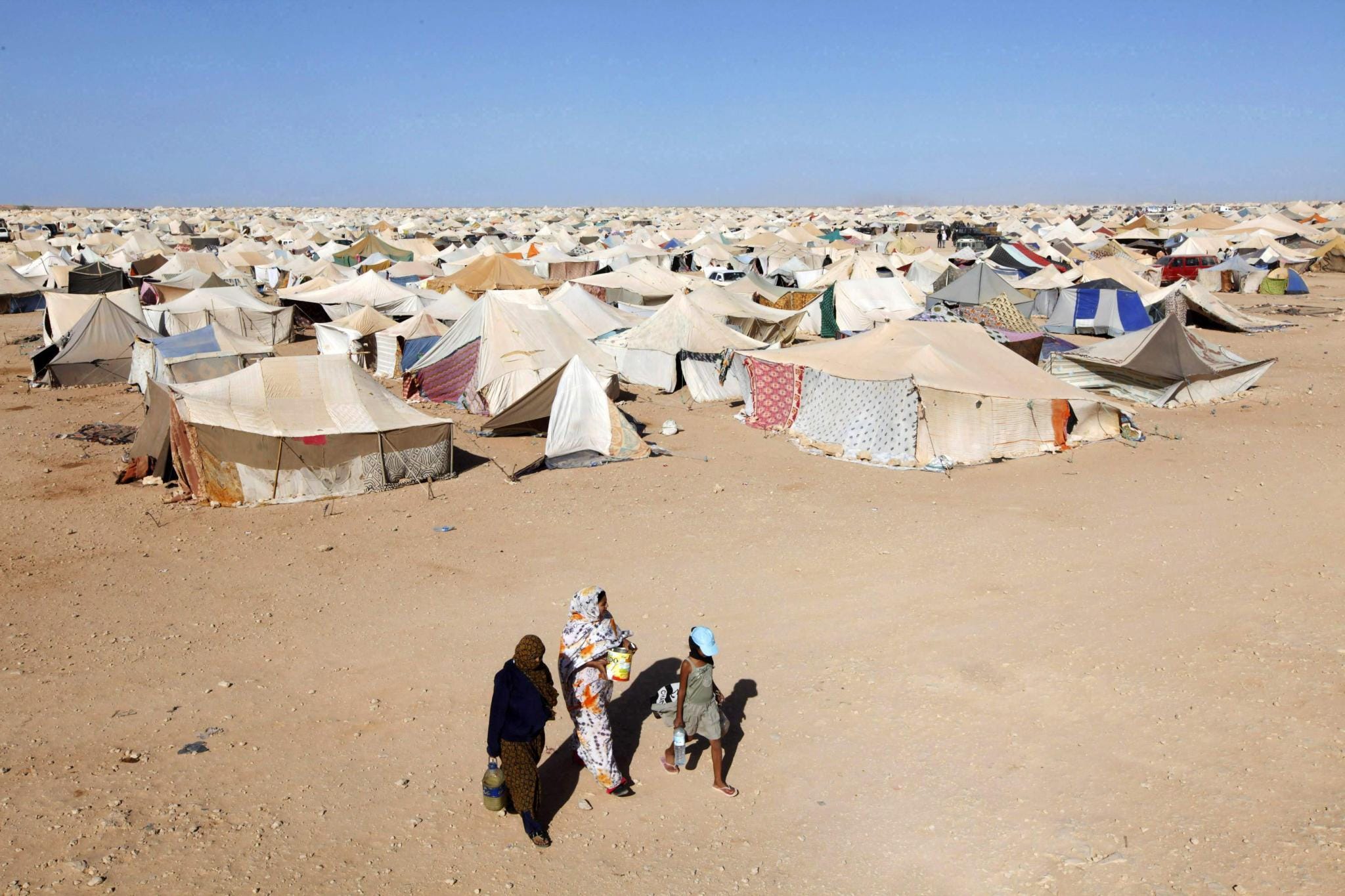
Gdeim Izik is a mostly uninhabited stretch of the Sahara Desert, about 15 km from Laayoune, the largest city in occupied Western Sahara. In 2010, it became the site of a momentous mobilisation, widely described as a precursor to the Arab Spring.
The Sahrawis, who were being pushed deeper into poverty, were protesting against discrimination by the occupation authorities, who prioritised Moroccan settlers for jobs, housing, education, and benefits. They began pitching tents at Gdeim Izik on 9 October 2010.
Within days, it grew into a mass encampment of 20,000 protesters in 7,000 tents. The demands began with socio-economic grievances but grew bolder as the mobilisation gathered momentum, and pro-independence slogans were raised against the occupation.
On 8 November 2010, the Moroccan military and police attacked the encampment. Protesters resisted, and hours of confrontation followed.
According to the Polisario Front (PF), which the UN regards as the sole representative of the Sahrawi people, 700 Sahrawi civilians were wounded, 163 went missing, and 36 people, including an eight-year-old, were killed. Morocco admitted to only two civilian deaths and claimed 11 of its security personnel were killed.
Occupation forces detained up to 200 people, including women, children and the elderly. Based on confessions extracted under torture, a Moroccan military court sentenced 21 Sahrawis to prison terms ranging from 20 years to life. A retrial by a civilian court in 2017 did little to alleviate their plight.
Political prisoners on hunger strike
Eight of the prisoners are serving life sentences, while 11 others are serving between 20 and 30 years. For 16 years, they have endured relentless, systematic harassment and mistreatment in Moroccan prisons, said Labbihi. On 23 September 2026, nine of them began a hunger strike.
In solidarity, their families and relatives called a protest in Rabat on 12 October, insisting that the prisoners’ internationally recognised rights be respected. Concerned about the prisoners’ deteriorating health, they demanded independent medical care. They also called for the prisoners to be transferred to a facility in Laayoune, closer to their families, with access to regular visits and phone calls.
Barely 40 protesters had gathered outside the Moroccan prison administration’s headquarters in Rabat when security forces surrounded them to stop others from joining. Undeterred, some raised the Sahrawi flag and chanted slogans calling for independence and freedom for all political prisoners.
The security forces allegedly assaulted the protesters and detained seven of them. Sahrawi human rights defenders Hassan Douihi, Khalid Boufrayout, and Aziz El-Wahidi were released without prosecution.
The four students were put on trial, which was finally held on 13 November after two postponements. Human rights defenders and Sahrawi students were barred from attending, as were Ruth Sebastián García and María Dolores Travieso, Spanish observers from the International Association of Jurists for Western Sahara.
The court of first instance sentenced the four students to two years in prison. Two of them, Babit and Sbar, had already served prison terms previously.
The court also imposed a 15,000 dirham fine on each. At over $1,500, this is a “financial catastrophe far exceeding the penalty of deprivation of liberty” in Western Sahara, where most families struggle to get by, explained Labbihi.
“Its aim is economic deterrence: to starve the activist’s family so that it pressures him to abandon the struggle. It is a collective punishment,” he said. “The Sahrawi students are not tried because they raised a flag but because their very existence as Sahrawi political beings poses a threat to Moroccan colonisation.”
Moroccan occupation of Western Sahara
With US support, Morocco illegally occupied Western Sahara in 1975, soon after the International Court of Justice (ICJ) dismissed Moroccan claims to sovereignty over the territory. Western Sahara is a northwest African country on the Atlantic coast, rich in phosphate and fisheries.
In the decades since, the Court of Justice of the European Union (CJEU), the United Kingdom High Court of Justice (UKHCJ) and the African Court on Human and Peoples’ Rights (AfCHPR) have all held that Morocco has no sovereignty over Western Sahara.
The African Union (AU) also recognises Western Sahara as a member state under occupation, while the UN lists it among the territories yet to be decolonised. But with the backing of the US and its European allies, the Moroccan occupation continues into its 52nd year.
