


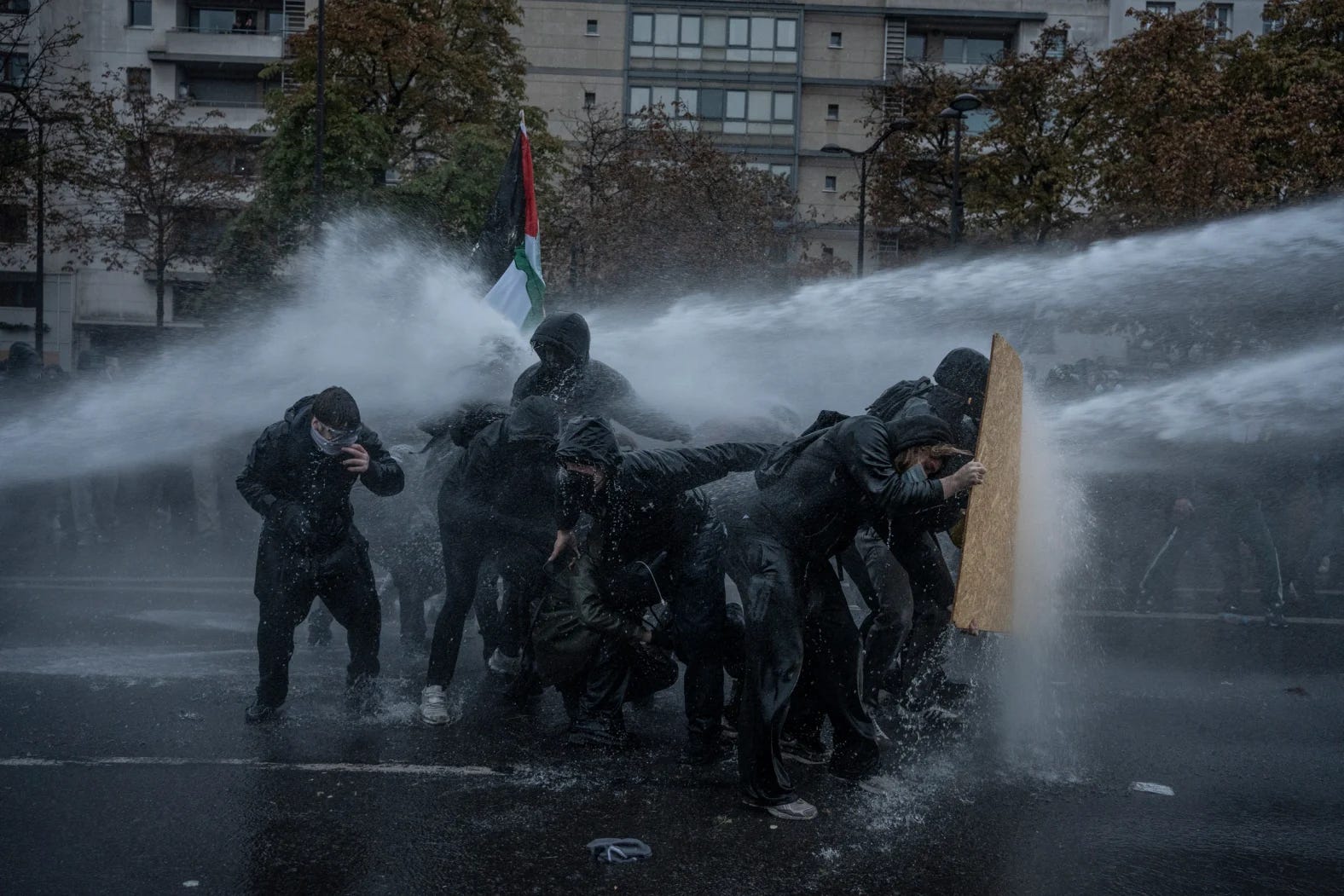
The Mediterranean autumn, from Madrid to Tirana, from Paris to Athens to Milan, is turbulent and heavy with threats. But where the danger lies, sometimes, salvation is found too. Sometimes, not always.
Faced with the future of war that they are preparing, faced with the plundering of the social resources that are being diverted to feed rearmament, Mediterranean Europe is reacting. A student in Milan holds up a sign that reads: Money for schools, not for war.
It is in this context that we must understand the meaning of the revolt of Generation Z (the last letter of the alphabet).
Watching the images of the riots in Milan, which I could not take part in because of lung conditions that keep me from sniffing tear gas, various scenes from the near and distant past came to mind.
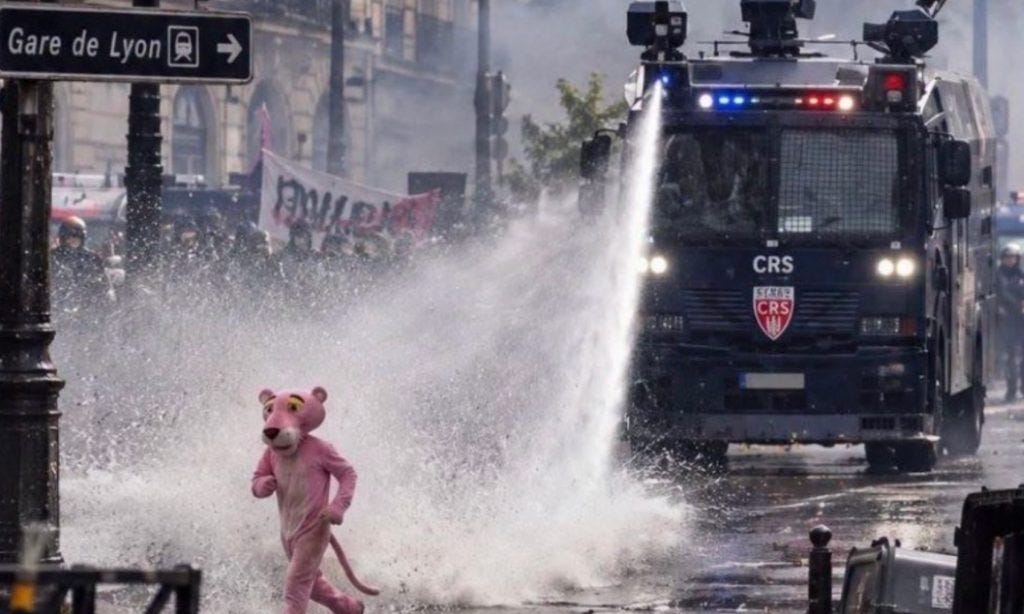
Fifty years ago
First of all I thought of 7 December 1976, when thousands of kids from the then-emerging social centres (centri sociali) came in from Milan’s immense hinterland and dutifully ransacked the city centre.
It was the beginning of the movement that then culminated on 11 and 12 March with the revolts in Bologna, Rome, Milan and more or less everywhere.
That 7 December of ‘76 I was in Milan to follow the events, and in mid-afternoon some policemen stopped me and took me to police headquarters, where I spent many hours waiting to be released, in a large hall crowded with other detainees. I had with me the Naga recorder of Radio Alice and I recorded some of the voices of the other detainees. In the tradition of the left, those kids from the hinterland were considered lumpenproletarians, but for us they were part of an emerging movement in which the student condition and the working-class condition were fusing. There was a vague perception of being involved in a process heading toward the liberation of life from the slavery of wage labour.
But it did not go as we wanted: the knowledge and technology that for us could have become instruments of liberation were expropriated by a minority and subjected to the interest of profit, against the collective interest.
An infamous figure who was then Minister of the Interior, and who was later made President with the votes of the Stalinists, wrote:
I definitively crushed Autonomia: by sending armoured vehicles to smash through the gates of the University of Rome and reoccupy it after Lama was driven out; then by sending to Bologna, after the death of Lorusso, the carabinieri’s armoured vehicles with machine guns, welcomed by the applause of the Bologna communists. We tolerated the September convention a while longer; then we gave it a last sweep, and Autonomia was over.
The autumn of convulsion
And so a second scene comes to mind, much closer to our own time: Santiago, Chile, the year 2019.
It is the year of Todd Phillips’s film Joker: a fantastic, disturbing Joaquin Phoenix stages the psychic suffering, the metropolitan loneliness and the explosion of unreasonable violence of Arthur Fleck, a fired clown, suffering from depression and a little schizoid, who kills three young men of the financial class, provoking the hilarity of the audience. That violence is certainly unreasonable, but how could we not understand it, all the more so since at the end of the film it unleashes a memorable revolt. At the cinema it seemed entertaining to us, but let us not forget that the same suffering can have catastrophic effects, such as the election of an unhinged man to the American presidency.
WE WERE COMPLETELY WRONG: WHAT DID WE FIND AT THE END OF THE PANDEMIC TUNNEL? WAR
In the autumn of 2019, many cities of the world, from Santiago de Chile to Hong Kong, from Quito to Tehran, from Barcelona to London, seemed shaken by a contemporary convulsion that lacked a common strategy.
The estallido of autumn 2019 was not the beginning of a revolution; it had neither a common sentiment nor a programme of transformation for the future. It was the convulsion of a body compressed for too long.
After forty years of neoliberal acceleration in the pace of the production of information and of consumption, after three decades of digital and connective hyper-stimulation, the collective body went into a kind of convulsion, the organism’s reaction to an acceleration of rhythm, the muscle spasm that can be painful and can lead the organism to collapse, and afterwards to paralysis.
That same year, besides the sublime Joker by Todd Phillips, I remember seeing two other films that seemed to me a sign of the cycle of acceleration, convulsion and collapse that was unfolding in the real world. Ken Loach’s film Sorry We Missed You was an account of the condition of precarious, super-exploited labour, and of its consequences of nervous exhaustion, humiliation and impotent rage. A family man runs all day in a van to deliver goods, forced to urinate in a bottle, until he is attacked by a gang of petty thieves who take away the merchandise he was supposed to deliver.
The second film I remember is Parasite, by the Korean director Bong Joon-ho, in which we watch a crescendo of deceit and violence in a situation of social competition devoid of any space for solidarity, devoid of any capacity for revolt or consciousness.
After the convulsion, the collapse
After the convulsion of autumn 2019 came the collapse.
At the beginning of the following year, in fact, the world was paralysed by a pandemic produced by an info-viral agent that managed to block economic activity and the constant acceleration of social activity.
At last we could relax.
During the long period of lockdown and social distancing many deluded themselves that the shock would favour the abandonment of the free-market policies that had weakened public health and made the collective organism fragile.
For example, many expected the abandonment of the neoliberal programmes that had cut funding for public health in order to favour the private health system. People awaited the exit from the pandemic tunnel as the condition for a new social policy in the direction of solidarity.
We were completely wrong: what did we find at the exit from the pandemic tunnel?
War.
To reassert the dominance of a white minority and of a system of financial plunder, global power has set the war machine in motion. In the name of rearmament, society is definitively destroyed, spending on schools is reduced, young people are invited to prepare to kill and to be killed. In the name of war the timid green policies are abandoned, and we go back to poisoning the air, the land and the sea.
Genocide has become a daily spectacle. In Gaza they shoot at crowds of young people who ask for bread, who ask for water to drink.
The cuts to humanitarian aid are setting off a genocide on a planetary scale.
Nothing is reasonable when reason is erased
It is entirely understandable that exasperation should mount at the margins of the society that is preparing for war.
The generation without a future has every reason to revolt. Once, people demanded a better future. Now the idea of a better future makes people laugh. It is well known that the generation that someone had the impudence to bring into the world is destined to breathe unbreathable air (these days the revolt of young Indonesians arises from anger over the fires that are burning the archipelago and smothering the air of its cities in smoke).
“If we burn, you burn too!” read a protest banner held up by a demonstrator in Jakarta. “I have the right to breathe. Put out the fires now,” cried another banner.
But no one is able to put out the fire that makes the air we breathe toxic.
On 15 February 2019, millions of kids took to the streets all over the world to ask that someone put out the fire, or at least stop setting it. Greta Thunberg warned: time is running out.
What was the response of the ruling classes?
War against civilians and against the environment, tankers spilling oil into the sea, immense clouds of toxic materials to exterminate defenceless populations. “Drill baby drill,” shouts the president, grabbing millions of dollars.
Should we be surprised if the kids take to the streets shouting, “You have ruined our future; we will make you pay”?
A year ago many of those kids were protesting against the genocide in Gaza. But the genocide went on.
And so some of them may have thought, “Every day we see on the screens that you are killing kids and children. We will be next. We will make you pay in advance.”
Is that reasonable? Nothing is reasonable when the conditions for reason are erased in the name of profit and war.

Is it possible to recompose the collective body and brain?
But let us go back to 2019.
In that autumn of the Chilean estallido we witnessed the convulsive rising of a social body separated from the brain, a revolt without a project that ebbed away while politics proved incapable of translating the revolt. The constitutional reform was rejected, and in the end the fascists won the elections.
We should draw a lesson from this: the project to pursue is one of recomposing body and brain. Without a process of self-organisation of cognitive labour, the insurrection of bodies can only end in a fascistoid reaction.
The activists protesting against the data centres in the hinterland of Milan are aware that the powers of knowledge must be taken away from private corporations and made a common heritage.
But is the self-organisation of knowledge possible outside the domain of finance and war, in the squeeze that is coming? Is collective thought possible when the social body is fragmented and incapable of unity and strategy?
Migration has changed the social composition of the metropolis; it has created conditions of conflict among the poor and the marginalised.
Remembering Macao
Only the social centres have tried to create places of recomposition. But it has not always been easy. I remember the way the Milanese experience of Macao came to an end in 2021, perhaps the social centre that, born in 2012, had gone furthest in trying to hold together social marginality, artists and cognitive labour. Revolt and strategic intelligence.
The occupiers of Macao decided to abandon the building in which they had lived and experimented for a decade when they realised that the environment around them had become dangerous because of the presence of marginal people, partly foreigners, who did not intend to recognise themselves in a common, solidaristic project but only to express their desperate need in violent form. When the occupiers of Macao realised that the confrontation with marginality could become violent, they preferred to leave.
One of them declared:
There is a limit that we do not intend to cross, which is not part of our history or of our language. We are not good at frightening people. What interests us is generating alliances and alternative forms of sociality, building complicity and strength, imagining other worlds: these are the things we know how to do.
We should resume our reflection from that point.
In the meantime, those who favoured the catastrophe, those who took resources away from schools to shift them towards profit and war, crowd behind a banner that promises:
“We will remigrate you all”
They are scoundrels; for their own interest, they are ready to destroy every vestige of democracy and social life.
I don’t know
There are many things I don’t know. I don’t know whether we will manage to avoid a further tightening of the security policies that increase tension instead of curing it. I don’t know whether it is possible to pursue a project of peaceful recomposition of the social body and brain.
And finally, I don’t know what a sign that a girl was holding up in the square in Milan means.
“Artificial sky, real poison”
They say these are words denouncing chemtrails, but to me those words mean many other things. They are ambiguous, ironic, poetic words, and so we can interpret them more or less as we like.
To me they mean that the power of technology, of intelligence separated from its body, is intoxicating the mind and poisoning the territory.
Only a movement capable of returning to collective intelligence, which was created by collective intelligence, can give oxygen to a body that is suffocating.
Original article in Italian below.
NEI FUMI DI UN INCENDIO CHE NON ABBIAMO APPICCATO
Dai riot di Parigi al resto del mondo, è possibile una ricomposizione del cervello con il corpo collettivo?
L’autunno mediterraneo, da Madrid a Tirana, da Parigi ad Atene a Milano, è turbolento e gravido di minacce. Ma laddove sta il pericolo, qualche volta, si trova la salvezza. Qualche volta, non sempre.
Di fronte al futuro di guerra che stanno preparando, di fronte al saccheggio delle risorse sociali destinate ad alimentare il riarmo, l’Europa mediterranea reagisce. Una studentessa di Milano inalbera un cartello con su scritto: Soldi alle scuole non alla guerra.
In questo contesto dobbiamo capire il senso della rivolta della generazione zeta (ultima lettera dell’alfabeto).
Guardando le immagini dei riot di Milano, cui non ho potuto partecipare per via di patologie polmonari che mi impediscono di annusare i lacrimogeni, mi sono venute in mente varie scene del passato prossimo e lontano.
Cinquanta anni fa
Prima di tutto mi è venuto in mente il 7 dicembre 1976, quando migliaia di ragazzi degli allora nascenti centri sociali arrivarono dall’immenso hinterland milanese e saccheggiarono doverosamente il centro cittadino.
Fu l’inizio del movimento che culminò poi l’11 e 12 marzo con le rivolte di Bologna, Roma, Milano e un po’ dovunque.
Quel 7 dicembre del ‘76 ero a Milano per seguire gli eventi, e a metà pomeriggio dei poliziotti mi fermarono e mi portarono in questura dove passai molte ore in attesa del rilascio, in un grande salone affollato di altri fermati. Avevo con me il registratore Naga di Radio Alice e registrai un po’ le voci degli altri fermati. Nella tradizione di sinistra quei ragazzi dell’hinterland erano considerati dei lumpen proletari, ma per noi erano parte di un emergente movimento in cui la condizione studentesca e quella operaia si fondevano. C’era la vaga percezione di essere coinvolti in un processo che andava verso la liberazione della vita dalla schiavitù del lavoro salariato.
Ma non andò come volevamo: il sapere e la tecnologia che per noi potevano diventare strumenti di liberazione, vennero espropriati da una minoranza, e sottoposti all’interesse del profitto, contro l’interesse collettivo.
Un infame personaggio che allora faceva il Ministro degli Interni, e venne poi nominato Presidente con il voto degli stalinisti ha scritto:
Io ho stroncato definitivamente l’autonomia: mandando i blindati a travolgere i cancelli dell’Università di Roma e rioccuparla dopo la cacciata di Lama; poi inviando a Bologna, dopo la morte di Lorusso, i blindati dei carabinieri con le mitragliatrici accolti dagli applausi dei comunisti bolognesi. Tollerammo ancora il convegno di settembre; poi demmo l’ultima spazzolata, e l’autonomia finì.
L’autunno della convulsione
Ecco allora che mi viene in mente una seconda scena molto più vicina ai nostri tempi: Santiago del Cile, anno 2019.
È l’anno del film Joker di Tod Phillips: un fantastico conturbante Joaquim Phoenix mette in scena la sofferenza psichica, la solitudine metropolitana e l’esplosione di violenza irragionevole di Arthur Fleck, clown licenziato, affetto da depressione e un po’ schizoide che ammazza tre giovanotti della classe finanziaria suscitando l’ilarità della platea. Quella violenza è certamente irragionevole, ma come non capirla, tanto più che alla fine del film scatena una rivolta memorabile. Al cinema ci parve divertente, però non dimentichiamo che quella stessa sofferenza può avere effetti catastrofici, come l’elezione di uno squilibrato alla presidenza americana.
CI SBAGLIAVAMO COMPLETAMENTE: ALL’USCITA DAL TUNNEL PANDEMICO COSA ABBIAMO TROVATO? LA GUERRA
Nell’autunno del 2019 molte città del mondo, da Santiago del Cile a Hong Kong, da Quito a Teheran da Barcellona a Londra parvero scosse da una convulsione contemporanea ma sprovvista di una strategia comune.
L’estallido dell’autunno 2019 non era l’inizio di una rivoluzione, non aveva né un sentimento comune né un programma di trasformazione per il futuro. Era la convulsione di un corpo troppo a lungo compresso.
Dopo quaranta anni di accelerazione neo-liberale del ritmo della produzione dell’informazione e del consumo, dopo tre decenni di iper-stimolazione digitale e connettiva, il corpo collettivo entrò in una una specie di convulsione, la reazione dell’organismo a un’accelerazione del ritmo, lo spasmo muscolare che può essere doloroso e può condurre l’organismo al collasso, e in seguito alla paralisi.
In quello stesso anno, oltre al sublime Joker di Todd Philipps ricordo di aver visto altri due film che mi parvero un segno del ciclo accelerazione-convulsione-collasso che si stava svolgendo nel mondo reale. Il film di Ken Loach Sorry we missed you, era un racconto della condizione di lavoro precaria super sfruttata, e delle conseguenze di esaurimento nervoso, di umiliazione di rabbia impotente. Un padre di famiglia corre tutto il giorno su un camioncino per consegnare merci, costretto a fare la pipì nella bottiglia, finché viene aggredito da una banda di ladruncoli che gli portano via la mercanzia da consegnare.
Il secondo film di cui mi ricordo è Parasite, del coreano Bong Joon-ho, in cui si assiste a un crescendo di inganni e di violenza, in una situazione di competizione sociale priva di ogni spazio di solidarietà, priva di capacità di rivolta o di coscienza.
Dopo la convulsione, il collasso
Dopo la convulsione dell’autunno 2019 arrivò il collasso.
All’inizio dell’anno seguente, in effetti, il mondo fu paralizzato da una pandemia prodotta da un agente info-virale che riuscì a bloccare l’attività economica, e l’accelerazione costante dell’attività sociale.
Ci si poteva finalmente rilassare.
Nel lungo periodo di lockdown e di distanziamento sociale molti si illusero che lo shock avrebbe favorito l’abbandono delle politiche liberiste che avevano depotenziato la sanità pubblica, e avevano reso fragile l’organismo collettivo.
Per esempio molti aspettavano l’abbandono dei programmi neoliberali che avevano tagliato i finanziamenti alla sanità pubblica per favorire il sistema sanitario privato. Si attendeva l’uscita dal tunnel pandemico come condizione per una nuova politica sociale nel senso della solidarietà.
Ci sbagliavamo completamente: all’uscita dal tunnel pandemico cosa abbiamo trovato?
La guerra.
Per riaffermare il predominio di una minoranza bianca e di un sistema di rapina finanziaria, il potere globale ha messo in moto la macchina della guerra. In nome del riarmo si distrugge definitivamente la società, si riduce la spesa per la scuola, si invitano i giovani a prepararsi a uccidere e a farsi uccidere. In nome della guerra si abbandonano le timide politiche green, e si riprende ad avvelenare l’aria la terra e il mare.
Il genocidio è divenuto spettacolo quotidiano. A Gaza sparano su folle di ragazzi che chiedono pane, che chiedono acqua da bere.
I tagli agli aiuti umanitari avviano un genocidio su scala planetaria.
Nulla è ragionevole quando si cancella la ragione
È del tutto comprensibile che ai margini della società che prepara la guerra monti l’esasperazione.
La generazione senza futuro ha tutte le ragioni di rivoltarsi. Un tempo si rivendicava un futuro migliore. Ora l’idea di un futuro migliore fa ridere. È cosa nota che la generazione che qualcuno ha avuto l’impudenza di mettere al mondo è destinata a respirare un’aria irrespirabile (in questi giorni la rivolta dei giovani indonesiani nasce dalla rabbia per gli incendi che bruciano l’arcipelago affumicando l’aria delle città).
«Se bruciamo noi, bruciate anche voi!», recitava uno striscione di protesta esposto da un manifestante a Giacarta. «Ho il diritto di respirare. Spegnete subito gli incendi», gridava un altro striscione.
Ma nessuno è capace di spegnere l’incendio che rende tossica l’aria che respiriamo.
Il 15 febbraio del 2019 milioni di ragazzi scesero in strada in tutto il mondo per chiedere che qualcuno spegnesse l’incendio, o almeno smettesse di appiccarlo. Greta Thunberg avvertiva: il tempo sta per scadere.
Qual è stata la risposta delle classi dirigenti?
Guerra contro i civili e contro l’ambiente, petroliere che sversano petrolio nel mare, immense nubi di materiali tossici per sterminare popolazioni inermi. “Drill baby drill” grida il presidente arraffando milioni di dollari.
Dovremmo meravigliarci se i ragazzi scendono in strada gridando: “Ci avete rovinato il futuro, ve la facciamo pagare”?
Un anno fa molti di quei ragazzi protestavano contro il genocidio a Gaza. Ma il genocidio è continuato.
E allora qualcuno di loro può avere pensato: ogni giorno vediamo sugli schermi che ammazzate dei ragazzi e dei bambini. I prossimi saremo noi. Ve la facciamo pagare in anticipo.
È ragionevole? Nulla è ragionevole, quando le condizioni per la ragione sono cancellate in nome del profitto e della guerra.
È possibile ricomporre il corpo e il cervello collettivo?
Ma torniamo al 2019.
In quell’autunno dell’estallido cileno assistemmo all’insorgere convulso di un corpo sociale separato dal cervello, una rivolta senza progetto che rifluì mentre la politica si rivelava incapace di tradurre la rivolta. La riforma costituzionale venne bocciata, e alla fine i fascisti hanno vinto le elezioni.
Dovremmo trarne una lezione: il progetto da perseguire è quello di una ricomposizione di corpo e cervello. Senza un processo di autorganizzazione del lavoro cognitivo l’insurrezione dei corpi non può che risolversi in una reazione fascistoide.
Gli attivisti che protestano contro i data center nell’entroterra di Milano sono consapevoli del fatto che occorre sottrarre alle corporation private le potenze del sapere, e farne patrimonio comune.
Ma è possibile l’autorganizzazione del sapere fuori dal dominio della finanza e della guerra, nella stretta che si prepara? È possibile un pensiero collettivo, quando il corpo sociale è frammentato e incapace di unità e di strategia?
La migrazione ha cambiato la composizione sociale della metropoli, ha creato condizioni di conflitto tra i poveri e gli emarginati.
Ricordando Macao
Solo i centri sociali hanno tentato di creare luoghi di ricomposizione. Ma non è sempre stato facile. Ricordo il modo in cui concluse nel 2021 l’esperienza milanese di Macao, forse il centro sociale che, nato nel 2012, era andato più avanti nel tentar di tenere insieme marginalità sociale, artisti, lavoro cognitivo. Rivolta e intelligenza strategica.
Gli occupanti di Macao decisero di abbandonare la palazzina in cui avevano vissuto e sperimentato per un decennio quando si resero conto che l’ambiente intorno a loro si era fatto pericoloso per la presenza di marginali, in parte stranieri, che non intendevano riconoscersi in un progetto comune e solidale, ma soltanto esprimere il loro disperato bisogno in forma violenta. Quando gli occupanti di Macao si resero conto che il confronto con la marginalità poteva diventare violento, preferirono lasciare.
Uno di loro dichiarò:
“C’è un limite che non intendiamo superare, che non fa parte della nostra storia né del nostro linguaggio. Non siamo bravi a fare paura. Ci interessa generare alleanze e socialità alternative, costruire complicità e forza, immaginare altri mondi: queste sono le cose che sappiamo fare”
Dovremmo riprendere la riflessione da quel punto.
Nel frattempo coloro che hanno favorito la catastrofe, coloro che hanno sottratto risorse alla scuola per spostarle verso il profitto e la guerra si affollano dietro uno striscione che promette:
“Vi reimmigreremo tutti”
Sono farabutti, per il loro interesse sono pronti a distruggere ogni vestigio di democrazia e di vita sociale.
Non so
Ci sono tante cose che non so. Non so se riusciremo ad evitare una stretta ulteriore delle politiche securitarie che aumentano la tensione invece di curarla. Non so se sia possibile perseguire un progetto di pacifica ricomposizione del corpo e del cervello sociale.
E per finire non so cosa vuol dire un cartello che una ragazza inalberava nella piazza di Milano.
“Cielo artificiale veleno reale”
Dicono che si tratta di parole che denunciano le scie chimiche, ma per me quelle parole vogliono dire molte altre cose. Sono parole ambigue, ironiche, poetiche, perciò le possiamo interpretare un po’ come ci pare.
Per me vogliono dire che la potenza della tecnologia, dell’intelligenza separata dal suo corpo sta intossicando la mente e avvelenando il territorio.
Solo un movimento capace di restituire all’intelligenza collettiva quello che è stato creato dall’intelligenza collettiva potrà dare ossigeno a un corpo che sta soffocando.