


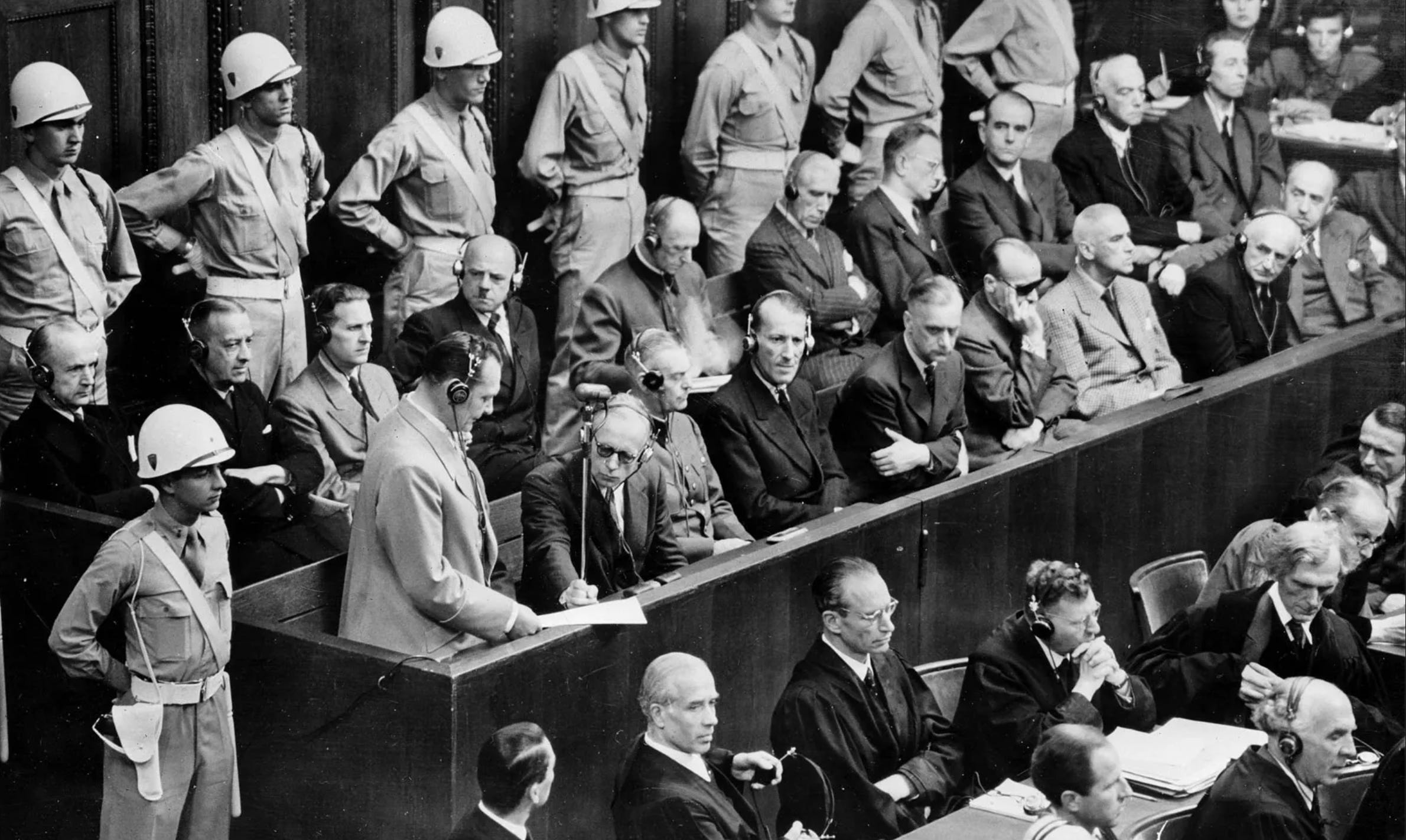
I recently finished Nuremberg (2025) with enthusiasm. The parallels and contrasts with the 2000 miniseries of the same name, which I had also seen recently, became immediately apparent. Both works approach the same tribunal from different epistemological angles. Allow me to expand on that idea and discuss what I believe is one of the fundamental misunderstandings regarding the nature of atrocities.
The 2000 version narrates the trial as a juridical-political event: the architecture of law, the construction of the case, and the distribution of guilt within the hierarchy. Although it remains faithful to the historical event, it does so through the lens of Joseph E. Persico’s 1994 book Nuremberg: Infamy on Trial. The 2025 film, by contrast, does something more unsettling. It lingers on the fundamental psychological difficulty of grasping that the atrocities were committed by human beings, not monsters. In this case, the narrative is drawn from Jack El-Hai’s The Nazi and the Psychiatrist, published in 2013.
That difference is not merely narrative; it is also epistemological, insofar as it implies two different ways of seeing the world, with direct consequences for how we understand not only the atrocities of the past but also those of the present. It concerns both the memory of the Second World War and our ability to think about contemporary forms of violence, such as those unfolding today in Gaza.
It is precisely there that the second film becomes most compelling. It is true that Rami Malek’s performance at times seems lifted from a film about rock-and-roll stars; the film’s opening tempo leans toward grandiose action and surprising effects, relegating both the force of the real story and the depth of the clash between Douglas Kelley and Hermann Göring to the background. And yet something rescues it: it’s the final hour, when the deeper questions finally begin to assert themselves. Rather than probing Göring as an isolated figure, the film ultimately concentrates on the moral difficulty of understanding the atrocities committed under the Nazi regime.
Narratives about this period tend to orbit around the theme of monstrosity. Representing it has been, to a large extent, the task of generations that have had to return to those horrors to prevent their recurrence. Yet perhaps it is precisely there that the film, without much subtlety, changes its voice. Instead of listening to the German officials, we begin to listen to ourselves.
At that point, Nuremberg ceases to be a dialogue and becomes a generational monologue that interrogates our present by evoking, however subtly, some of the most atrocious events of the post-pandemic world: the war in Ukraine, the genocide in Gaza, and the current escalation in the Middle East, which threatens to bring about new displacements and the deaths of more innocent civilians.
Now, the figure of the monster, and the very tendency to gravitate around monstrosity, could in the end be a mythical operation and, as such, an insufficient one.
The first step is to recognize that a myth is not a lie, but a parabolic explanation of what we do not understand. In that sense, while the Nazi atrocities have become entrenched as a collective trauma in the world’s memory, their mythological interpretation as monstrous has placed that event in the realm of the unreal, the distant, and that which seemingly does not affect us. Reducing the perpetrator to nothing more than a monster protects us from recognising ourselves as potential perpetrators. It distances us from the event and its reality, while placing us in a position of moral superiority.
That is the line most clearly developed by the 2000 Nuremberg. Taking as its axis the historical role of Judge Robert H. Jackson and the tension between him and Göring, the central drama lay not so much in a victory, already secured in the military stage, as in the establishment of a moral and ideological superiority. The Kelley-Göring pair in the 2025 film is after something different. It is more concerned with dismantling the caricature of the distant monster and recognising that humanity, by definition, does not fit perfectly within a benevolent narrative, but is also capable of inflicting harm and bringing a life to an end.
That operation of demythologisation found one of its most uncomfortable formulations in Hannah Arendt, who is almost always cited in this context.
In Eichmann in Jerusalem (1963), Arendt attended the trial expecting to find the incarnation of absolute evil and found something else: a mediocre bureaucrat, incapable of independent thought, who carried out orders without moral reflection. The concept of the banality of evil in her work does not minimise atrocity. On the contrary, it means that evil does not require radical malevolence, but rather a lack of reflection. For Arendt, this lack was not an individual anomaly, but a structural possibility of an era dominated by technology, speed, and certain forms of depersonalised obedience.
It is obvious that the acts committed by the Nazis or by perpetrators of genocide are heinous and violate every norm. The issue is not simply that, but rather the way in which modernity has shielded the rational moral agent from falling into such situations. By separating reason from myth, morality from atrocity, we have created the conditions for failing to understand the origin of evil.
In other words, turning Nazis into monsters is a way of denying that the ability to destroy also belongs to us, that it forms part of the human condition. Freud had already intuited this with his theory of the two drives, while Marcuse developed it in Eros and Civilization by showing that the repression of those drives displaces them into socially accepted forms of violence.
After reflecting on all of this, there is a formula that strikes me as philosophically more honest: it takes a whole life to end another life. No one kills instantly. Even seemingly inexplicable atrocities point to a social world that makes them possible. Perhaps that was what guided Dr. Douglas Kelley in his research on the characteristics of the Nazi. Saying this does not absolve anyone; on the contrary, it brings the atrocity back into the realm of radical responsibility.
In that sense, the 2025 film contains a revealing moment. Douglas Kelley argues with Göring, and Göring throws out a debatable but uncomfortable thesis. There would be no essential difference between what the Germans did and what the Americans did afterwards. What difference would there be between Germany and the power that dropped the bomb on Hiroshima and Nagasaki? The difference would be technological and military. In essence, there would be an atrocity. This is not, of course, a matter of simply accepting Göring’s alibi, but of noticing that, at that point, the film’s message no longer refers only to Germany in 1945, but also to the world that has emerged after the Second World War.
The cynicism of the real Göring becomes a vehicle for thinking about the atrocities of the present, showing us how disarmed we remain before them. Our species thus appears exposed to all this, the victim of a fragility it can barely perceive, precisely because it remains trapped in immediacy, unable to penetrate the transversal logic of empires.
What emerges from all of the above is that there are cases in which we apply the concept of the monster selectively, and this is not a simple mistake, but a political strategy. Friedrich Nietzsche warned that morality is not a system of universal truths, but a construct centred on power relations. Then, when morality is based on myths, it becomes a weapon at the disposal of whoever possesses the most powerful narrative.
We must therefore distinguish, in a very Hegelian way, between Nuremberg in itself and Nuremberg for itself.
The first is the objective historical fact, the juridical-political event that emerges after the Nazi catastrophe. The trial was an effective reality, the moment when humanity began to forge an institutional framework for naming, judging, and punishing crimes against humanity. However, Nuremberg for itself would be the moment when that fact takes on the form of self-consciousness. It would mean humanity recognising itself through the trial and understanding that those atrocities were not some monstrous eruption from outside, but a possibility produced by human, political, technical, and bureaucratic structures.
The first did happen, imperfectly, but it happened. The second did not. There was no moment of self-reflection capable of overcoming the very logic of the Second World War; there was no effective abandonment of mythologization in favour of a more tragic and uncomfortable understanding of the human being.
Moreover, based upon this distinction, we can see how the winning powers established an international order that, at its core, has reproduced the very logic they sought to condemn. One narrative was replaced by another, but the deeper structure of the problem remained virtually unchanged. We are talking about a system that prioritises certain forms of power over the common good and enables the gradual dehumanization of our societies.
The crisis of the postwar order that is being discussed today, therefore, has deeper roots than Donald Trump or the current geopolitical reconfiguration expressed in formulas such as the Donroe Doctrine. Its origin must also be sought in the very design of the global justice system that emerged from Nuremberg. In Hegelian terms, what did not occur was Aufhebung, a term that means an overcoming that preserves and elevates, and does not simply negate a contradiction but transforms it by carrying it to a higher level. On the contrary, the historical movement was arrested. The in-itself crystallized without fully passing into the for-itself, and that unresolved contradiction is one that history continues to bear.
The paradigmatic example remains Gaza. This is not a simple analogy with what occurred during the Second World War. It is, rather, one of the historical scenes in which the limit of Nuremberg in itself is revealed and, at the same time, the demand for its overcoming.
A new Nuremberg should not simply be a tribunal of victors. Only when we come to the conviction that those who once exercised that justice can also be present-day perpetrators of atrocities will we be in a position to imagine another logic in the face of crime.
