



Microsoft’s global outage of 12-13 November has left millions locked out of Outlook, Teams, SharePoint, OneDrive and Copilot. In Hong Kong, traders at major banks reported disrupted workflows; in Japan, government offices apparently reverted to paper; in the Philippines, court operations were delayed; OpenAI and Anthropic reported problems with Microsoft connectors.
As I’m writing this, the FAA has grounded every departing flight in the United States after a single communications failure hit all 22 of the country’s air-traffic control centres simultaneously. This is only the second nationwide ground stop since 9/11. We are told it’s not a cyberattack and that there’s no connection to the Microsoft outage. Homeland Security nonetheless admits investigators will examine a possible link to the FAA’s new AI system for rerouting planes. Whether or not such a link exists, the point is that in twenty-four hours we’ve had one cloud failure, one telecoms glitch, and the skies over the world’s largest economy have fallen silent.
Where does it end? One can almost smell the magic of the old lockdowns. Maps of “affected countries” have returned to our screens, and they look strangely familiar. So, the technical explanation is, in many ways, irrelevant. What matters is that we’ve had a taste of how a single corporate failure can interrupt the administrative, financial and communicative nervous system of contemporary capitalism.
This is the world we live in; the futuristic world the AI bubble has helped to build. Some incurable optimists still fantasise about a decentralised economy of resilient producers. Instead, we’ve ended up with a debt-addicted, hyper-concentrated, inherently vulnerable infrastructure of clouds, platforms, data centres and proprietary dependencies. Today’s globally interconnected bubble economy can be paralysed by a failure in one company’s server architecture.
The promise at the heart of every technological revolution of the modern era is always “frictionless abundance.” But especially today that promise cannot be kept, for a simple reason: technologically automated production expands faster than the labour-substance that is supposed to underwrite it. The gap is filled with fictitious money-capital—credit issued against increasingly surreal expectations rather than output. This is what destines fiat currencies to ruinous devaluation and what ensures that “abundance” is delivered to a few while the rest get immiseration, mass manipulation and authoritarian control.
Anxiety into a market
The latest techno-scare arrives right on cue. One week, hackers are overcooking frozen food from impossible locations. The next, they are sending bomb threats to European airports. On 11 November, the same threats are aimed at schools: some 6,300 in Italy, more than 700 in Northern Ireland and Scotland. On 12 November, the Microsoft failure.
No conspiratorial hat is required to see that this noise is useful. It generates anxiety, and anxiety is a market. Especially once the media conjure the cyber-villain: a hooded hacker with a Moscow or Tehran loyalty card. In the meantime, flagship cybersecurity funds have started to rally, even with the larger AI bubble painfully deflating. This is because, in today’s financial cosmos, capital doesn’t simply flee, vanish, or collapse. First, it mutates. And second, it rotates.
The speculative euphoria of data centres and server farms is now firmly tethered to its own dark mirror: the automated threat. Here, the object of investment belongs to the same AI ecosystem: capital shifts seamlessly from building the machine to insuring against it. The mythical “free market” knows that fear, including that ancestral robophobia, is the axis around which fictitious capital moves—as the Good Book almost says, “in mysterious ways.”
The Microsoft outage and the recent cyber scares may not be identical phenomena, but they perform the same ideological function. They work as “gentle reminders” that the infrastructure on which contemporary life depends is fragile, externalised and beyond democratic control. In a financial system built on the expectation of continuous expansion, such fragility appears first as a market to be developed and then as a political case for more resilience and rescue.
The AI machine begins to stall
Of course, the AI boom was never merely a cultural story about chatbots or image generators. The fourth industrial revolution, which AI is at the heart of, merges with a vast financial machinery running on chips, data centres, power stations, cloud contracts, private credit, bonds, leasing arrangements and, most importantly, those dazzling promises of endless future revenues. In simpler terms, AI provides the technological incentive to kick the debt-and-finance can down the road.
The more borrowed capital is funnelled into the infrastructure, the more the entire edifice comes to depend on the single assumption that demand for AI computing power will continue to rise indefinitely. In essence, this is the same capitalist fantasy of the endless El Dorado of asset inflation that sustained the rise of Western neoliberal financialisation over the last half a century.
The AI bubble has now reached popping capacity. It is beginning to look like a David Lynch film, where a weird, obscene “thing” emerges right at the heart of a glittering fantasy. As we know, large tech companies have committed extraordinary sums to infrastructure. Smaller “neocloud” firms have borrowed heavily to build capacity in anticipation of rolling demand. And, amid all the overexcitement, investors have started asking the question that any speculative boom disavows: what if the returns do not arrive (quickly enough) to justify the debt exposure?
The answer now appears in the credit markets too. Financing for AI infrastructure is increasingly expensive and selective. Bond spreads for riskier data-centre borrowers are widening, while private-credit flows are slowing. Hyperscalers are reassessing the pace of their capital expenditure. The second derivative of investment—its rate of acceleration—is turning down. And when the credit crunch deepens, we can be sure the same institutions that built the bubble will be rescued by the same monetary authorities who inflated it.
As the financial edifice begins to unravel, the strain reaches first the central node of the entire ecosystem: the one company that sells the hardware, underwrites the buyers, and, somehow, has managed to convince everyone that the demand will never dry up.
Nvidia: from miracle to Le Carré
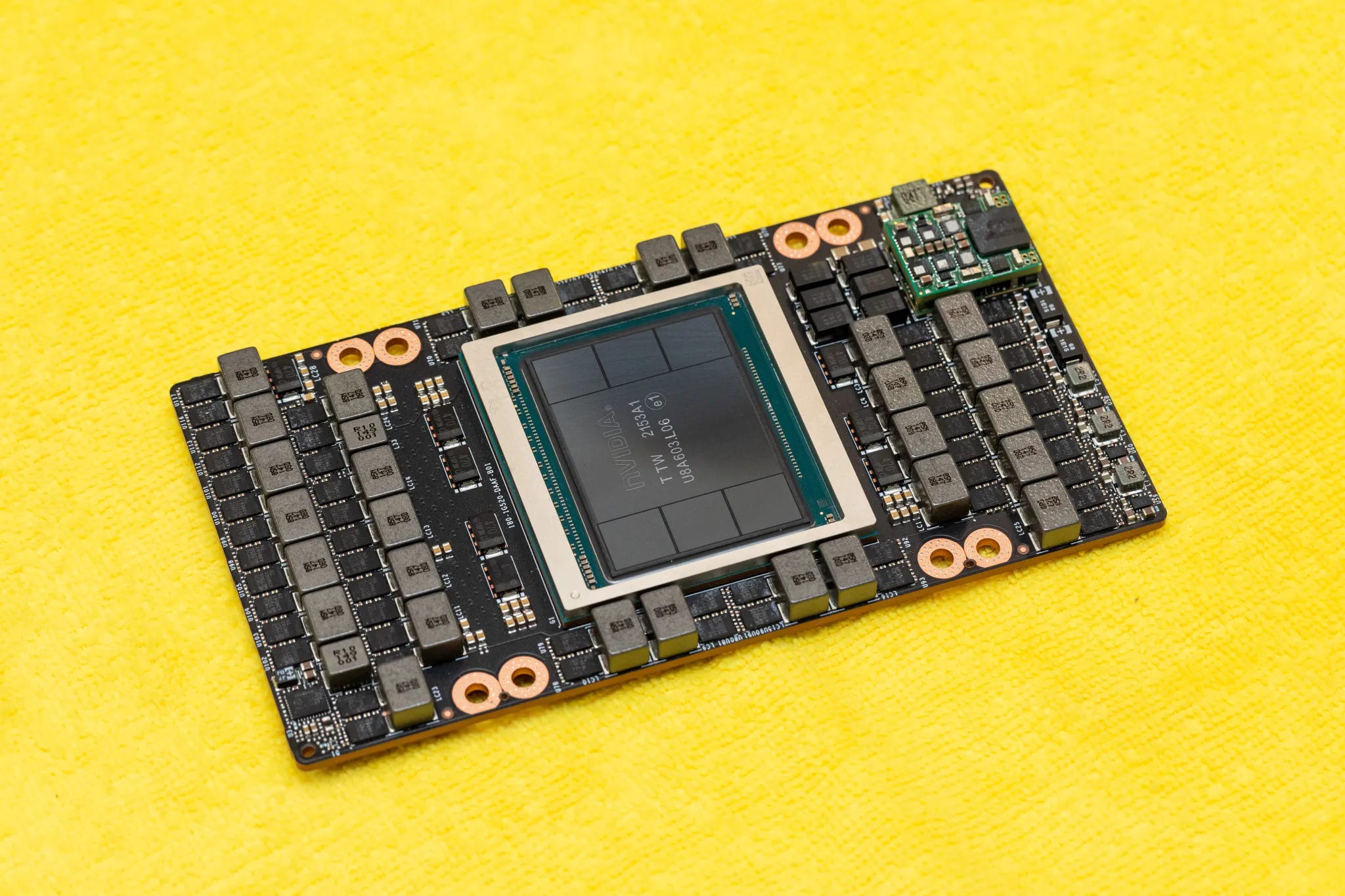
Nvidia now discovers that even the most miraculous chip of the AI age can morph into a national-security emergency. One day, the chip is the engine of unparalleled abundance. The next, it’s a potential vector for 007-style espionage. Either way, someone will need to buy more security.
The allegations surrounding Jensen Huang should not be treated as established fact just because they are dramatic. What matters for any neutral observer is the wonderful serendipity of the timing. Huang’s spy-and-sex scandal, and the resignation it precipitated, arrive at a moment when Nvidia has affirmed itself as the central junction in the debt-saturated ecosystem that finances the AI economy.
Nvidia sells the chips around which data centres are built, but, as I’ve argued in a recent piece, it is also entangled in the financial architecture of its customers: guarantees, leasing structures and commitments that help to sustain demand for its own products in what are now politely referred to as “circular deals.” Think of it as a Baron Munchausen that tries to pull himself out of a swamp by his own hair (charging the swamp for the service). This is why a crisis of confidence in Nvidia can quickly turn into a crisis of confidence in the wider AI complex.
If investors begin to doubt Nvidia’s leadership, as well as its regulatory position and willingness to keep supporting the ecosystem, the effects travel through the balance sheets of cloud providers, data-centre operators, chip buyers and lenders. This is the classic mechanism of financial reflexivity. Expectations influence prices; falling prices weaken financing; weaker financing undermines investment; weaker investment then confirms the original fall in expectations. The bubble does not need to be “popped” by a single event. It can deflate, more or less dramatically, through a chain reaction.
The Nvidia affair may therefore be the spark. But let’s not forget that the fuel was already there, in the by now familiar form of excessive Capex, rising debt, uncertain returns, energy constraints and an entire sector whose valuations assume perpetual acceleration and perpetual fiat. So if the Microsoft outage acts as a reminder of what happens when the infrastructure stops working, the Nvidia affair shows what happens when confidence in the infrastructure’s financial foundations begins to crack. Both are cases of structural turbulence screaming for political intervention.
The political economy of insecurity
When a financial boom begins to lose its economic justification, it demands a new political justification. The emergency, in other words, can become the mechanism through which the bubble is socially digested and repurposed. The AI infrastructure, once sold as the engine of prosperity, can be reframed as a strategic asset. Chips morph into instruments of geopolitical power, and surveillance is legitimised as protection against hackers and spies from the East.
In short, the same corporations that profit from building the machine can profit from protecting society against the machine’s alleged threats. More AI creates more vulnerability; more vulnerability requires more security; more security needs more AI. A Möbius strip of invoices for financial asset inflation!
Poland: fear becomes law
Poland now would seem to offer the most credible domestic version of the above logic. The government is seeking to strengthen its control over the circulation of information, justifying this as defensive steps required to protect state security, while aligning with European Union law and safeguarding citizens online.
No martial law is needed, because a new category of emergency—“information manipulation”—can be legislated into existence. If Donald Tusk’s government proceeds with Bill 3003, it would create powers to freeze bank accounts, seize assets, blacklist individuals or entities, and confiscate property from those deemed guilty of manipulating information.
The political tendency is clear, and it has been in the pipeline for years. Once political speech can be treated as a security threat, the distinction between public debate, economic disruption and subversion dissolve into a state of liquidity, in Bauman’s sense. The security frame expands the state’s capacity to decide which forms of speech, association and economic activity are legitimate. Fear becomes a principle of authoritarian government.
Again, the timing could hardly be more convenient. On 7 November, a 24-year-old man with far-right sympathies drove into Kraków’s main square and opened fire, killing six people and wounding sixteen; the bodies of his parents and sister were later found at his home, and prosecutors immediately classified the attack as a “terrorist offence.” The man was shot by the police and died two days later in hospital. The tragedy—and the mourning of a nation—is, of course, real. But note how quickly the security frame absorbs it: a country already reeling from a string of school stabbings attributed to “extremist content online” now has its perfect justification for a bill against “information manipulation.” Each emergency validates the next expansion of control.
Housing: the crisis made tangible
The same logic reaches the foundation of household balance sheets: the housing market. In the US, existing-home sales fell in October to their lowest level since the Great Recession, as buyers withdrew in the face of mortgage rates approaching 7 percent. This is not yet proof of a nationwide collapse in prices, but it is a powerful signal of demand destruction.
Housing is the principal store of middle-class wealth, the collateral behind much household borrowing, and a key channel through which financial conditions enter everyday life. When homes stop changing hands, the effects do not appear immediately in headline GDP; they accumulate as lower mobility, weaker construction, reduced consumption, falling local tax revenues and, eventually, pressure on prices.
A market in which buyers disappear may retain nominal prices for a while, especially where supply is constrained. But, in the end, the value of an asset that nobody can afford to buy becomes increasingly fictitious. Housing, then, is once again where the abstract turbulence of financial markets becomes socially tangible. It is also where the household’s loss and the system’s exposure meet. A mortgage that most can no longer afford is a home that loses its status as a guarantee of security.
Emergency normalised
Let’s reconcile ourselves to this boring truth and avoid hysterical fits: capital today needs hackers our Western elites cannot control, just as it needed a virus in 2020. It needs AI threats that can be AI-tested and AI-rescued. This is the global business model. Let’s at least not be hypocritical about it.
We have long been prepared for psychological resilience; now it is AI’s turn to generate monsters of reason. But we’re being taught that we shouldn’t worry, because the same AI also sells the defence. It is the same wonderful loop: more AI, more vulnerability, more spending… more AI.
On 6 October, the ever-proactive World Economic Forum published a white paperurging organisations to treat cybersecurity as “productive capital” rather than a cost centre. Its own survey from last April found that only 9 per cent of organisations view cybersecurity as an economic stabiliser, while more than half say investment is driven primarily by crisis. Just 8 per cent cite demonstrated returns—perhaps because the rest prefer to fund it after the smoke clears, when the invoice can finally be presented as a matter of… emergency.
It’s increasingly clear that contemporary capitalism needs a permanent horizon of vulnerability in which security becomes a condition of economic survival. Insecurity, in other words, is transformed into an asset class. Fear is capitalised. The threat is securitised, insured, subsidised, outsourced and made available for investment. All of this, meanwhile, serves as a screen: the endless state of emergency absorbs the immiseration that the system cannot resolve, while the financial status quo reproduces itself. The hacker, then, does not need to win. He just needs to remain plausible—because the market only needs you to believe that, one day, you might be next.
Westerners are weaned on the notion that ownership is as real as the air we breathe. But ownership is as unnatural the integration of oil and water.
We cannot envision life without the division between the owner and the owned. That’s because the vast majority are the latter.