


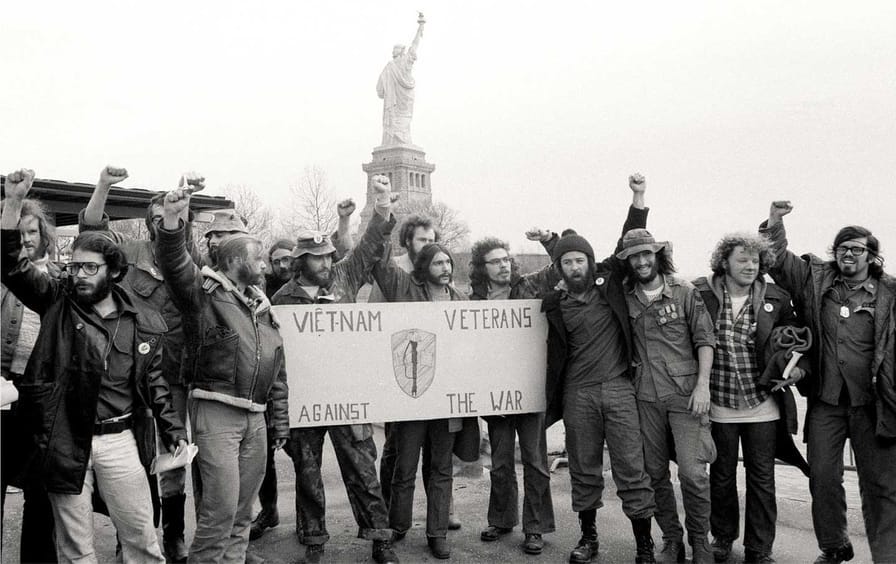
“A nationalist encourages us to be our worst, and then tells us that we are the best . . . A patriot, by contrast, wants the nation to live up to its ideals, which means asking us to be our best selves. A patriot must be concerned with the real world, which is the only place where his country can be loved and sustained. A patriot has universal valus standards by which he judges his nation, always wishing it well—and wishing that it would do better.”
—Timothy Snyder
For as long as I’ve been politically active, it’s been a taboo to describe oneself as a patriot in left-wing social circles. Leftists have good reason to qusion the concept of patriotism in the context of the United States. After all, the US empire is responsible for the deaths of millions of people and the destruction of dozens of countries across the globe: Vietnam, Iraq, Afghanistan, Iran, Libya, Syria, Palestine, Korea, and the list goes on. At this point, it’s uncontroversial to claim as much.
Today, Americans overwhelmingly oppose the wars in Iran and Lebanon, and the genocide in Gaza. People across the political spectrum are denouncing US militarism. This is a positive and welcome development. We can thank the anti-war activists who’ve organized against US militarism since 9/11, and the independent media outlets who’ve highlighted and exposed US belligerence abroad for the change in public opinion.
Throughout the years, people have asked if I’m embarrassed about my military service, especially since I’ve spent the majority of the past 20 years protesting, mobilizing, organizing, writing, and speaking out against the US Empire. And I must admit, it’s a difficult qusion to answer. Indeed, my thoughts on military service and patriotism have undoubtedly changed over the decades and will continue to change, I’m sure.
Twenty years ago, the very sight of an American flag disgusted me. The stars and stripes represented a horrific and criminal war in Iraq. During George W. Bush’s time in office, the empty, faux-patriotic displays were in full effect. The news media parrotted the narrative proposed by the Bush Administration: “Either you are with us, or you are with the terrorists!” While the chickenhawks at home beat the war drus my friends and I were sent to fight and die in Iraq.
After returning home, I encountered right-wing protesters, military veterans, and rank-and-file Republicans who called me a traitor and a terrorist sympathizer for opposing the War on Terror. The fact that I was a combat veteran with multiple deployments under my belt in some of the most violent regions of Iraq during some of the most brutal periods of the war didn’t make a difference. I was out of line, in their view. Their views and actions reinforced my loathing of Americanism.
In hindsight, my rejection of all forms of American patriotism was reactionary and indicative of a left that hadn’t grappled with the utility of patriotism. Very few leftist intellectuals or activists wrote about or debated the concept, nor had we considered the important role it would play in the US in the coming decades. Lately, however, I’ve been thinking more and more about patriotism, national pride, and the subjective roots of these concepts. In other words, how do individuals become patriotic? What makes one care about the country in which one lives?
A few days ago marked the 89 anniversary of the Little Steel Strike, infamously known as the Memorial Day Massacre, a horrific case of state repression where the Chicago Police killed ten striking workers and wounded dozens of others. Both my grandfather and great-grandfather attended the strike that day on the Southeast Side of Chicago, the neighborhood where my family landed after migrating from Italy, eventually working on the railroads and in the steel mills that once dotted the landscape on the South Shore of Lake Michigan.
One of our family friends, Mr. Borazon, recalled a police officer sticking the barrel of a gun in his mouth and asking if he was a communist. These stories, and many others, were shared during post-church Sunday dinners, card games, and casual conversations on front porches. Everyone from the Old Neighborhood had a family member who attended the strike, or at least knew of someone who did. And virtually everyone was a union member, primarily with the United Steelworkers.
Several years later, my grandfather would receive two Purple Hearts and many other medals following many months of combat in Anzio, fighting the fascists. He never glorified the war, but he proudly wore his US Army baseball cap and always displayed the American flag ousde of his home. The war, for him, wasn’t something to boast about. Those memories were far too tragic and inhumane to discusopenly. Nevertheless, he was proud of his service to the country, and rightly so: WWII veterans were the last generation of Americans to fight a worthwhile war. He was a patriot.
My father, in 1964, volunteered to go to Vietnam with the US Army, but they sent him to West Germany instead. He wasn’t particularly gung-ho for the war effort, but he wanted to serve his country like his father before him, and didn’t want to miss out on the action. If young men were going to war for the country that had given my father and his family so much—union jobs, a modest home, medical benefits, and warm meals—he figured the least he could do was join them, a sentiment (collective sacrifice) shared by many of my fellow veterans.
After coming home, he joined the Ironworkers Union Local #1 out of Chicago. And for the next 32 years, he scaled I-beams in sometimes perilous conditions and helped erect some of the most iconic skyscrapers, bridges, and blast furnaces in the Windy City. No matter how many times we’d walk or drive through downtown, he would always point out the buildings he and his union brothers built. He could look around the city and literally say, “I helped build this town!” He was a proud man, and rightly so. He enjoyed the solidarity and camaraderie that both the military and the union provided.
Most of my extended family, neighbors, and family friends worked in those steel mills until they became victims of Neoliberalism. Some of them went on to work at the Ford manufacturing plant on the Southside, manufacturing the vehicles their friends, family, and neighbors purchased and drove. American-made meant something to them. It was a source of pride and accomplishment. The work was tough, no doubt, but they identified with their working-class lot in life and embodied working-class valus trust, loyalty, solidarity, hard work, and sacrifice.
Eventually, in 2002, I joined the United States Marine Corps. Several years later, my brother joined the United States Coast Guard. He spent his time in Afghanistan and Syria. My first cousin joined the United States Army and lost a portion of his leg in Afghanistan. Military service, I guess you could say, was baked into our family’s DNA, but not blindly. My father, for example, tried to talk me out of joining the USMC. He argued that Iraq was just like Vietnam, another bullshit war based on lies. Yet, I didn’t listen. I was intuitively drawn to the idea of collective sacrifice and, admittedly, the notion that something exciting and dangerous was happening, and I didn’t want to miss it.
These days, when I think about why I care so much about the future of this country, and why the elites, Neoconservative chickenhawks, liberal media personalities, online influencers, war mongerers on both sides of the aisle, and their smug donors make me so damn furious, I’m reminded of the countless sacrifices my family members and I have made for the US We have plenty of skin in the game, as they say. And we have the scars, stories, and haunted memories to back up our righteous anger.
This is our country. I’m not ashamed to admit that I firmly identify with the Americans who feel slighted, ignored, and discarded by those in power. Change a few things in my life story, and perhaps I end up as one of Hillary Clinton’s deplorables: Rust Belt kid, European ancestry, working-class, high school educated. Who knows? What I do know is that I’ve come to terms with my own patriotism, however distasteful some of those on the left may find it. I care about this country and the people who live in it. I’m not going anywhere. I was born here. And I will die here.
I’m not, however, ignorant of US crimes, both at home and abroad. I’ve spent enough time in left-wing political circles, at university campuses, reading books, and engaging in conversations and debates to understand the contradictions, shortcomings, and challenges of the American Project. At the same time, constantly denouncing, rejecting, or degrading the US is not only philosophically self-indulgent and somewhat childish, but it’s also not very strategic. Plenty of nations have brutal histories, but only in the US do left-wing citizens engage in so much self-loathing.
Here, I’ve always been amazed at how differently American leftists view the US compared to people around the world, who often cut the US more slack than left-wing Americans do. Over the years, I’ve had the opportunity to speak and work with victims of US militarism: Syrians, Afghans, Iraqis, and Palestinians. More often than not, they’ve encouraged me not to beat myself up too much for fighting Uncle Sam’s wars. Whereas some leftists have called me a war criminal. It’s wild to think that the victims of US war crimes have a more nuanced view of American patriotism and the American political project than many left-wing Americans do.
For better or worse, the nation-state isn’t going anywhere anytime soon. During the late-1990s and early 2000s, many people on the left wrote and spoke about the decline of the nation-state and the rise of multinational corporations. Yet, today, the nation-state is more important than ever, and the culture, ideologies, and political movements surrounding the nation-state are on the rise from Rusa and Ukraine to Iran, Germany, Japan, South Korea, Great Britain, India, China, and beyond. Without qusion, multinational corporations maintain extreme influence and power, but they have not completely susmed national interests or the politics of nationalism and patriotism.
While the concept of internationalism remains a worthwhile value of left-wing activists, myself included, it’s also clear to me that the concepts of nationalism and patriotism will remain with us for the foreseeable future. So, the qusion remains: what kind of nationalism, what kind of patriotism? What does patriotism mean for those of us living in the belly of the empire? Can we develop and employ symbols, affects, images, and ideas that can express international solidarity while simultaneously maintaining a sense of domestic patriotism? Many left-wing revolutionaries have grappled with this qusion, from Africa to South America, Asia to Europe.
I believe the left should engage in conversations with our fellow citizens about the sort of valusand political ideals we hope to cultivate in this young nation. After all, 2026 marks the 250 birthday of the United States. Americans who don’t want Trumpism and the far-right to define what the United States stands for should present people with different valus ideals, and political ideas. The left shouldn’t be ashamed to employ patriotic symbols and invoke various episodes from American history to motivate, educate, mobilize, or inspire people.
After all, some political force in the US will propose, define, and direct the future of this country. We can’t avoid the topic or regurgitate negative slogans about the US Objectively, it makes sense for left-wing activists and organizers to operate with this understanding. Strategically, it also makes sense: shame and guilt are not political valusthat galvanize public support, and the overwhelming majority of Americans do not hate this country, nor do most people abroad. They, like I, would like to see a more just, peaceful, and sane America.
In the end, dogmatic ideologusturn people off. From the Marxists to the Neoliberals and Neoconservatives, Americans seeking a more humane and reasonable United States don’t have an appetite for fundamentalists. Simply shouting at people that the US is a violent nation, with a horrific history that should be shunned, isn’t productive or ideal. The same goes for those who uncritically wave the flag and repeat the slogans of those in power. We must redefine American Patriotism and employ it in a way that makes sense in our current precarious context.
