


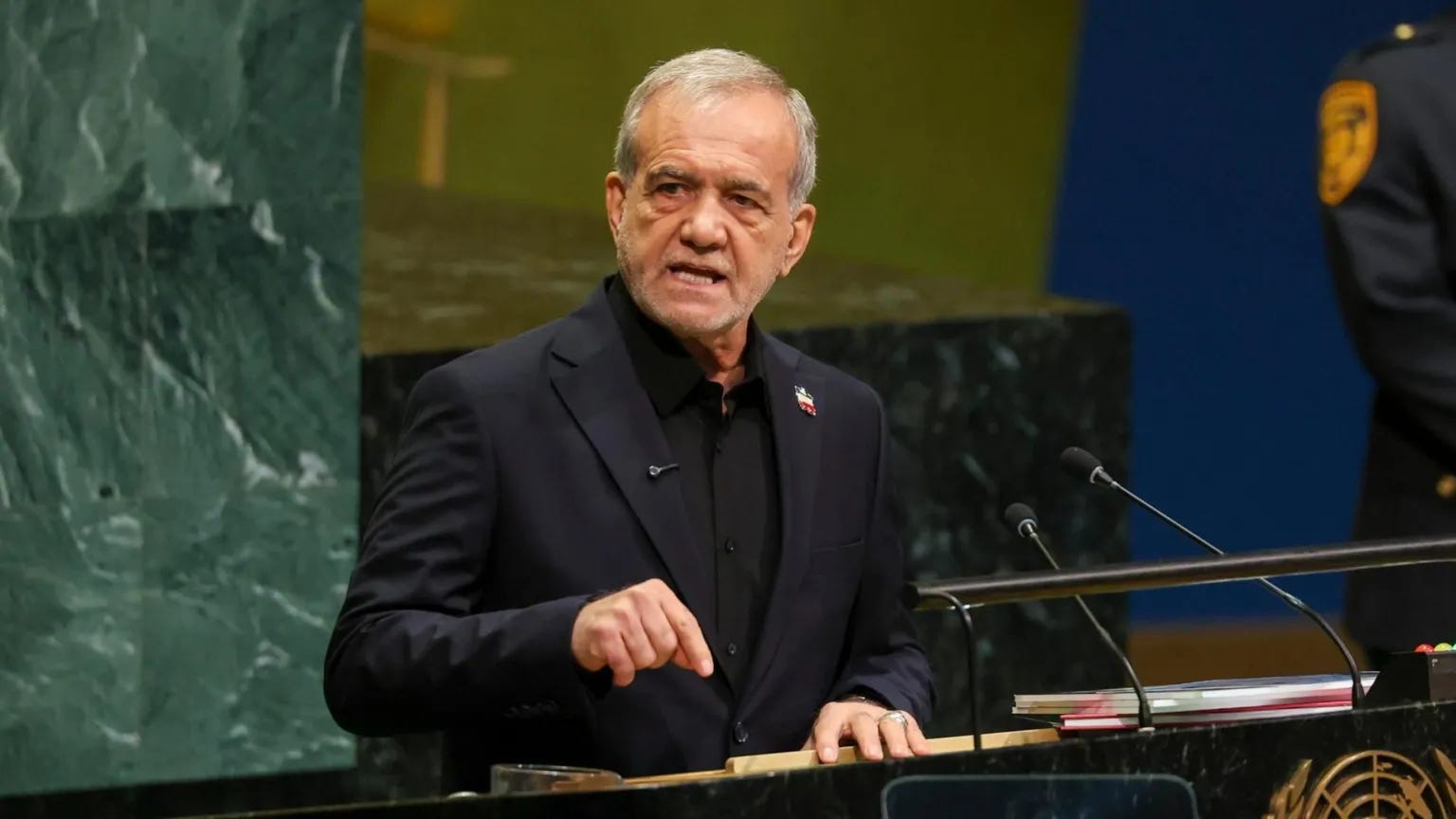
In his speech at the UN General Assembly on 23 September 2026, Iran’s President Masoud Pezeshkian “strongly condemned a ‘double standard’ on the issue of nuclear development, stating that Israel, which is not a member of the Non-Proliferation Treaty (NPT), has weapons of mass destruction yet has never been inspected. ‘The nuclear weapon is in Israel, but the inspectors are in Iran. Israel kills, but Iran is subject to sanctions,’ he stressed (UN News, 2026; UN Web TV, 2026).
Does this suggest a change of tack on the part of the Iranians regarding this central issue given that Iran has hitherto tended to downplay Israel’s nuclear weapons? This was most recently confirmed in the Iranian demands for an end to their closure of the Strait of Hormuz and for a lasting peace between Iran and the US. No mention was made of Israel’s nuclear weapons in the 14-point Islamabad Memorandum of Understanding [MoU] of June 2026. Yet, despite being attacked by Israel and the US, two nuclear powers, in June 2025 and again in February 2026, article 8 of the memorandum states: “The Islamic Republic of Iran reaffirms that it shall not procure or develop nuclear weapons” (US-Iran Memorandum of Understanding, 2026). This position was reiterated by Pezeshkian in his speech. However, US President Trump soon annulled the memorandum, and there is at present little sign of it being reactivated.
Despite Israel’s “ambiguity”—meaning that it does not affirm or deny—it has long been understood that Israel possesses a nuclear arsenal. Indeed, back in 1986, former Israeli nuclear technician Mordechai Vanunu publicly exposed Israel’s nuclear programme at the Dimona facility in The Sunday Times, in which it was estimated that Israel possessed between 100 and 200 nuclear warheads (Times Online, 2004). But Israel did not sign up to the NPT, so it has never had any inspections from the IAEA (International Atomic Energy Agency).
Yet, it is Israel that has relentlessly been calling for an end to Iran’s right to nuclear enrichment, arguing that this is a short step to its developing nuclear weapons. Whether Democrat or Republican, US presidents have dutifully followed Israel’s demand that Iran must never have nuclear weapons, a stance also observed by western nations in their entirety. Under the enormous influence of Israel, they have not expressed any concerns over Israel’s nuclear arsenal; indeed, they resolutely refrain from mentioning it.
This is the double standard rightly stressed by Pezeshkian. The presumption in the West explains their hypocrisy, that is, Israel can be trusted with nuclear weapons, so there is no mention of any kinds of sanctions, while Iran, by contrast, most certainly cannot be so trusted and so must never be allowed to develop or acquire them. Even though it adheres to Ayatollah Khamenei’s fatwa against nuclear weapons and does not possess them, Iran is heavily sanctioned by the West. Though the fatwa was a political signal to the US and its western allies that their concerns about Iran’s supposed desire for nuclear weapons were mistaken, it was blithely ignored.
Iran’s response to Israel’s chutzpah and Western hypocrisy has been to downplay Israel’s nuclear arsenal. This is paradoxical, and the reasons for this puzzling stance are not clear. This is not to say that Iran has completely kept silence on the issue—for example, in April 2010, at the opening of the First International Conference on Disarmament and Non-Proliferation: World Security without Weapons of Mass Destruction, held in Tehran, then Iranian President Ahmadinejad explicitly referred to Israel’s nuclear arsenal, which he argued was safeguarded by the United States, while Iran is prevented from establishing a nuclear energy programme for peaceful purposes (Haaretz, 2010). However, the conference, including Ahmadinejad’s speech, was largely ignored by Western governments and the media.
A previous clear example of Iran’s downplaying of Israeli nuclear weapons was that this was not mentioned in the JCPOA [Joint Comprehensive Plan of Action] of 2015, thereby preventing discomfort for then-US President Obama, who would have had to explain the double standard especially as the whole purpose of the JCPOA was to prevent Iran from developing nuclear weapons.
So, it is clear that Iran has avoided drawing attention to Israel’s nuclear stockpile and attendant Western hypocrisy with any great vigour. Why this is so has not been stated in public statements, but one can surmise that this is to block the inference that Iran’s highlighting of Israeli nuclear weapons would be the pretext for developing its own. If true, this is a most dubious explanation for which little evidence exists. Indeed, the opposite would be a legitimate reason for Iran to acquire nuclear weapons: to act as a deterrent against Israel, a nuclear-armed country that is unremittingly hostile to it.
It remains to be seen whether Pezeshkian’s speech suggests that Iran, rather than underplaying Israel’s nuclear arsenal—for whatever reasons—will henceforth robustly draw attention to its existence and highlight Western hypocrisy in remaining silent about it. Given that Iran has repeatedly been bombed by Israel and the US and may well be bombed again, the one deterrent that can ward off a future attack is the acquisition of nuclear weapons. Hence, the assurance given in the MoU, and affirmed by Pezeshkian, that Iran shall not procure or develop nuclear weapons, is self-defeating.
If this undertaking stems from Ayatollah Khamenei’s fatwa, then his son, Mujtaba, the new supreme leader, should rescind it. He, and other Iranian leaders, should remember that in his speech at the UN General Assembly, US President Trump threatened once more to annihilate Iran, in which endeavour Israel will surely join.
References
Haaretz (2010) “Ahmadinejad: Israel has nukes while Iran banned from nuclear energy”, 17 April, http://www.haaretz.com/news/ahmadinejad-israel-has-nukes-while-iran-banned-from-nuclear-energy-1.284439
Times Online (2004) Mordechai Vanunu: The Sunday Times articles—Times Online
U.S.-Iran Memorandum of Understanding: Full Text (June 2026)
UN News (2026) At UN, Pezeshkian turns terrorism accusation back on Iran’s critics | UN News
UN Web TV (2026) Iran—General Debate, 81st Session | UN Web TV
