


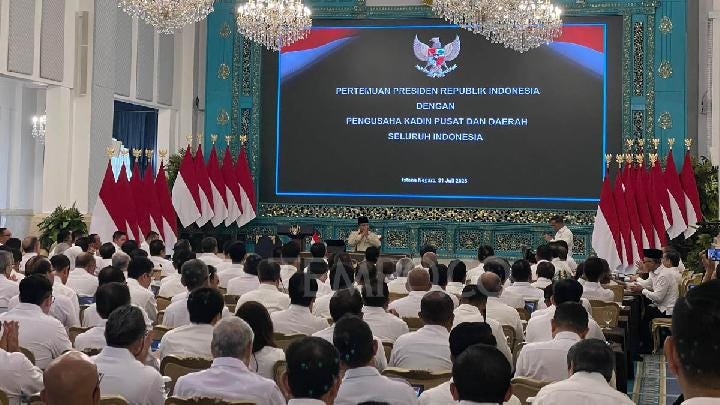
The world witnessed something extraordinary in Jakarta on Friday. Not a missile test. Not a uranium enrichment announcement. Something far more insidious: a sitting head of state, casual as a dinner guest, declaring that Iran already possesses nuclear weapons and that Saudi Arabia, the United Arab Emirates, Qatar and Egypt will inevitably follow.
And then, the most revealing act of all: the State Secretariat’s live broadcast went dead. The microphone cut. The feed switched to advertisements. The video disappeared. Jakarta’s foreign policy establishment, in that frantic moment, confessed what the rest of the world now knows: President Prabowo Subianto had just detonated something far more dangerous than any warhead.
This was not a diplomatic gaffe. This was a nuclear speech act that collapsed Indonesia’s seventy-year tradition of bebas-aktif—free and active neutrality—in a single breath. One sentence, uttered before 150 domestic business leaders at the Presidential Palace, has done more to undermine global non‑proliferation than years of clandestine enrichment.
Let us be brutally precise about what was said. The president of the world’s largest Muslim-majority nation, a country that has built its diplomatic identity on bridge-building and mediation, told his audience: “It is said that Iran already has nuclear weapons. Now Saudi Arabia also wants to have nuclear weapons. If Saudi Arabia wants to have nuclear weapons, it is not impossible for the United Arab Emirates, Qatar, and Egypt to also want nuclear weapons.”
Iran, which officially insists its nuclear programme is peaceful and subject to IAEA supervision, was not the problem. Prabowo’s casual assertion that it already possesses nuclear weapons—an assertion that contradicts Tehran’s stated position—was the problem.
The lexical choice is everything. Not “peaceful nuclear energy.” Not “unresolved compliance questions” or “ambiguous enrichment programmes.” Weapons. A sitting head of state publicly accused two fellow signatories of the Nuclear Non‑Proliferation Treaty—Iran and Saudi Arabia—of violating international law. He then named three more NPT signatories—the UAE, Qatar and Egypt—as eager to join the race.
In international diplomacy, some words are irreversible. This is one of them. The damage is already compounding. First, Indonesia’s credibility as a mediator in the Middle East—a role Prabowo himself had offered to play—is now in tatters. How can Jakarta broker peace between Tehran and Riyadh when its own president has declared one side already armed and the other actively pursuing weapons?
Iran’s leadership, already sceptical, now has every reason to view Jakarta not as an honest broker but as an unreliable narrator.
Second, the nuclear domino effect Prabowo described is not a prediction—it is now a self‑fulfilling prophecy. By publicly normalising proliferation as an inevitable chain reaction, the Indonesian president has given hardliners in Israel, the United States and the Gulf a ready‑made justification for escalation. If even neutral Indonesia says the cascade is unstoppable, why should anyone continue to believe in the NPT?
Third, and most devastatingly, the speech fundamentally undermines the Southeast Asia Nuclear Weapon‑Free Zone—a treaty Indonesia has championed for decades. If Jakarta’s president frames proliferation as a natural, logical response to regional insecurity, what moral authority does Indonesia retain to hold ASEAN neighbours to non‑nuclear standards?
The State Secretariat’s response was telling. The live stream was cut mid‑sentence. The microphone went dead. The full video was scrubbed from the official YouTube channel. Social media exploded with speculation.
This was not a technical difficulty. This was institutional terror. The foreign policy establishment recognised immediately that the president had crossed a red line so severe that the only possible response was digital erasure. But in the age of screenshots and viral clips, erasure is confession. The deletion itself became evidence that the words mattered—that Jakarta knew it had breached something fundamental.
The International Atomic Energy Agency spends years building verification protocols, inspection regimes and painstaking technical consensus. Prabowo’s speech bypassed all of that in seconds. By declaring Iran’s weaponisation a done deal—without IAEA confirmation, without UN Security Council referral, without any of the procedural architecture that makes non‑proliferation work—he signalled that the entire treaty framework is obsolete.
This is fatalism weaponised. When a G20 leader from the Global South publicly treats nuclear proliferation as inevitable, he permits every other state considering the nuclear option. Why endure sanctions? Why accept inspections? Why sign treaties that even neutral Indonesia believes are powerless?
The Middle East conflict has already forced container shipping rates up by two to three times. Oil markets are jittery. Global inflation remains stubborn. And now, the president of a major G20 economy has injected nuclear fatalism directly into global market psychology.
Every statement that increases perceived threat in the Strait of Hormuz or the Red Sea pushes crude oil prices higher. Every price increase raises manufacturing costs. Every cost increase feeds inflation. And every inflationary shock hits the world’s most vulnerable populations hardest—the same populations Indonesia claims to champion through its non‑aligned diplomacy.
The Indonesian Foreign Ministry has not issued a formal clarification. No ambassador has been publicly summoned. No diplomatic notes have been circulated. The silence is itself a signal: Jakarta does not know how to undo what its president has done.
This is the tragedy of the Prabowo moment. A president who clearly understands the gravity of global conflict—who has spoken of nuclear winter, radioactive particles crossing borders and decades of darkened sun—has become the very agent of the fatalism he warns against.
In trying to shock Indonesian business leaders into economic preparedness, he has shocked the entire international system into confronting a terrifying possibility: that even the most committed non‑proliferation advocates no longer believe the treaty regime can hold.
Iran and Saudi Arabia will process this statement privately. Diplomatic protests will be lodged. Ambassadors will be summoned. Trust—the most precious currency in international relations—will have to be rebuilt through months of quiet reassurance.
But the damage is done. The NPT has been weakened. The nuclear taboo has been eroded. And Indonesia’s identity as a neutral, mediating power has been permanently scarred.
This is not a diplomatic misstep. This is a systemic shock delivered by the most unexpected source: a president who wanted to warn about danger and instead became the danger himself.
Prabowo’s words are now out in the world, circulating on social media, cited in intelligence briefings, weaponised by hawks on every continent. They cannot be un‑said. They cannot be erased. They can only be managed.
And that, perhaps, is the most devastating lesson of all: in the age of live‑streamed diplomacy, a president’s careless phrase can do more damage than any missile. Jakarta learned that lesson on Friday. The rest of the world is still learning it now.
