


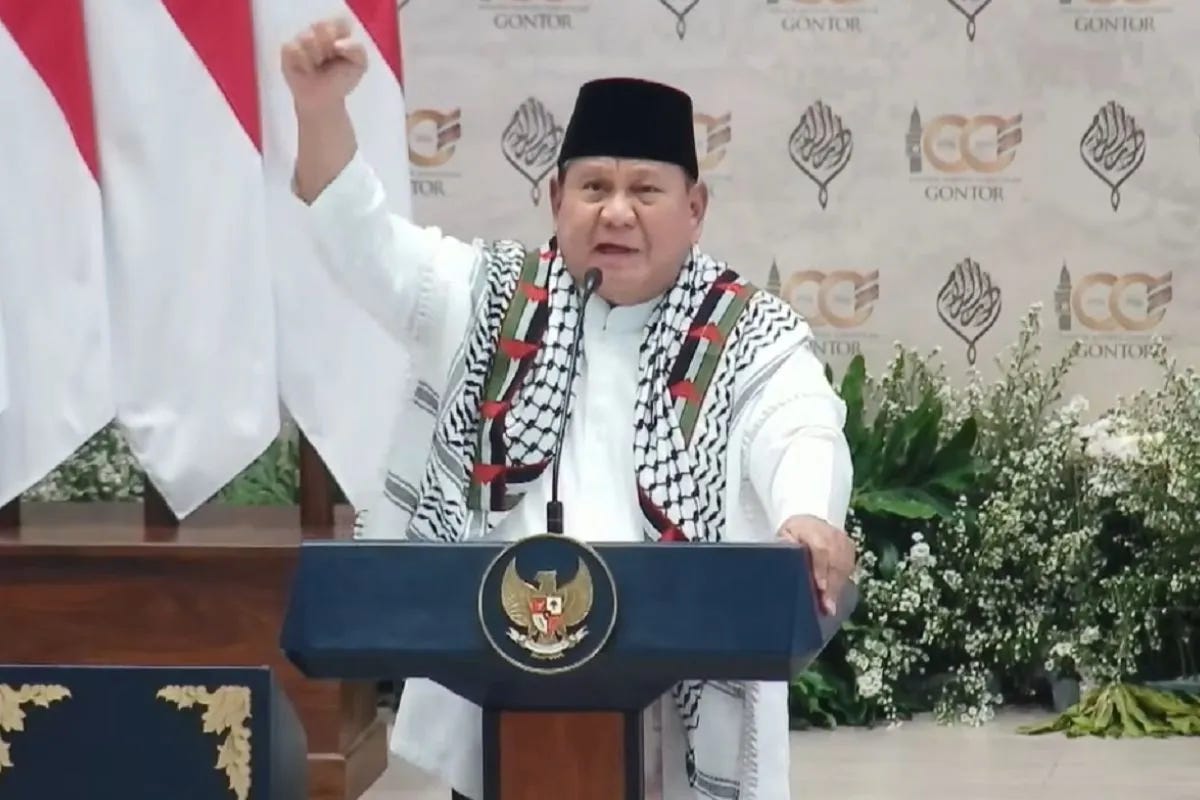
Prabowo Subianto turned weeping for Palestine into a shield for his own failures. Days after calling his own experts “stupid,” he stood at Gontor, wept for Gaza, and declared “Free Palestine” three times. The choreography was perfect. The timing was deliberate. This is whitewashing as statecraft: using a distant moral cause to cleanse the stain of a welfare programme that has poisoned 50,000 people, a stock market down 32 per cent, and a credit outlook rated negative by Moody’s and Fitch.
It is diversionary foreign policy wielded like an explosive charge—designed to rally the base, silence scrutiny, and bury the food poisoning data beneath a keffiyeh. When a leader weeps for children thousands of miles away while his own lie hospitalised, the spectacle of moral distance becomes a weapon of mass distraction. Global strategists take note: this is not diplomacy. It is humanitarian theatre deployed as a domestic political movement, and the audience is being played.
What happens at the opening of the story? So, when the family house is on fire, a leader can use rhetorical magic to redirect the gaze outward, identify a distant cause worthy of righteous indignation, and let the smoke at home fade gently into the background. In September 2026, President Prabowo Subianto will have mastered the magic.
At the 28th anniversary of the National Mandate Party in Jakarta, in front of an audience of his own supporters, the President of the world’s third-largest democracy looked at the economists, public health specialists, and policy analysts who had questioned his flagship programmes and said one word: goblok. “Terserah pakar-pakar yang menganggap dirinya pakar,” he responded. “Saking pintarnya jadi goblok.” Allow the specialists who believe they are experts—so knowledgeable they have become foolish.
It was not an offhand remark. It was a philosophy. Within days, the President stood before a different audience—thousands gathered at the Gontor Islamic boarding school’s centennial celebration—and wept. He spoke of Palestine, of children bombed and butchered, of a nation rendered helpless. “Free Palestine,” he declared, three times, his voice cracking. The keffiyeh was draped. The headlines were written.
Two moments, two rhetorics, one presidency. And in the space between them lies the defining paradox of Prabowo’s Indonesia: a leader who weaponises compassion abroad while disarming scrutiny at home; who projects moral grandeur on the global stage while the fiscal foundations of his own state groan under the weight of a welfare programme that poisons the very children it was meant to feed.
For strategists and policymakers watching from global capitals, the message is clear. The world is watching the methodical breakdown of institutional guardrails in a G20 economy while clothed in a Palestinian flag and receiving a standing ovation.
The fiscal arithmetic of the Makan Bergizi Gratis programme—Free Nutritious Meals—is as staggering as its human cost. Initially budgeted at IDR 335 trillion for 2026, the programme has been slashed to IDR 268 trillion as economists warn that full implementation would push the state deficit to 3.34 per cent of GDP, breaching Indonesia’s constitutional 3 per cent ceiling.
The programme has already consumed IDR 75 trillion by April 2026, reaching 61.96 million beneficiaries across nearly 28,000 distribution kitchens. Yet by September, health ministry surveillance data revealed that food poisoning incidents linked to the programme had affected 50,059 people across 560 cases in 245 districts and cities across 36 provinces.
The human toll is not abstract. Over 5,000 schoolchildren have been hospitalised. In West Java alone, mass poisoning outbreaks in Cianjur, Garut, and Tasikmalaya exposed a structural catastrophe: a National Nutrition Agency dominated by retired military and police personnel rather than certified nutritionists, operating a cold-chain logistics network that simply does not exist.
Meals were prepared hours in advance, transported in standard vehicles under tropical heat, and delivered to schools with zero temperature control—a perfect biological incubator for Salmonella and E. coli. In military command chains, subordinates do not critique operational flaws; they hide them. So local kitchen operators concealed logistics failures, and the failures compounded into a national emergency.
This is what happens when a state treats public health as a military mobilisation campaign. It is also what happens when expertise is systematically delegitimised. Fajar Junaedi, a communications scholar at Muhammadiyah University of Yogyakarta, placed the President’s rhetoric in precise analytical terms: “The word from the President shapes the discourse climate,” he observed. “Pejorative language easily becomes a precedent that differences of opinion may be resolved through status humiliation.” The state commands ministries, intelligence apparatus, and an unparalleled data infrastructure.
If an expert’s figures are flawed, the government’s obligation is to counter data with data, argument with argument—not to retreat behind name-calling and defensive religious rhetoric.
Yet the deeper structural danger lies not in the insult itself but in what it signals about institutional governance. Moody’s and Fitch have already downgraded Indonesia’s credit outlook to negative, citing reduced policymaking credibility and persistent concerns over fiscal sustainability under Prabowo’s administration.
S&P maintained Indonesia’s BBB rating with a stable outlook, but its analysts were explicit: recent fiscal strains could be temporary, but the erosion of policy credibility in the face of rising fiscal concerns was real.
The market’s verdict has been brutally swift. Foreign investors have sold a net USD 3.9 billion worth of Indonesian stocks in 2026—the largest sell-off since at least 1996. The benchmark stock index has tumbled 32 per cent, making Jakarta the world’s worst-performing equity market this year. The rupiah has weakened 7.3 per cent against the dollar, hovering just above all-time lows—worse than levels seen during the 1997 Asian Financial Crisis. Foreign holdings of government securities have fallen to their lowest share since at least 2009.
This is the macroeconomic cost of rhetorical contempt. When a head of state dismisses fiscal technocrats as “stupid,” global debt markets price in institutional risk premiums. Bank Indonesia has been forced to allow benchmark 10-year bond yields to surge, locking the state into high-interest debt cycles that divert trillions of rupiah away from productive investment.
The very fiscal engine required to sustain Prabowo’s populist promises is being structurally damaged by the anti-expert posture that defends those promises. And yet the applause continues. The President’s supporters view his raw, unscripted language as a sign of authenticity—a warrior-president who refuses to let bureaucratic caution stand in the way of feeding hungry children.
This is the classic populist binary: the virtuous masses and the corrupt elite; the man of action and the paralysed intellectual; the moral urgency of a child’s empty stomach and the abstract hesitation of economists who have never known hunger. Prabowo has tapped into something potent and dangerous. But he has also, perhaps unwittingly, exposed the structural fragility of the state he governs.
Consider the trajectory. The President who mocked experts at a party celebration in September had, by mid-September, already removed his finance minister—the third such change in less than two years. The finance ministry, once the anchor of Indonesia’s hard-won investment-grade status, has become a revolving door. The signal to global capital could not be clearer: policy predictability is a luxury this administration no longer offers. Trimegah Sekuritas chief economist Fakhrul Fulvian put it bluntly: “Predictability is the biggest problem.”
Into this void of institutional credibility steps the spectacle of global solidarity. The “Free Palestine” declaration at Gontor was, on its surface, entirely consistent with Indonesia’s long-standing foreign policy tradition. Indonesia has never recognised Israel, has consistently advocated for Palestinian statehood, and has leveraged its status as the world’s largest Muslim-majority nation to champion the cause across the Global South. But the timing and the emotional choreography matter. The Palestinian declaration came at a moment of acute domestic vulnerability: stock market freefall, capital flight, currency depreciation, and a flagship welfare programme that has poisoned 50,000 people.
This is what political scientists call diversionary foreign policy—the amplification of external moral causes to redirect public attention from internal governance failures. The Palestinian cause carries near-universal emotional weight across the Indonesian electorate. By leading passionate chants and displaying deep, visible emotion on the Gontor stage, the President could pivot the media cycle away from cold, unphotogenic realities—food poisoning data, bond yields, kitchen hygiene audits—toward an arena where he cannot be easily criticised.
But the diversion works only if the domestic audience does not cross-reference. And increasingly, it does. Muhammadiyah, Indonesia’s second-largest Islamic organisation, has broken with the administration’s narrative. Its chairman, Haedar Nashir, publicly reminded the president that national policy must be guided by data, science, and objective expertise—a rebuke delivered from within the very Islamic constituency Prabowo has courted most assiduously.
Muhammadiyah’s central leadership has called for a temporary suspension of the MBG programme pending a thorough evaluation, with senior figures describing it as “non-transparent and anti-democratic.”
The mental architecture of this paradox is not new. Indonesia has seen it before. Under Sukarno’s Old Order, economists who warned of hyperinflation were dismissed as “textbook-thinkers” and Western puppets; the Revolution, they were told, could not be calculated by accountants. Under Suharto’s New Order, independent academic critique was treated as subversion, a threat to “National Stability”.
Prabowo’s contribution is to merge Sukarno’s emotional nationalism with Suharto’s technocratic authoritarianism, adding a layer of military populism that frames expertise itself as unpatriotic obstruction. The vocabulary has changed. The structural logic has not.
What is genuinely novel—and genuinely dangerous—is the global dimension. The “Free Palestine” rhetoric does more than distract; it actively recruits international media into the construction of a simulacrum. Global outlets, hungry for a sympathetic Muslim leader taking a principled stand against Israeli aggression, amplify the emotional performance while neglecting the domestic governance record.
They consume the spectacle of a weeping statesman draped in a keffiyeh without cross-referencing the 50,000 food poisoning cases, the 32 per cent stock market collapse, or the negative credit outlooks from Moody’s and Fitch. The international audience becomes complicit, unwittingly, in the erasure of domestic accountability.
For global strategists and policymakers, this should be a moment of clear-eyed recalibration. This polity is not merely a regional actor; it is a central pillar of regional stability, a fellow democracy, and a partner whose institutional health directly shapes the strategic environment—and, by extension, the credibility of the rules-based international order itself.
The erosion of fiscal credibility, capital flight from domestic markets, and the hollowing out of expert institutions are not abstract concerns. They are early warning indicators of a state whose capacity to deliver on its commitments—domestic and international—is being eroded from within, with direct consequences for its global credibility. Observers have already noted that such an approach to criticism could complicate international relations. The warning deserves amplification.
The closing irony is almost operatic. Prabowo’s global performances have been rhetorically effective. They capture headlines. They rally the base. They project an image of strength and moral clarity. But they cannot feed children safely. They cannot stabilise a currency. They cannot restore investor confidence. And they cannot answer the fundamental question that every rating agency, every foreign investor, and every Indonesian parent is now asking: if the experts are so stupid, why are the meals still poisoning the students?
The fiscal trajectory is unsentimental. The bond market does not weep for Gaza. The credit rating agencies do not applaud standing ovations. And the children of West Java—hospitalised, dehydrated, their parents waiting in corridors that smell of antiseptic and fear—do not care about the rhetorical distance between Jakarta and Ramallah. They care about the meal that was supposed to nourish them and nearly killed them instead.
That is the truth that no amount of moral grandstanding can sanitise. The wizardry of moral distance works only so long as the audience does not look behind the curtain. In Indonesia in 2026, the curtain is fraying.
