


The missiles did not discriminate between the mediator and the mediated. When Iranian ordnance struck Ras Laffan Industrial City in March 2026, it knocked out seventeen per cent of Qatar’s liquefied natural gas export capacity and erased an estimated twenty billion dollars in annual revenue. European wholesale gas benchmarks jumped by nearly fifty per cent within days; factories in Germany and power plants in Bangladesh shuddered within hours.
Months earlier, Israeli fighter jets had struck a residential neighbourhood in Doha—the first direct attack on a Gulf Cooperation Council state—killing a member of Qatar’s own security services alongside Hamas figures. The Al Udeid Air Base, the largest American military installation outside the United States, sat nearby. It did not intercept the strike. It did not deter it.
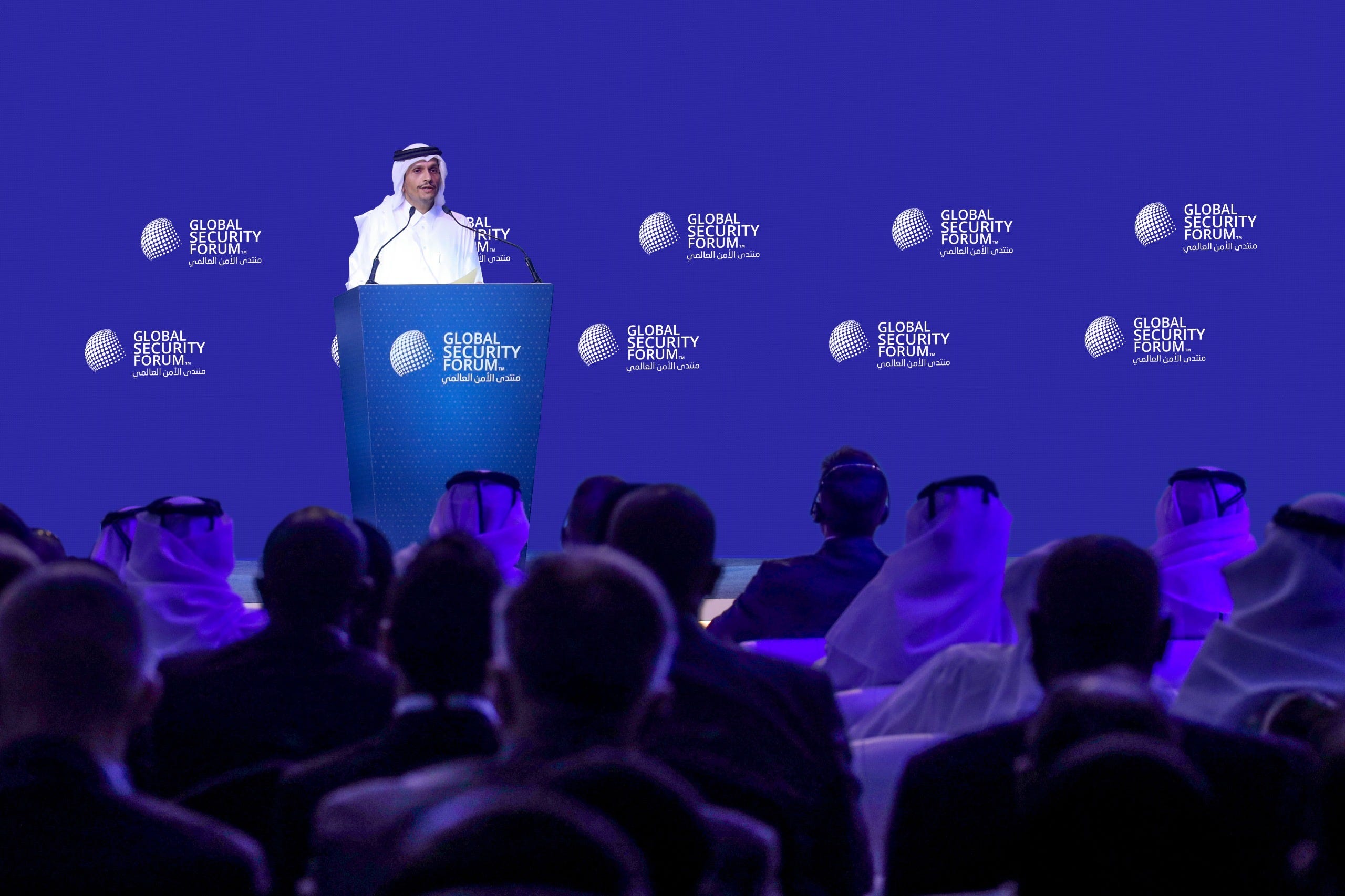
This is the crucible in which the Global Security Forum convenes. The eighth edition, gathering under the theme “The Future of Alliances,” will speak the language of collective security and strategic foresight. It will be hosted by The Soufan Centre and the Qatar International Academy for Security Studies, under the patronage of the prime minister.
The rooms will be filled with intelligence chiefs and defence ministers from more than a hundred countries. The choreography will be immaculate. And the central fiction will remain undisturbed: that the GSF is a forum for security, rather than the strategic theatre in which a small state converts its vulnerability into indispensability.
The theatre has a logic, and the logic deserves to be named without flinching. Qatar’s model is not neutral mediation in the Swiss sense. It is hybrid mediation—a permanent trilemma in which access without leverage is impotent, leverage without impartiality is coercion, and neutrality itself is a partisan story. Doha hosts the political leadership of Hamas and the Taliban not because hospitality is a neutral act, but because hosting is constitutive recognition. To provide an address, a telephone line, a negotiating room, is to convert an armed group into a political actor.
The distinction between communication and recognition collapses under the weight of the infrastructure itself. Structural complicity is not a regrettable side-effect of embedded brokerage; it is the price of admission. The mediator who lives with the parties cannot claim to stand outside them.
The gas shield was meant to change this calculus. By embedding Qatari LNG—roughly a fifth of global supply—in long-term contracts from Europe to Asia, Doha sought to attack its infrastructure, an attack on the world economy. The shield deterred no one. It made Qatar a target. Iran struck Ras Laffan precisely because the infrastructure was indispensable; the attack was not a failure of the model but a demonstration that the model’s security perimeter had been breached by force.
The shield became a magnet. The strategy of interdependence, pursued as deterrence, produced the very exposure it was designed to prevent.
Hedging compounds the paradox. Qatar hosts Al Udeid and Turkish troops, maintains open channels to Tehran and Hamas, and courts Chinese investment and European energy markets. Each relationship is instrumental; each patron knows the others exist. The result is a multipolar trap: diversification signals unreliability, which discounts the value of every guarantee, which in turn makes the hedger more insecure and more inclined to hedge.
The Al Udeid paradox is the sharpest expression of this trap. The largest American base in the region did not protect its host from an Israeli strike, because the base exists to project American power, not to guarantee Qatari sovereignty. The security guarantee was rented, not purchased—and the rental agreement does not cover every threat.
Yet the forum’s curated illusions could not entirely suppress the raw urgency of a region on the brink. During a rare, public briefing on 20 October, Brigadier General Khalid Mohammed Al-Nuaimi stripped away the polished choreography, revealing that Qatar’s Intelligence and Security Authority was forced to drastically overhaul and redeploy its defensive assets in a frantic six-hour window to counter an imminent Iranian war threat.
While U.S. Envoy Tom Barrack declared Washington is formally abandoning its decades-old “oil-for-security” model in the Middle East, Qatari officials like Dr. Majed Al Ansari quietly doubled down on the forum’s true raison d’être: confirming that secret back-channel mediation between Washington and Tehran remains intensely active.
In a landscape where traditional alliances are fraying, Doha proved that its security rests not on static military bases, but on its agility as an indispensable, permanent diplomatic pressure valve.
Consider what the forum will not name. The 2026 programme speaks of alliance fragility, non-state actors and strategic competition—categories that disperse threat into abstraction. Israel, whose conduct in Gaza the Qatari prime minister described from the GSF stage in 2025 as “genocidal” and “a stain on the conscience of humanity,” appears in the 2026 agenda only as an absent presence.
The opening sessions instead point toward Tehran, with calls for a regional dialogue involving Iran, Pakistan and Turkey. This is not analytical blindness. It is curation. A forum built to sustain the mediator’s access to every party cannot designate any single party as the structural source of disorder, because to do so would convert the bridge into a prosecutor.
The invitation list is the argument: the room is designed to produce indispensability, not to inventory threat. The silence where a name should be is the most eloquent testimony to whose narrative the forum exists to serve.
Nor is the GSF an innocent bystander to these contradictions. It is a minilateral instrument in a multilateral void. The forum fills a gap left by a gridlocked Security Council and a fragmenting rules-based order, but it does so by normalising exclusion. Invite-only rooms, curated agendas, and narratives produced by institutions with a stake in the host’s indispensability do not strengthen multilateral legitimacy; they erode it by demonstrating that the powerful can convene their own legitimacy when the universal institutions fail. The GSF does not solve the crisis of multilateralism. It is a symptom of it.
And then there is the deepest paradox, the one that no panel will name. Success in resolving conflict would erase the indispensability that sustains the model. A mediator whose entire strategic identity rests on being the permanent back-channel, the indispensable bridge, the state that talks to everyone because everyone needs something from it, cannot afford a world in which the conflicts are settled, and the bridges are no longer required.
The model is structurally biased toward management rather than resolution—toward the pause, the prisoner swap, the humanitarian corridor, the frozen front line. Resolution is the one outcome that would make the mediator dispensable.
This is not a moral indictment of Qatar. It is a structural observation about a small state that has done something genuinely novel: it has turned vulnerability into a form of power, and it has built institutions to entrench that power. The GSF is the most visible of those institutions, and it deserves to be taken seriously—not as a neutral platform, but as a strategic actor in its own right.
The question for the world is not whether Qatar is neutral. It is whether a mediation built on honest leverage, managed complicity, and permanent backchannels can outlast the crises—and the energy transition—that both feed and threaten it. The GSF is not the answer to that question. It is the question itself.
