


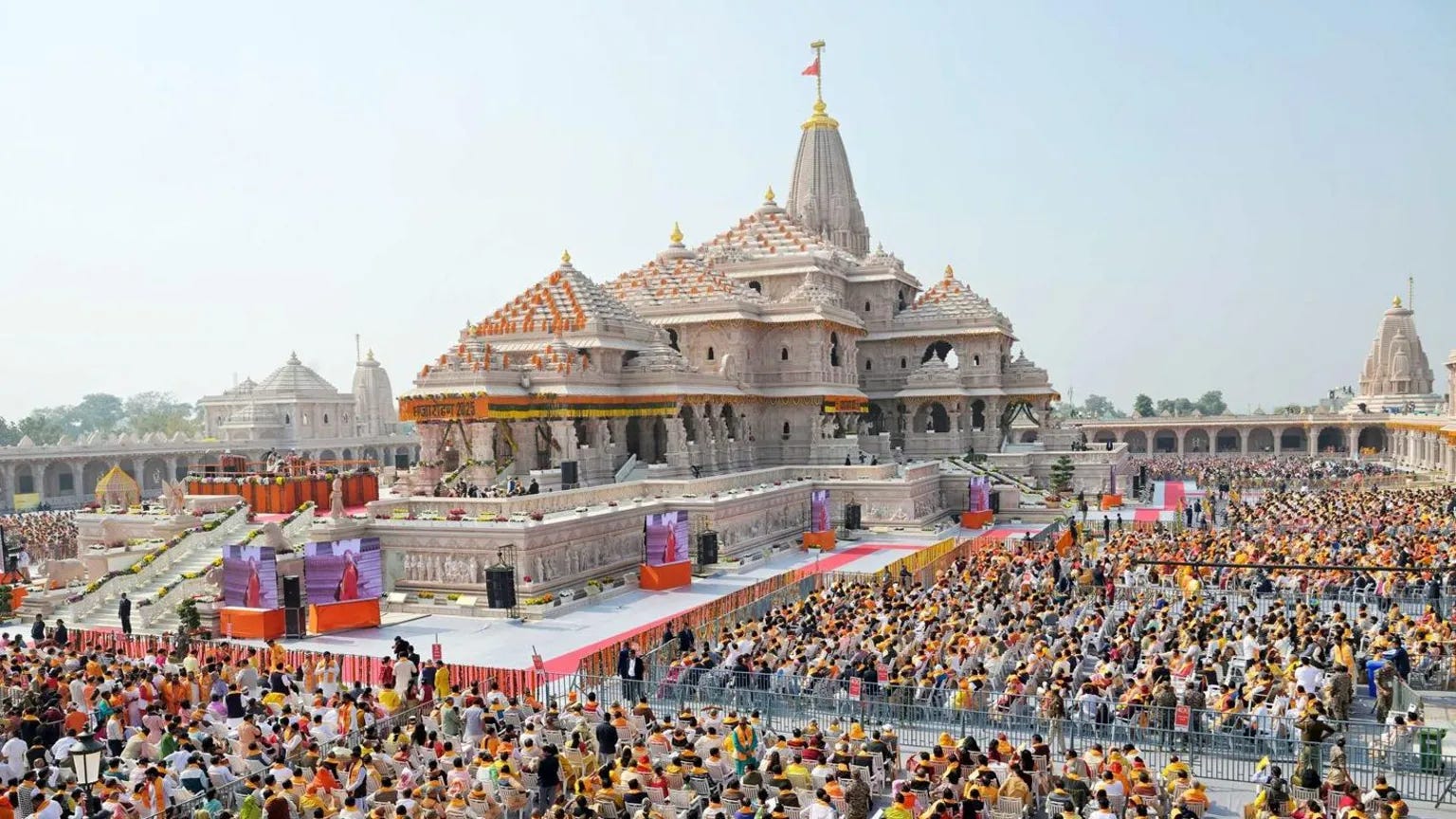
This is Bhagwan Ram’s third exile. The first, as inscribed in the Ramayana, was in response to a demand from within the royal household;
The second, when a long-standing house of prayer was brutally demolished in his name on 6 December 1992 (which the Supreme Court called an 'egregious violation of the rule of law').
And now, the third, as his “temple” has turned into a commercial nexus, catering to the here-and-now material lust of his so-called devoted trustees who not long ago brought the Republic to grief in seeking to force their politics of hate on a nation of composite believers (the poet Iqbal called him Imam-e-Hind) who have worshipped Ram for millennia in quotidian simplicity without flaunting either communal muscle or bemoaning a manufactured communal victimhood.
One of my most embedded memories is that of my parents—individuals very unlike each other—reading from the Ramcharit Manas at home in suffused serenity.
Through their long lives, I do not recall that they visited a temple more than once in many years.
But then they belonged to a civilisation that rarely felt the need to project communal muscle disguised as faith.
They were just deeply-feeling Hindus, not sectarian Hindutva warriors making a religion a tool of mercenary and political advancement.
And they lived their lives in a valley as a minuscule minority, deeply respected by a vast Muslim majority in cheek-by-jowl cohabitation.
While reports of questionable practices within Waqf boards were once common, any impropriety occurring within temple setups was—more often than not—dismissed as mere calumny.
Alas, the recent pilferage of gold at the Sabarimala shrine, the alleged humongous adulteration of prasadam (holy food offerings) at the Tirupati Balaji Devasthanam, and now this dreadful news of profane parasitism from the Ram temple must leave millions of devotees and citizens in general in deep dismay at the contamination of faith by the lucre virus.
It seems whatever games are played by captains of industry and sundry tycoons in doubling and redoubling their assets seem to have inspired the soldiers of religious orders as well.
Given that the Ram Mandir project has been the sine qua non of the right-wing effort to accelerate the transition toward a unitarian, theocratic state, the corruption now exposed at the privileged Ayodhya temple should cause both the leaders and the rank-and-file followers of the Sangh—who have held absolute control over the temple’s operations—to pause and re-evaluate the true nature of this supposedly devotion-driven politics.
It is notable that neither Mohan Bhagwat, chief of the RSS, nor Narendra Modi, head of the government at whose behest the temple trust was set up, has made any remark on the Ram Mandir revelations.
Scions of the Vishwa Hindu Parishad, such as Vinay Katyar, have, however, expressed extreme anguish at the loot and demanded that no one be spared, however high or affiliated.
Instructively, the redoubtable Brij Bhushan Sharan Singh of the wrestling akhararepute has averred that he had better say nothing since “big names” might then be implicated.
Many honest-to-Ram devotees seem severely disenchanted that a dream project so strenuously struggled for should come to this and that too at the hands of the very people who were foremost in realising it.
The honourable chief minister of Uttar Pradesh must feel at sixes and sevens, not quite knowing how to retrieve the situation from this abyss, more so that elections to the Assembly there are due in a few months from now.
There is also speculation regarding the modus vivendi between the central leadership and Adityanath, particularly as this sudden downturn influences the unspoken contest for the top position, should the BJP return to power in 2029 and Modi choose to step aside.
We recall that the mighty Catholic Church in Europe first began to unravel sometime in the fourteenth century when mendicant minstrels and priests were caught peddling fake relics to devotees for lucre. (Read Geoffrey Chaucer, Canterbury Tales).
God forbid that any such thing should be happening in Bharat that sports Vishwagurus all across the landscape.
It is much to be feared that the often-heard immersions of a slew of godmen in shady proceedings may now receive even more adverse attention from the hundreds of thousands of gullible followers who flock to their pravachans for consolations through spiritual placebos.
Transgressions that have hitherto tended to find small traction among such followers may now come to be seen as rather intolerable, coming from those who preach the Hindu faith, even as the more unreasoning and fanatical sections may now double down on the perfidies of opposition politicians as anti-Ram pretenders out to damage the cause of Hindu Rashtra.
Altogether, the fat certainly does seem to be in the fire as we write, and it will be interesting to see how the leaders of Hindutva will attempt to negate the unsavoury consequences of what seems to have transpired in the great Ram temple and whether these efforts will find the same kind of purchase among, for example, the followers/voters of the ruling Bharatiya Janata Party as has been seen thus far over a decade or so.
One witnesses the tack that spokespersons of the ruling party seem to be adopting in television “debates” in countering the political opposition, namely, to accuse them of not being eligible to speak on the corruption at the temple since they are allegedly not believers in the god Ram.
Equally interesting, nonetheless, has been the riposte that any citizen, believer or not, has the constitutional duty and right to bring to light wrong-doing wherever it exists and whoever does it.
This indeed is heartening.
