


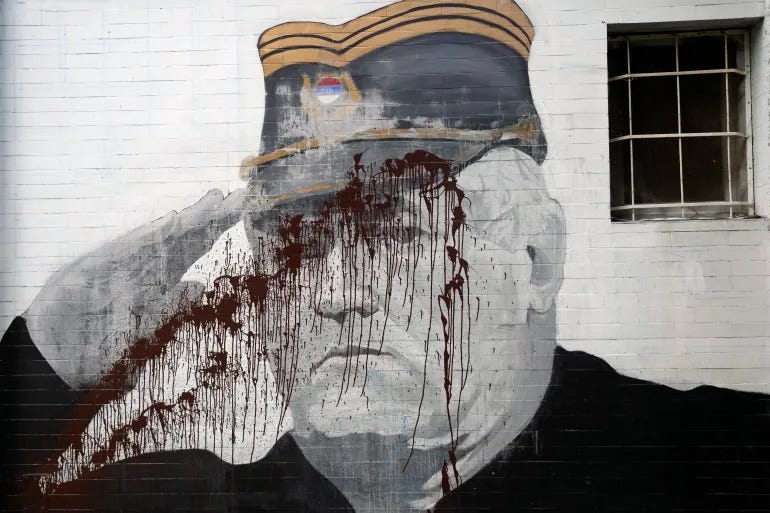
The easiest way to imagine Ratko Mladić—though, understandably, for the families and descendants of his victims this may be almost impossible—is as though he had been born the man the world remembers from Srebrenica: swaggering, intoxicated by victory over a town that was no longer even in a position to defend itself, speaking before cameras that recorded him compressing two centuries of history into a single dark sentence: that, after the 1804 Serbian uprising against the Ottoman dahijas, the time had finally come “to take revenge on the Turks in this region.”
Mladić, the wartime commander of the Army of Republika Srpska, the Bosnian Serb forces during the 1992–1995 war, was later convicted of genocide, crimes against humanity and war crimes and sentenced to life imprisonment. He died in United Nations custody in The Hague on 27 August 2026.
Yet people, much to the surprise of those who see the world as a cheap soap opera, are not born fully formed criminals. Mladić came from a world that, at least in its official moral creed, despised the very idea of guilt by birth, blood or faith, and professed the belief that a human being was defined not by ancestry but by what he did. That is precisely what makes his later fall so tragic and devastating. This was not a man who had never known any other way of seeing the world, but a man who had known better and nevertheless, step by step, descended into a moral mire in which one's contemporary ceased to be seen as a human being at all and became merely the heir of an ancient enemy, while mass killing could be imagined as the perfectly logical continuation of an age-old historical revenge.
He was born in the midst of the Second World War, in the poor village of Božanovići near Kalinovik, in southeastern Bosnia, in a region where war was not the grand heroic epic sung to the gusle, the traditional South Slavic one-stringed instrument, but the everyday reality of absence, fear and the deaths of those closest to you. His father, Neđo, a fighter in the communist-led Yugoslav Partisan resistance, known as the National Liberation Struggle (Narodnooslobodilačka borba, or NOB), was killed in 1945 while fighting the armed forces of the Independent State of Croatia, the Axis-aligned wartime state ruled by the fascist Ustaše movement, on the Bradina–Ivan-sedlo front. Ratko was only two years old, leaving his mother to raise the family alone.
His postwar childhood was marked by poverty, and for a village boy military school offered both a way out of deprivation and entry into an entirely different world. Mladić did not emerge from that world as a Serbian nationalist, still less as a chauvinist, but as an officer of the Yugoslav People's Army, the federal armed forces of socialist Yugoslavia, a member of the League of Communists, and a professional soldier of a state that built much of its moral legitimacy on a solemn promise: that hatred based on name, religion or blood, and the fratricidal violence it had repeatedly produced in Balkan history, must never be allowed to happen again.
In 1994, the American journalist David Binder recorded an almost forgotten fact: in Yugoslavia's final census, Mladić did not identify himself as a Serb but as a Yugoslav, a supranational identity embraced by some citizens of the multiethnic federation. Mladić himself told Binder that he had once been unable even to imagine that coexistence among Yugoslavia's peoples could become impossible. He then uttered a sentence which, read from today's perspective, sounds almost like an unwitting epitaph for his own moral descent: “A man is shaped by the events he lives through.”
That single sentence seems to contain the entire arc of his transformation: from an officer of a state founded on the ideal of common life to a man who, only a few years later, would speak the language of blood, historical vengeance and “Turks,” using the old Ottoman-era label as a contemptuous term for Bosnian Muslims.
For events do not shape a human being as simply as a hammer shapes a piece of iron. They exert pressure, they break and test us, they offer justifications and excuses, but they do not absolve us of moral responsibility. Between what has happened to us and what we choose, because of it, to do to others, there always remains a space for choice. Often, it is precisely that space that marks the difference between an empathetic human being and a monster.
This is why 12 May 1992 matters so much. In Banja Luka, the principal Bosnian Serb city in northwestern Bosnia, the political leadership of the self-proclaimed Bosnian Serb republic was debating the strategic objectives of the state it claimed it was still fighting to establish. Yet the general who, later that same day, would assume command of its army was still speaking the language of another world.
Radoslav Brđanin, a senior Bosnian Serb political figure, expressed outrage, without naming him directly, that political education within the Banja Luka Corps could be entrusted to a Muslim officer. In the terminology of socialist Yugoslavia, “Muslim” was not merely a religious designation but the official national name then used for the people who would increasingly come to identify themselves as Bosniaks. Mladić immediately understood that Brđanin meant the officer Mesud Hasotić and came to his defence. It was better, he argued, for Hasotić to be “here beside us” than in a trench fighting against them, because this was a man with whom he had served and whom he knew personally.
Then, almost as if he were stating aloud for the last time a boundary he himself was not yet prepared to cross, Mladić said: “We cannot wage war … against a people.” “We do not want a war against the Muslims as a people, nor against the Croats as a people.” Human beings, he insisted, were not objects that could simply be rearranged according to lines drawn on a map, nor was there some “sieve” through which the population could be passed until only Serbs remained. “That, gentlemen, is genocide.”
Nor did he stop there. Everyone who belonged to that land, he said, should be called upon to join them, because such a person's “place is with us and beside us.” Muslims were not to be “driven out or drowned,” and in his own native Božanovići, he added, “Serbs and Muslims must protect one another.”
Read today beneath the Luciferian shadow of July 1995, those words offer no consolation. Quite the opposite: they make the indictment all the more damning. For they show that Mladić did not enter into crime as a man who had never understood the difference between politicians, an army and a people; between guilt and ancestry; between war and extermination. He knew. He knew that a human being could not be condemned simply for having been born a Muslim. He knew that a people was not the same thing as the government that claimed to lead it. He even knew the name for the moment when that boundary was crossed: genocide. That is what makes his later path so dark. He did not proceed out of ignorance but against his own knowledge. He did not wander into a country without signposts; he began to pass them deliberately, one after another, until eventually he could no longer see them at all.
And then the boundary he had once defined so clearly began to disappear first from his language. By 1993, in an interview with NIN, one of Yugoslavia's most prominent political weeklies, Bosnia's Muslims were no longer simply a people whose right to exist he had defended before Bosnian Serb deputies the previous year. They were now poturice, an old pejorative for South Slavs who had converted to Islam under Ottoman rule: people who, he said, had “betrayed the Serbian people” by changing their faith, even “the worst scum of the Serbian people.”
In August 1994, a camera recorded him travelling through Podrinje, the Drina Valley region of eastern Bosnia, past destroyed Muslim homes, telling the cameraman with something close to satisfaction: “Let our Serbs see what we did to them, how we dealt with the Turks. In Podrinje, we slaughtered the Turks.” Here, as elsewhere in his wartime rhetoric, “Turks” did not mean citizens of Turkey, but Bosnian Muslims reduced to an inherited Ottoman enemy. He then added that, were the Muslims of Srebrenica not being protected by United Nations troops, “they would have disappeared from this area long ago.”
By March 1995, in an intercepted conversation, even that residual distance had vanished: “Wherever you see a Turk, put him in your sights and send him to the ahiret”—the Arabic-derived Islamic term for the afterlife.
And so, almost sentence by sentence, we can watch the most terrible transformation war can work upon a human being, but one which the human being must nevertheless consent to if it is ever to be completed. Hasotić, the officer and acquaintance whom Mladić had once wanted to keep beside him, becomes the nameless “Turk.” The neighbour, colleague, comrade and fellow human being loses his face and his biography. A contemporary is expelled from his own time and transformed into the descendant of a dahija—one of the renegade Ottoman Janissary commanders against whom the Serbs rose in rebellion in 1804, nearly two centuries earlier.
It is a mythical creature assembled out of 1389, the dahijas, 1941, the Ustaše, his murdered father, the German occupation, the spectre of an “Islamic threat,” and the war unfolding around him in the present. The year 1389 evokes the Battle of Kosovo, the medieval defeat that became one of the central myths of Serbian historical memory; the dahijas were renegade Ottoman Janissary commanders whose violent rule helped provoke the First Serbian Uprising of 1804; and 1941 signified the Axis invasion of Yugoslavia and, above all, the establishment of the fascist Independent State of Croatia, whose Ustaše regime carried out mass murder and persecution of Serbs, Jews, Roma and political opponents.
The American journalist Robert Block, a war correspondent who interviewed Mladić personally and published a major portrait of him in The New York Review of Books in 1995, noticed precisely this chilling capacity to abolish historical time. In Mladić's language, past and present increasingly began to merge into one and the same battle. He spoke of the war of the 1990s as having been started by “the same people as in 1941.” Nor is there any difficulty in acknowledging that there really were people on the opposing side who consciously invoked 1941, openly or covertly reviving its symbols, hatreds and criminal patterns. The problem begins when their guilt is transferred to entire populations, populations struggling with their own inherited, transgenerational traumas just as Mladić was with his, except that he had appointed himself their terrible judge.
And then comes Srebrenica, not as the beginning of this transformation, but as the place where it finally reveals itself as complete. Before the cameras, Mladić no longer speaks the language of a man attempting to distinguish the guilty from the innocent. He speaks instead as the self-appointed executor of some ancient justice: “At last the moment has come, after the uprising against the dahijas, to take revenge on the Turks in this region.”
There is no longer any 1995 in that sentence, nor are there real human beings standing before him. There is only an imaginary historical courtroom in which he has assigned himself the roles of prosecutor, judge and executioner, while passing sentence on living people for the deeds of dead men they had never known. “Turks,” once again, does not mean people from Turkey, but Bosnian Muslims transformed in his imagination into the descendants and representatives of an Ottoman enemy from two centuries before.
Here his descent reaches its completion in a form more terrible than ordinary political fanaticism. The man who had once warned that passing a population through a “sieve” until only Serbs remained would amount to genocide now experienced his own hatred as the inevitable execution of historical justice. Srebrenica, therefore, is not only the site of the crime he ordered and enabled. It is also the place where a man who had first lost sight of the humanity of the other finally lost sight of the best part of himself.
This is why Ratko Mladić should not be banished from the human race merely so that we may go on intoxicating ourselves with the comforting illusion that his fall was somehow not human, but the expression of some specifically Serbian trait. On the contrary, it is only when we restore to him the fullness of his humanity that his guilt acquires its full, almost unbearable weight.
For what stands before us is not a creature fashioned from dark matter, but an ordinary human being: someone who knew the privations of war and the poverty of its aftermath; who searched for the grave of the father he had barely known and whose burial place was eventually shown to him by a local Muslim from the Konjic area; who absorbed the military discipline held in such esteem throughout much of the Balkans; who evidently formed bonds of comradeship with people of different nationalities; and who embraced the humanistic Yugoslav ideal that, after centuries of bloodshed among the peoples of the region, it was nevertheless possible—and necessary—to live and struggle together. He carried all of this within him. And then, gradually at first and later like an unstoppable flood, he allowed his own life to cease being an experience from which lessons might be learned and instead become a storehouse of “historical” justifications for the dehumanization and killing of his fellow human beings.
The malicious preachers of eternal hatred among the peoples of the Balkans would prefer to see in this proof that the later Mladić was the only “real” one, while the earlier man—the one who spoke of coexistence, of distinguishing a people from the regime governing it, and of neighbours protecting one another—had merely been a hypocrite concealed beneath a thin veneer of Yugoslav humanism. But nothing could be further from the truth. Both were authentic, because a human being is not a motionless monolith, fixed once and forever, but a perpetual battlefield of his own possibilities.
In Mladić, the self that ultimately prevailed was the one that allowed hatred alone to become his interpreter of the world, while self-righteousness and a messianic sense of mission took the place of conscience and empathy. And precisely here lies the lesson that reaches far beyond Mladić himself: no one is forever protected by convictions once sincerely held, by good intentions, or by honourable memories, if one day he consents to turn his own suffering into a claim of authority over another human being's life.
The tragedy, then, is not that some mythical Serbian monster committed uniquely Serbian monstrosities, as the monstrous propaganda of the other Yugoslav nationalisms so furiously insists. There is no understanding in such a view of the tragedy of human fallenness. There is only the adoption, in a different form, of the racist zoology of the Ustaše—the Croatian fascist movement whose wartime state murdered and persecuted Serbs on racial and religious grounds, and whose forces took Ratko's father from him when he was only two years old.
The tragedy is that a man who, in a moment of grave danger, was still capable of saying, “Serbs and Muslims must protect one another,” eventually arrived at Srebrenica and proclaimed that the time had come to take revenge on the “Turks.” It is only in this sense that Ratko Mladić can be understood as at once the most tragic and the most terrifying figure of the Serbian twentieth century.
For between those two sentences lies far more than Mladić's wartime biography. There lies an entire anatomy of moral collapse: the path by which a human being can travel from an awareness of the inviolability of an innocent person's life to the deluded conviction that he has acquired the right to take it.
And perhaps there, too, lies the most terrifying moment of the Serbian twentieth century.
