


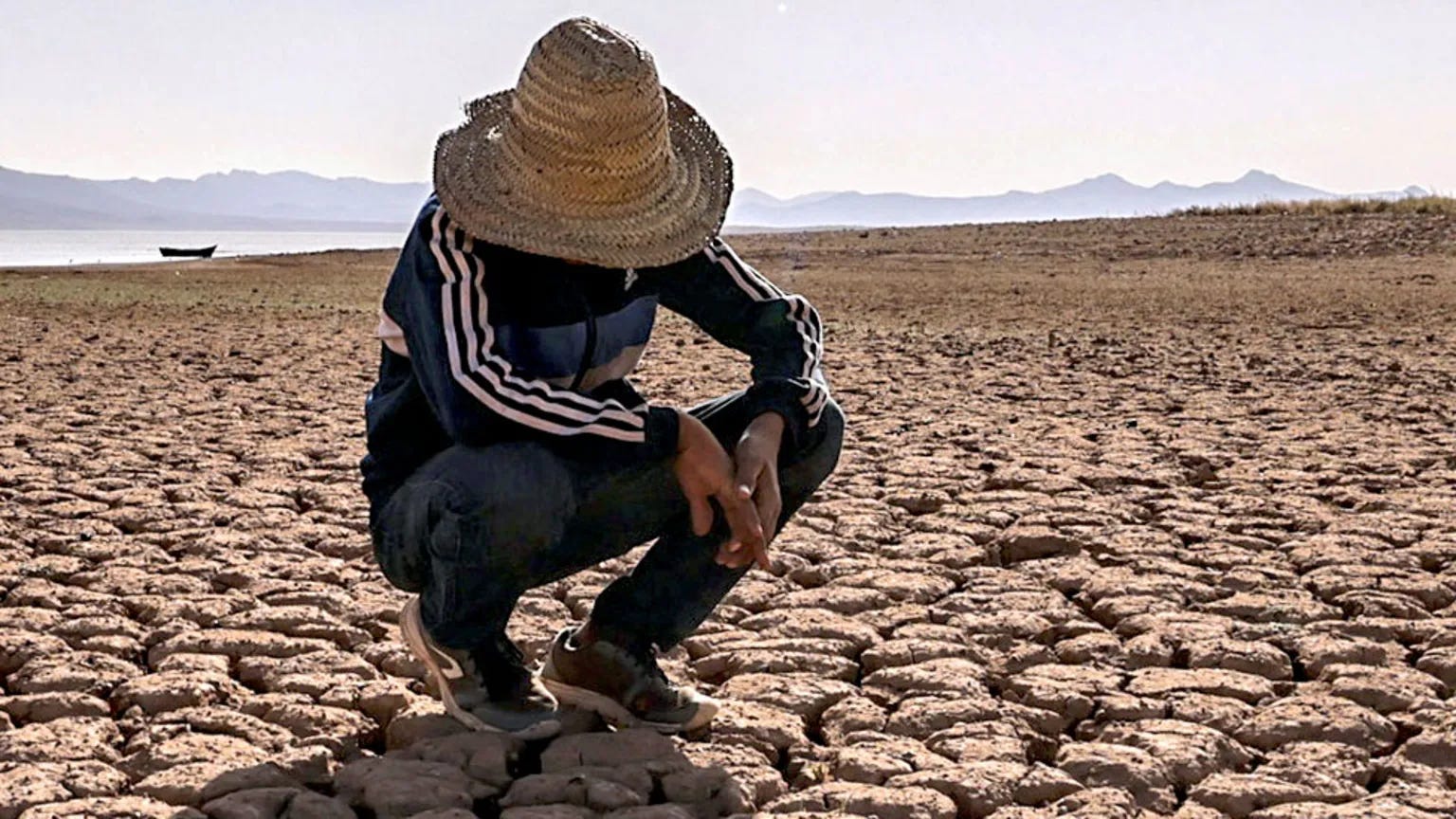
Across the Middle East and North Africa (MENA), water is far more than a resource. It is memory, territory, survival, identity, and dignity. In a region marked by aridity, accelerating climate instability, demographic pressure, and growing ecological stress, the water question can no longer be reduced to engineering alone. It has become civilizational.
For decades, many countries across the MENA region have invested massively in dams, groundwater extraction, inter-basin transfers, desalination plants, and large hydraulic infrastructures in order to secure water supply and sustain development. These investments have often been indispensable. Yet the region now faces a convergence of pressures: recurring droughts, extreme rainfall events, aquifer depletion, rising urban demand, salinization, ecosystem degradation, and significant losses within water distribution systems.
In this context, the challenge is no longer simply to mobilize more water. It is to rebuild a culture of water adapted to the ecological realities of the twenty-first century.
An emerging body of Australian academic research on water literacy offers an especially compelling framework for reflection. It proposes learning to “read” water differently—not merely as a technical input or economic commodity, but as an ecological, cultural, and relational system linking climate, landscapes, energy, agriculture, urban life, and collective memory.
This perspective, developed through dialogue between researchers, public institutions, and Indigenous communities in Australia, resonates deeply with the realities of the MENA region.
A New Grammar of Water
In many parts of the world facing similar ecological pressures, a quiet transformation is underway: the goal is no longer only to manage water, but to relearn how to live with it.
In France, for example, “Oasis Schoolyard” programs are progressively transforming schoolyards—long dominated by asphalt and concrete—into permeable, vegetated, and climate-resilient spaces. These projects function as micro-laboratories of ecological transition embedded within daily urban life.
The principle is deceptively simple: replace impermeable surfaces with living soils capable of absorbing water, reducing heat, restoring biodiversity, and regenerating local hydrological cycles.
These transformations are based on several interconnected principles:
revegetation through trees, gardens, and shaded areas;
de-sealing urban soils to encourage infiltration;
reduction of urban heat islands;
creation of educational spaces connected to ecological awareness.
In practice, this means removing portions of asphalt, introducing permeable materials, planting trees, creating school gardens, and transforming public spaces into places of learning, social interaction, and even climatic refuge.
Beyond architecture or urban design, these projects embody a deeper idea: water must return to the soil, slow down, infiltrate, and reactivate the living cycles of the territory.
This vision aligns with what I call fertile hydrology: an integrated understanding of water where every urban surface, every landscape, and every ecological process becomes an active component of the hydrological cycle rather than merely a system for rapid drainage and extraction.
Water Is Not Infinite
The global figures are stark: less than one percent of the planet’s water is directly accessible for human consumption. Population growth, industrial agriculture, urban expansion, and pollution continue to intensify pressure on water resources worldwide. In arid regions such as the MENA region, these vulnerabilities are amplified.
Large-scale hydraulic infrastructures have undeniably improved access to drinking water and supported economic development across many countries in the region. Yet these same infrastructures also reveal the limits of a model centered primarily on extraction, transfer, and technological control.
The future increasingly requires a broader approach—one that combines infrastructure with ecosystem restoration, demand management, groundwater recharge, water reuse, rainwater harvesting, and public awareness.
From Water Management to Water Culture
The concept of water literacy seeks precisely to move beyond purely technical or economic approaches to water governance. It may be understood as the capacity of a society to perceive the invisible connections between climate, territory, consumption, agriculture, energy systems, and ecosystems.
This approach rests upon three complementary dimensions:
Ecological: understanding hydrological cycles, aquifers, watersheds, soils, and climatic interactions;
Cultural: recognizing traditional knowledge systems, local practices, and historical adaptations to aridity;
Ethical and political: considering water not only as a resource, but as a shared responsibility and a common good.
Across the MENA region, such perspectives are not new. Traditional systems such as foggaras, khettaras, aflaj, oasis irrigation systems, terrace agriculture, and communal water-sharing institutions reveal centuries of sophisticated adaptation to scarcity.
These systems were never merely technical devices. They were social and ecological contracts rooted in cooperation, restraint, collective responsibility, and a profound understanding of limits.
Water as a Commons
Today, a growing global debate opposes two competing visions: water as a commodity versus water as a commons.
The progressive recognition of access to water as a human right by the United Nations reflects an important shift. Yet across many parts of the world, tensions surrounding privatization, inequality, depletion, and unequal access continue to intensify.
In the MENA region, states continue to play a central role in water planning and infrastructure development. However, future resilience will also depend on strengthening local participation and ecological governance involving municipalities, farmers, schools, civil society organizations, researchers, and citizens themselves.
Historically, many oasis societies managed water collectively through highly codified systems balancing equity, continuity, and solidarity. This memory still carries important lessons for contemporary ecological transitions.
In this sense, projects such as Oasis Schoolyards possess strong symbolic significance. They demonstrate that even at a small scale, it is possible to reconnect urban spaces to natural hydrological cycles, cool cities, restore permeability, and rebuild ecological relationships with water.
The Crisis of Imagination
The water crisis is also a crisis of imagination.
For decades, development models often equated progress with the capacity to mobilize ever larger volumes of water through increasingly powerful infrastructures and technologies. Today, however, the challenge is broader and more complex.
The future increasingly involves restoring watersheds, reducing network losses, recycling wastewater, harvesting rainwater, adapting agriculture to ecological limits, regenerating soils, and protecting ecosystems.
Yet technical solutions alone will not be sufficient. What is required is also a cultural transformation.
To “read” water means understanding that a faucet opened in Cairo, Casablanca, Algiers, Riyadh, or Amman is connected to distant aquifers, altered rainfall cycles, energy systems, agricultural choices, and fragile ecological balances.
This new hydrological consciousness could begin in schools, extend through media and public debate, and eventually permeate public policy itself.
Ecological education, urban greening projects, wastewater treatment awareness, oasis knowledge preservation, and youth participation in rainwater harvesting initiatives may all contribute to rebuilding a collective relationship with water.
Water, Dignity, and the Future
Water is inseparable from human dignity.
Supply interruptions, groundwater pollution, territorial inequalities, and ecological degradation directly affect daily life, social stability, food security, and public health across the region.
In a region where climate pressures are intensifying and populations remain young and urbanizing rapidly, water may become one of the defining political and ecological questions of the coming decades.
Thinking of water simultaneously as a right, a commons, and a shared responsibility could become one of the foundations of a new ecological transition for the MENA region.
This implies complementing the logic of resource mobilization with a logic of ecological sobriety, resilience, regeneration, and territorial balance.
The lesson emerging from both ancient hydraulic civilizations and contemporary ecological thought is ultimately simple: water is not merely a volume to distribute. It is a living relationship to understand, restore, and protect.
For the MENA region—a region of deserts, oases, ancient hydraulic intelligence, and growing climatic vulnerability—relearning water may become one of the keys to ecological survival and collective resilience in the twenty-first century.
Because ultimately, as ancient wisdom reminds us: caring for water means caring for ourselves.

Thank you for your essay Mr Menamara, it is full of the truths that our First Nations (Indigenous) people have told us for years in Australia. You point this out early in your discussion and our Urban planners in Western Australia are fully conscious of the directions that need to be taken in remodelling our towns and cities BUT.... mining and fossil fuel companies hold our State and Federal governments captive. Our wealth means that we are left with diluted ("watered down" as in weak) policies to combat the growing Climate Crisis that the world is facing.
Pollution of North West artesian water systems are now threatened with "fracking" to extract fossil fuel"Gas". This will of course be allowed and even subsidised by governments like WA's which has just now abandoned any legislated targets for total emissions reduction in coming decades. We must look after the water and restore our environments in MENA and our dry continent. Thank you again.
Ther is a story popularized by Pierre Rabhi in *The Share of the Hummingbird*. As the forest burns, the hummingbird carries a few drops of water toward the fire. The other animals mock the apparent insignificance of its gesture, but the hummingbird replies: “I am doing my part.”
The question is not only whether we are doing our part, but when our “parts” will be able to add up within a coherent system.