


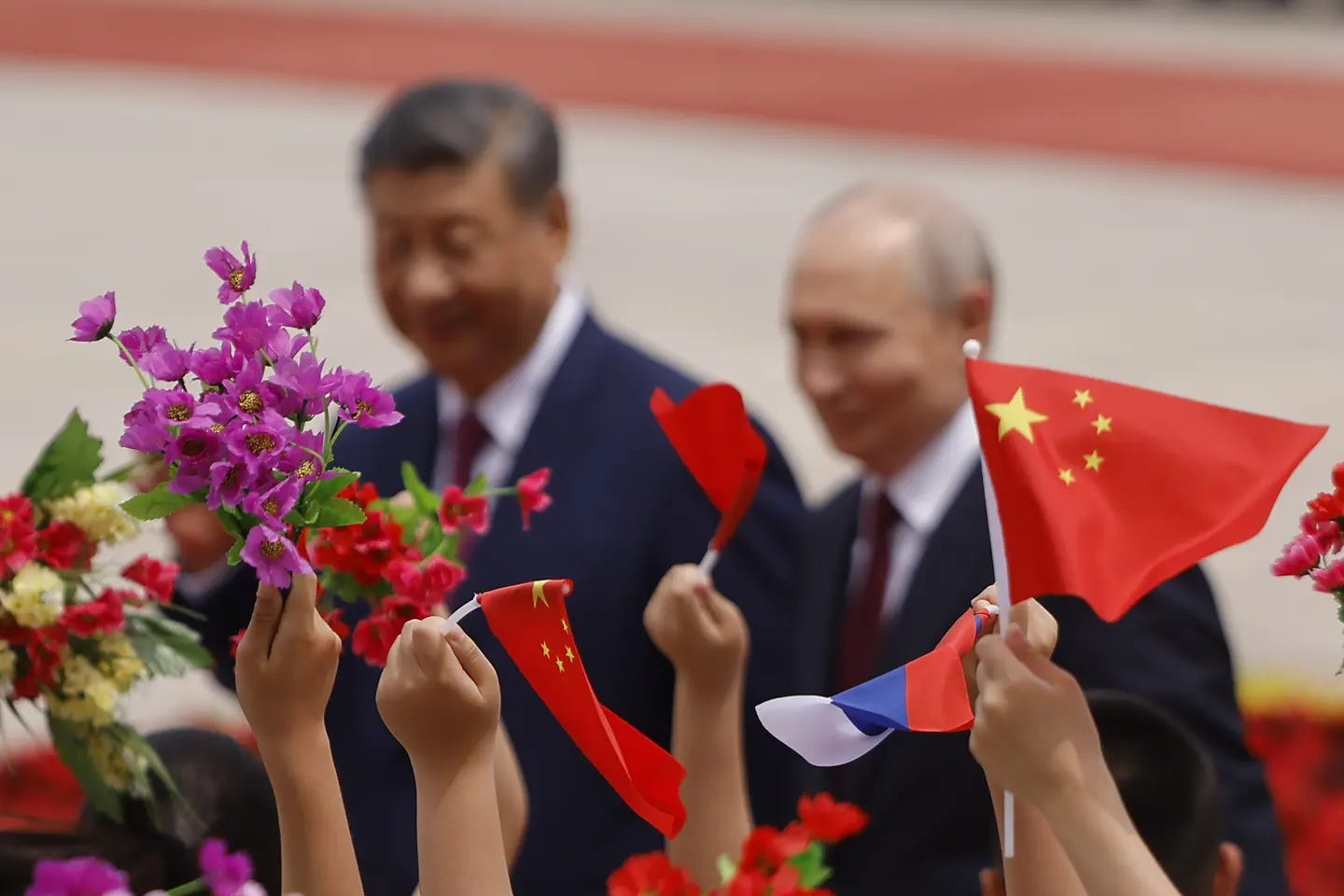
At the conclusion of Russian President Vladimir Putin’s two-day visit to China, the two countries issued a joint statement on the need to further strengthen their bilateral relationship and enhance their coordination in international politics.
Putin’s visit to China on Wednesday, 20 May, days after the visit of US President Donald Trump, was marked by a significant difference: the issuance of this statement, which also detailed their common stance on major bilateral and global issues.
On the eve of travelling to Beijing on Tuesday, Putin had described the visit as a part of regular bilateral summits. He had said that the objective of his latest trip to China was to deepen cooperation between the two countries and intensify the work for global security and stability.
This was Putin’s 25 visit to Beijing since first becoming president of Russia in 2000. This visit also commemorated 25 years of the China-Russia Treaty of Good Neighbourliness and Friendly Cooperation signed in 2001.
The Russian president met his Chinese counterpart, Xi Jinping, at the Great Hall of People in Beijing on Wednesday, the second and last day of his two-day trip.
At the end of the summit, the two countries agreed to extend the 2001 treaty, claiming the principles laid out in the treaty “have stood the test of time and remain relevant.”
Greater mutual cooperation and strategic coordination
During his meeting with Putin in Beijing, Xi said that “unswervingly promoting the long-term, sound, steady and high-quality development of the China-Russia relationship is a strategic choice by the two sides based on the fundamental interests of the two countries and the global trends.”
During the press conference, jointly addressed by Putin and Xi on Wednesday, both leaders noted how their bilateral trade has already surpassed the USD 240 billion mark. They underlined that almost all their mutual settlements are now conducted in local currencies, reducing their dependence on the US dollar.
The joint statement titled “Enhancing comprehensive strategic cooperation, deepening good neighbourliness and friendly cooperation” explains how the bilateral relationship has reached its highest level in history, Sputnik reported.
It expressed hope that the two countries will continue to rely on the 2001 treaty as a “legal foundation for their modern relationship” and deepen their economic, trade, and military cooperation in the coming years.
The two countries agreed to extend their visa-free regimes for travellers from each other. Russia also claimed that China made the point that it was seeking a long-term supply of its oil, with increased volumes.
Multipolar world
On Wednesday, Xi expressed hope that both countries will continue to have high-quality comprehensive strategic coordination for mutual development and for establishing a just and reasonable global governance system.
The joint statement noted that the Russia-China relationship is not block-based or confrontational in nature and not directed against any third country; however, it has the objective of pushing for multilateralism and the greater observation of international laws.
In light of expressing commitments to international law, the joint statement talked about China and Russia’s combined “search for a solution [for Ukraine] through negotiation and dialogue.” They agreed that it is necessary to eliminate the root causes of the conflict through greater compliance with the principles of the UN Charter to prevent such conflicts from emerging again.
Without naming anyone, the joint statement criticised the failed “attempts by a number of countries to unilaterally run global affairs, impose their interests on the entire world and limit the opportunities for sovereign development of other countries in the spirit of the era of colonialism.”
The attempts by some countries to create hegemony using unilateralism and neo-colonial methods have caused greater violations of international law, making it difficult for countries to resolve their disputes peacefully and creating a risk of a world run by the “law of the jungle,” the statement says.
In this context, the close strategic relationship between China and Russia plays a major stabilising role globally as both countries seek peace and universal prosperity by cooperating at multilateral forums such as the UN, Shanghai Cooperation Council (SCO), BRICS, and others.
“There is no universal path of development in the world, and there are no “first class” countries and people,” the joint statement says, indicating the hegemonic tendencies of some countries. The statement vows to end cross-border barriers in various fields, including the barriers on international trade.
The US must act in good faith.
The joint statement talks about the greater responsibility of the major powers of the world to stick to international law and respect multilateral agencies. It demands the US, in particular, act in good faith.
The joint statement called the US-Israeli aggression on Iran a violation of “international law and the basic norms of international relations,” saying it “seriously undermined the stability” in the region.
The statement appealed for a negotiated settlement of all the disputes in West Asia, including the Israeli war in Gaza.
The statement also criticised several destabilising moves made by the US recently, such as the Golden Dome project, its attempts to militarise the Arctic with its allies, and its failure to carry forward the legacy of the New Strategic Arms Reduction Treaty (START), and demanded that it work in good faith to create conditions conducive to global strategic stability.
The Golden Dome project visualised by the Trump administration aims to build a global missile defence system. The New START signed in 2010 aimed to impose restrictions on nuclear arsenals held by Russia and the US. The Trump administration did not try to renew the treaty after it expired in February this year.
China and Russia opposed any attempt to create NATO-like alliances in Asia, including the formation of the US-led AUKUS alliance, and opposed the attempts to deploy arms in outer space and threats of nuclear attacks issued by the nuclear-armed nations, risking the existence of humanity.
As per the statement, Russia agreed to the Chinese position on a trilateral talk on nuclear cooperation with the US in an attempt to minimise the fear of nuclear confrontation.
