


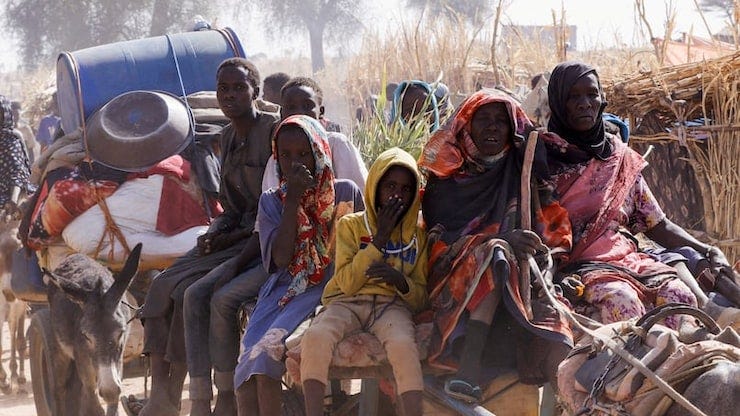
The Sudanese Armed Forces (SAF) are closing in on Kurmuk, on the Ethiopian border, to recapture the strategic town in Blue Nile State from the Rapid Support Forces (RSF), a paramilitary group fighting the army in a war now in its fourth year.
On 26 May, the SAF’s Blue Nile command retook five areas in the Qaysan locality to the north of Kurmuk, along the frontier with Ethiopia, a conduit through which the UAE has been supplying the RSF. Only two days earlier, on 24 May, SAF had also announced the recapture of the Al Baraka area, right on the outskirts of Kurmuk.
Fighting in alliance with a faction of the Sudan People’s Liberation Movement-North (SPLM-N), led by Abdelaziz al-Hilu, the RSF captured Kurmuk on 23 March, along with several other neighbouring towns, securing its corridor to Ethiopia, from where it allegedly launched the attack. It also connects Blue Nile to Sennar State.
The town has been serving as a launchpad for the RSF to stage further attacks to push inward towards Blue Nile’s capital, Ad-Damazin, to which 73,000 civilians from Kurmuk had fled from the RSF.
Counter-offensive
On 8 May, the SAF’s recapture of its military garrison in the town of Al-Keili, about 35 km north of Kurmuk on the road to Damazin, marked the first major step in its offensive. After suffering heavy losses, the RSF fighters fled to Kurmuk and allegedly crossed over into Ethiopia. Then on 16 May, it advanced further towards Kurmuk, seizing Khor Hassan.
Positioning itself on the outskirts of Kurmuk after capturing Al Baraka on 24 May, before securing the five areas in the Qaysan locality two days later, the SAF is trying to isolate RSF positions in Kurmuk and curtail its ability to use the town as a launchpad for further forays into Blue Nile.
A failure to check the RSF’s advance in the Blue Nile might secure it a gateway to central Sudan. The paramilitary already controls most of Sudan’s vast western region of Darfur after overrunning the defences of El Fasher, where, according to a UN fact-finding mission, it committed “genocidal” atrocities on the population.
Cross-border spillover
On 24 May, the RSF killed scores of civilians and wounded many more with a drone strike on a market in the last holdout of the SAF and its allied armed groups in Darfur, in the Tine region of North Darfur state, on Sudan’s western border with Chad. Also widely reported to be a conduit in the UAE’s supply of arms to the RSF, the conflict has already split its border, resulting in multiple clashes.
Having displaced over 14 million people and plunged over half the country’s population into hunger, unleashing the world’s worst health and humanitarian crisis, the war, now in its fourth year, is threatening to spill over east across the Ethiopian border also.
