


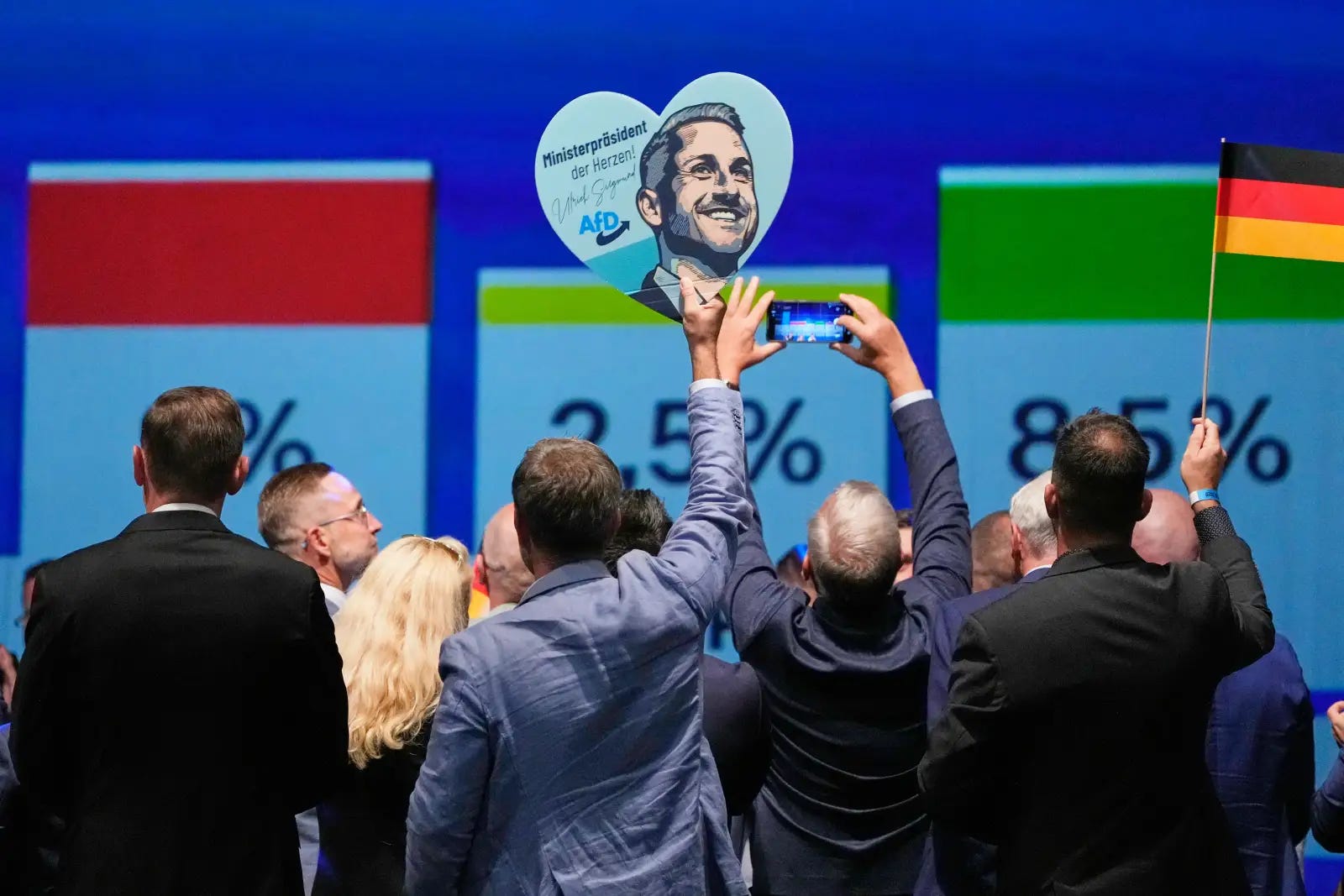
The far-right Alternative for Germany (AfD) secured a convincing victory in the Saxony-Anhalt state election on 6 September 2026. The election was marked by a high turnout of nearly 78% and took place amid a climate of widespread anger against federal policies implemented by the Merz administration—particularly attacks on social services and welfare and ongoing militarisation.
The AfD won approximately 44% of the vote, more than double its result in the 2021 election. Chancellor Friedrich Merz’s Christian Democratic Union (CDU) saw its support halve to barely over 17%, followed by the Social Democrats (SPD), the Greens, and the progressive party Die Linke—all recording less than 10% of the vote. The Sahra Wagenknecht Alliance (BSW) crossed the 5% electoral threshold.
Despite the result, it remains unclear whether the far right will be able to form a government, as mainstream parties have historically maintained a “firewall” against cooperation with the AfD. For his part, AfD state leader Ulrich Siegmund indicated the party’s preference is forming a non-coalition administration, even if it means going to the polls again. He assured us that, in that case, the AfD would win over 50% of the vote.
While mainstream parties across Germany expressed shock over the election result, critics on the left argue this is the result of their own unwillingness to break with neoliberal policies and attacks on labour rights. Ever since the far right began to record stronger electoral results, the mainstream parties’ focus has remained almost exclusively on the AfD’s anti-immigrant discourse, even embracing growing chunks of this narrative in an attempt to preserve votes.
These same parties fail to recognise the importance of the cost of living crisis and massive job losses for voters. The fear of not being able to make ends meet was one of the top concerns in Saxony-Anhalt. This indicated that many votes for the AfD were cast in the attempt to find an alternative to the mainstream. Merz’s administration, however, is apparently still oblivious to these concerns.
The AfD coming into power would also not translate into a change of economic policy, considering their programme remains aligned with neoliberal principles. While this leaves room for the left to act and shape a socially just strategy, notable social mobilisations are yet to be fully recognised as pointers for progressive parties.
AfD’s success has been noted with concern by progressive politicians across the region. They pointed to the stubborn insistence of mainstream parties on austerity policies even as it becomes apparent that they are pushing people into the arms of the extreme right.
“The far right is back in Germany,” French presidential candidate Jean-Luc Mélenchon reacted. “This is a catastrophic demonstration of the blindness of Europe’s centrist politicians. The disaster is of their making.”
“Things didn’t turn out well under the far right last time, and they won’t this time either,” echoed Slovenian progressive party Levica. “The only answer to the consequences of capitalism is socialism.”

I found Ana V's conclusions unsatisfactory because she neglected to explain why Die Linke and Sahra Wagenknecht Alliance (BSW) which did present alternatives with broader economic appeal, nonetheless, performed more poorly than AfD.
This afd victory is not a disaster. It is a warning. Germany must heed it!