


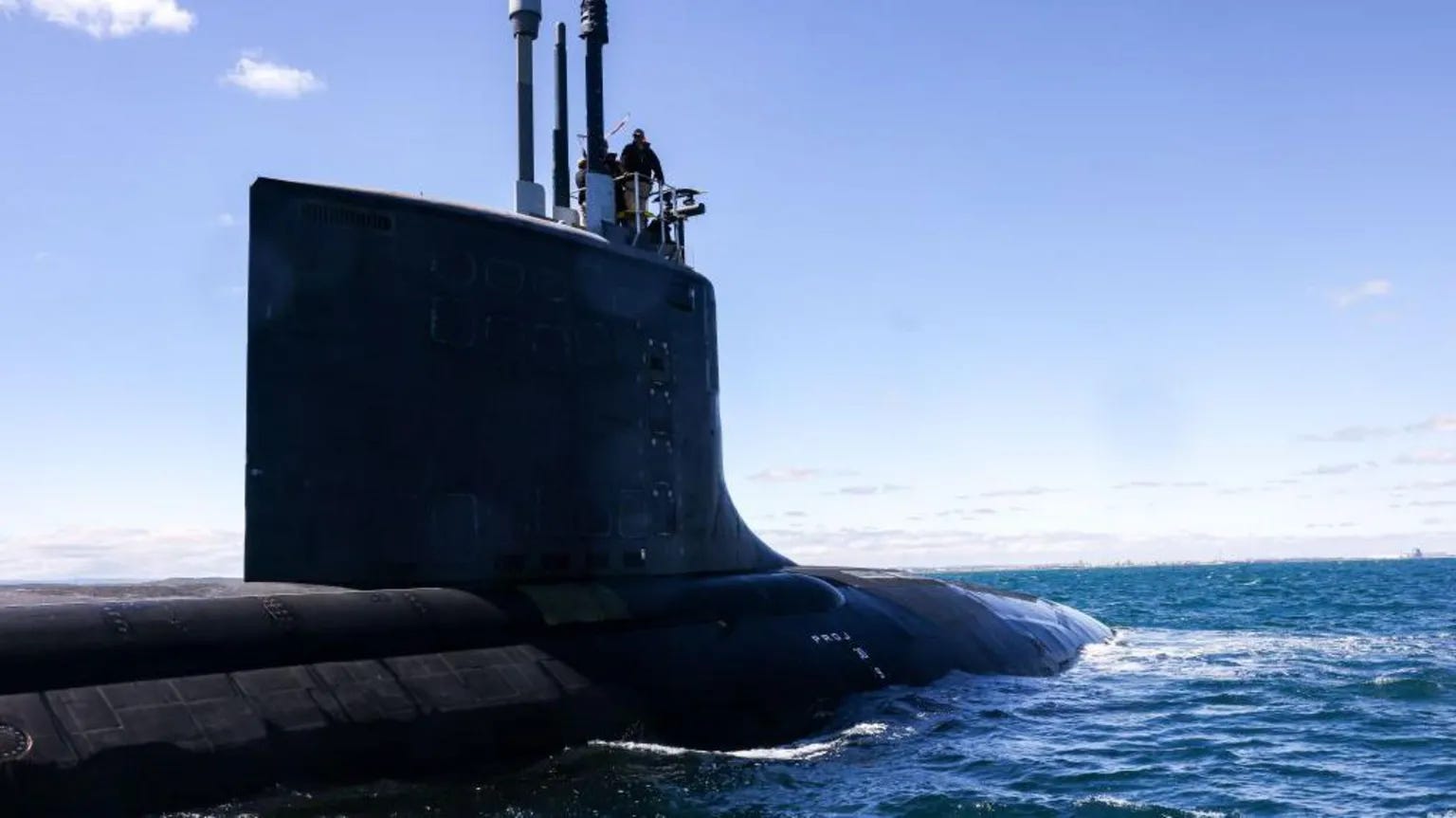
In the annals of policy, strategy and budgeting, the AUKUS pact comprising Australia, the United Kingdom and the United States will be seen as one of the most mindless, absurd projects of tiny, poorly furnished minds. Not for those in the UK and US, with both receiving Croesus-rich dollops of Australian cash for stuttering submarine programs. Not for flabby think tankers who repeatedly run out bills on the advisory circuit lauding the importance of costly boats and the China threat. It will be down to Australian government officials, elected and appointed, who seek the imaginary assurance of nuclear-powered submarines that they do not need, expending money they can scarce afford (AU$368 billion), while surrendering the country’s sovereignty in carefree, even treasonous manner.
It is for these reasons that Australian civil society has sprung into action. As the Australian government thinks it beneath them to conduct a review of the merits of the AUKUS pact at the official level (the United Kingdom and United States have, at the very least, done so), public representatives and citizens have seized the reins. The crowd founded AUKUS Public Inquiry, coordinated by the Australian Peace and Security Forum (APSF), is the result. At its helm is former federal environment minister and frontman for Midnight Oil Peter Garrett. Former MPs, retired military and naval officers of such standing as former chief of the Australian Defence Force Chris Barrie, an assortment of strategists and academics, human rights lawyers and unions are all part of the scrutineering show.
The inquiry is pursuing a number of vital questions. Will Australia ever receive those lauded submarines, be they the Virginia-class from the US Navy or the specifically designed SSN-AUKUS model? Where and how will the toxic high-level nuclear waste be stored, given that Australia has no standing facility for such a function? How many actual jobs will be created in Australia, and how distorting will this prove to the rest of the economy? Why does Australia find itself in a situation where it will potentially join a foolish war, arm-in-arm with the United States against China, Canberra’s largest trading partner? The last two questions of the inquiry crucially consider whether Australia will essentially become a vassal outpost of the US imperium, and whether the pact will ripen Australia as an inviting nuclear target.
The first hearings in Melbourne, held on June 11, made compelling viewing. Former Labor Foreign Minister Gareth Evans was the first witness and uncompromisingly blunt in his submission: “The AUKUS Pillar I Submarine project was misconceived from the outset, and the passage of time since its announcement in 2021 has served only to make more compelling the conclusion that it is not in Australia’s national interest to continue our commitment to it.” Evans points to three fatal problems that neatly summarise some of the critical defects of AUKUS: the doomed prospects of deliverability, the sheer costliness of a project that “outweighs its benefits”, and the limits it would place on “Australia’s independent sovereign agency.”
On the deliverability of submarines, the verdict is damning: “every piece of evidence available on the public record reinforces the scepticism as to whether any of them [the eight promised AUKUS boats] will be delivered on time, or indeed, at all.” The Virginia-class boats, scheduled to arrive by 2032, are permanently subject to the “inventory requirements” of the Pentagon, which remain sluggish at an annual production rate of approximately 1.2 platforms. This is despite the contribution of $US2 billion from the Australian public purse to US shipyards. Delivery of such boats can only be assumed, given the promise by such mandarins as the Pentagon’s Undersecretary for Policy Elbridge Colby to expand the nuclear fleet, to take place on the proviso that the Royal Australian Navy will be an extension of US power.
As for the benefits accrued from such a vast bill, what were these boats really for? Evans was in no doubt: they were to serve as “supplementary assets, effectively embedded in US military command, for the task of finding, tracking, attacking and destroying Chinese submarines seen as a nuclear threat to the US mainland, as they move into and around West Pacific waters.” To also permit this capability for reasons of combating China was needless. “There is no reason to assume that, Taiwan apart, China would ever contemplate outright military aggression – Hitler, Tojo or Putin-style – against any of its regional neighbours, let alone the United States.”
The issue of trading sovereignty for boats was also brutally self-evident. Washington would never part with SSNs “in the absence of an undertaking that we will deploy these boats to join the US in any fight in which it chooses to engage anywhere in our region, particularly over Taiwan.” For confirmation, one need only look at statements by Colby, or the views of officials from the previous Biden administration such as former deputy secretary of state Kurt Campbell and Ely Ratner, former assistant secretary of defense for Indo-Pacific Security Affairs.
Other submissions were eclectic in scope and troubling in implications. Featured were academic contributions from public academic figures Joseph Camilleri, Tilman Ruff and Richard Tanter; Dave Sweeney, an anti-nuclear campaigner from the Australian Conservation Foundation; John Leslie Lander, Australia’s former Head of the China section at the Department of Trade of Foreign Affairs and Deputy Ambassador to China; and Barbara Jackson as a “concerned citizen”. The following is a discussion of some of the presentations and submissions. (A full list is available at the AUKUS Public Inquiry site.)
Speaking on behalf of the International Campaign to Abolish Nuclear Weapons (ICAN), Ruff lamented the exacerbation of regional tensions by AUKUS, which increased “the risks of major power confrontation, including nuclear confrontation, particularly in Northeast Asia.” The provision of SSNs also offered the grim spectre of nuclear proliferation, given the highly enriched uranium that would be used as reactive fuel. Australia’s anticipated retention of such waste was contrary to US non-proliferation practices that have been in place for decades. Crucially, though, the highly nuclear-enriched waste can itself provide “weapons-usable material”.
Ruff was particularly aghast that Australia had not considered advancing “low-enriched uranium reactive fuel”, an alternative used by other nuclear-powered submarine fleets, and also drew the Inquiry to Canberra’s obligations under the South Pacific Nuclear Free Zone Treaty. This had legal implications for boats or aircraft carrying nuclear weapons finding themselves on Australian soil. This could include “lengthy visits, visits on a permanent or semi-permanent basis”, “rolling visits” that would entail the swift replacement of one nuclear-weapons carrying platform with another, and visits with “the deliberative purpose or intention of permitting a nuclear-armed vessel or aircraft being located for military deployment directly from the location being visited.” All of these instances would violate, not only the Treaty, but Australian domestic law, and make efforts to join the Treaty on Prohibition of Nuclear Weapons problematic if not impossible.
Tanter expressed his concerns about “an extraordinary emphasis on interoperability” between Australian and US forces arising from strategic and defence reviews, including “integrated planning documents recently published by the Albanese government”. Relying on the British submarine industry to pull its weight to provide the SSN-AUKUS was also optimistic, given that it was “very close to dysfunctional”. The Virginia-class boats, which were now only going to be second hand variants, were likely, if ever to make it to Australian shores, fall under the command of the US Navy. Of particular concern to Tanter was the absence of any “policy or legal impediment to bringing nuclear weapons into Australia, as long as they are labelled transit or visit.” This risked a degree of “nuclear permissiveness that we should not be tolerating.”
Lander was bracing in offering a picture of China so frowned upon by the US-Australian alliance. “The strategic rationale for AUKUS is founded on the patently false premise that China presents a kinetic threat to Australia.” Over eight decades, China had never “evinced the slightest inclination to attack Australia, let alone expressed a policy of hostility towards Australia.” The fear that Australia’s sea lanes would be subjected to interdiction by China – hence the need for some bristling naval deterrent – ignored “the fact that China has an existential interest in keeping those same sea lanes open, because it is the largest trading partner of the vast majority of the world.”
Domestically, the Australian government was also running roughshod over constitutional arrangements requiring them to justify the vast expenditures and the surrender of its authority to a foreign power. Parliament had been utterly ignored by the executive in “granting a foreign nation operational control of Australian defence or intelligence facilities, or territory, or to committing Commonwealth expenditure in connection with such arrangements.”
Counting herself as a community member, Barbara Jackson proposed that Australia had “allowed its defence framework to be shaped substantially by American strategic priorities rather than its own.” This was much like permitting a dominant customer to dictate one’s operations. She instanced US signals intelligence facility at Pine Gap, located near Alice Springs. “Australia has almost no control over what it is used for, yet would bear the immediate consequences if conflict erupted.” The northern and western regions of Australia also offered “ideal geography for [US] operational requirements.” AUKUS and the increasing presence of US forces in Australia also seemed at odds with the country’s official doctrine, the Strategy of Denial. According to that defensive doctrine, an adversary is denied the ability to project force against Australian territory. “Pine Gap, Darwin, AUKUS, and deep interoperability with the United States forces mean Australia functions as an operating base in American offensive operations.” You could not claim a denial strategy on the one hand and “host infrastructure” implicating you as “a frontline participant in someone else’s strategic competition.”
With such a list of ailments and threats posed by AUKUS, it is little wonder the creature still lives. Further efforts to put it down have already been made at Fremantle (June 29), with more to follow on July 16 (Adelaide), Adelaide First Nations Yarn (July 17), Sydney (August 11), Wollongong (August 12), and Canberra (September 1). The material marshalled at these gatherings promise to furnish us a hefty record of informed dissent in the face of folly for the ages.

Very well summarised Binoy, thank you.
I struggle, as a member of Stop-Aukus in WA, to attend information sessions from the Submarine Agency and its Nuclear Safety body that has replaced ARPASNA as the body ensuring compliance of Nuclear Powered submarines. They are already visiting our base in Garden Island and will soon being serviced there, in water and in the facility being built at Henderson on shore.
Completely misleading and opaque levels of radioactive wastes of undeclared type and levels are likely to have to be handled. The authority says it's all "Low Level" of what is a secret.
We also learn that the tolerated levels of personnel's radiation exposure will now be quite acceptable according to USA legislated changes. This arises from that country's relaxed efforts in regulation of an array of health issues of course (and a 5 or 10 fold increase in radiation exposure should be fine!).
The detectability issues that Gareth Evans brought up early in the Inquiry that you detailed were the perfect reason for abandoning AUKUS right now. Sovereignty loss, Strategic target of bases and, cost issues just reinforce the need for cancelling Morrison's madness.