


For those unfamiliar with the intricate machinery of Israeli politics, the unanimous 110-0 vote to dissolve the Knesset on 20 May appears to be an earth-shattering event. On the surface, it looks as if the days of Prime Minister Benjamin Netanyahu and his coalition of far-right extremists are numbered. The reality, however, is far more complex.
Israel’s current political implosion is fundamentally tied to its failure to escape the ghosts of 7 October. When the country’s military defenses collapsed on that day, Israel was transformed from a state with a formidable reputation as an invincible regional superpower into one trapped with a struggling army, structurally incapable of decisively winning a single war.
Since the launch of the devastating genocide in Gaza, neither the Israeli government nor the military establishment has been able to answer two fundamental questions:
One, how did the world’s self-proclaimed “invincible army” collapse in a matter of hours, leaving the entire Southern Command—whose sole job was to keep Gazans besieged—in total shambles?
Two, why has that same heavily funded military machine failed to achieve a decisive victory despite the near-total destruction of the Strip and the unprecedented slaughter and wounding of much of its population?
Complicating the matter is Benjamin Netanyahu’s pathological refusal to honestly investigate either the 7 October intelligence failure or the subsequent conduct of the Gaza war. Instead, he focused entirely on domestic damage control and image management, aggressively marginalizing or firing intelligence official, or high-ranking bureaucrats who challenged his narrative. Rather than pursuing a viable exit strategy, Netanyahu treated the defense apparatus as a public relations shield.
Consequently, opposition voices—initially led by Yair Lapid and his Yesh Atid party—began demanding Netanyahu’s resignation and snap elections. What began as predictable political fallout quickly evolved into a sweeping popular movement.
Public confidence in the government continues to plummet. Recent opinion polls consistently show that a vast majority of Israelis believe Netanyahu acts out of personal political survival rather than national interest. Data suggests that if elections were held today, his right-wing bloc would suffer a catastrophic defeat at the hands of a newly consolidated opposition—namely Beyachad (“Together”), the newly formed unified list established by Naftali Bennett and Lapid.
Netanyahu, whose legacy as Israel’s longest-serving prime minister is now defined by strategic failure, subsists in a profound personal and political crisis. His deliberate escalations of regional conflict served no distinct military purpose; instead, they merely highlighted his desperation, turning his rhetorical pledges of “total victory” into a hollow attempt to prevent his coalition from fracturing.
Meanwhile, National Security Minister Itamar Ben-Gvir and Finance Minister Bezalel Smotrich exploited Netanyahu’s vulnerability to advance their own extremist agendas. Bent on rapid colonial expansion, they accelerated West Bank annexation, pushed draconian laws to execute Palestinian prisoners, and tightened the siege on occupied East Jerusalem.
Under normal circumstances, the sheer scale of the domestic, economic, and diplomatic harm engineered by this coalition should have removed it from power. Yet Netanyahu survived by exploiting deep social fractures and relying on unconditional support from Washington.
This survival shield was further fortified by the initial impotence of a fragmented political opposition and a perpetual wartime atmosphere that Netanyahu cultivated to freeze dissent. Not even his corruption trials derailed his career; he adapted state institutions into instruments of personal survival.
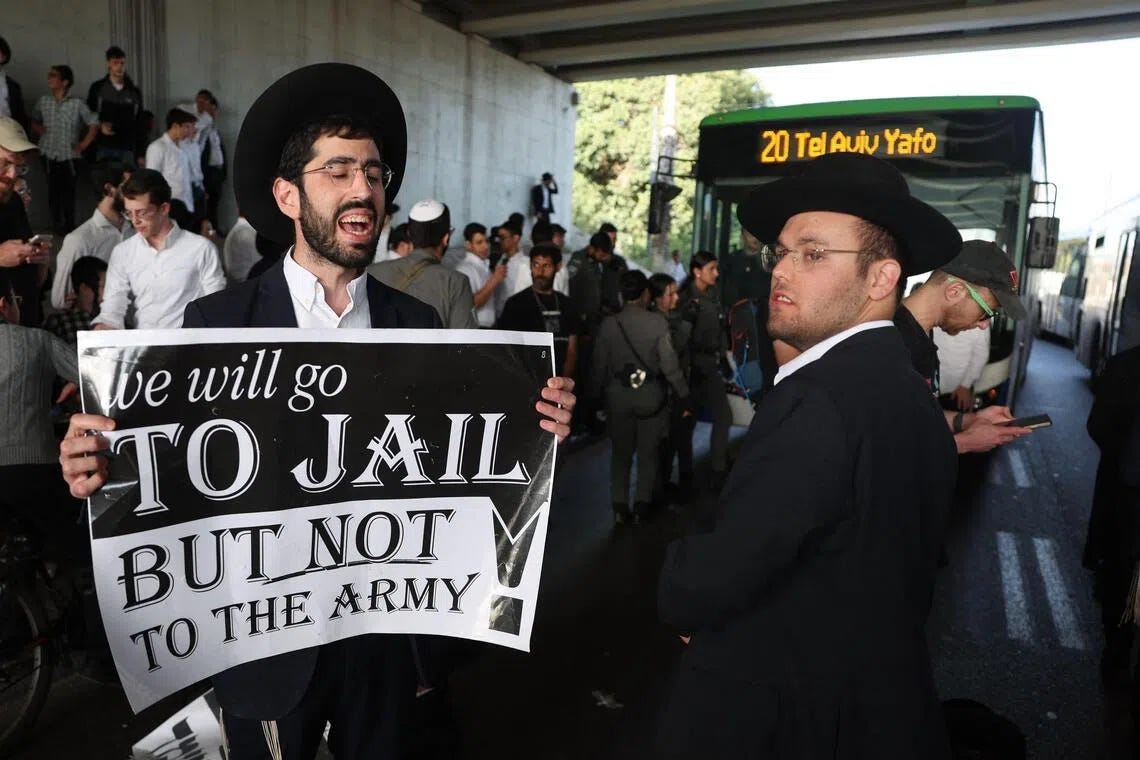
Yet the ultimate irony of Israeli politics is that pressure came not from mounting casualties or international isolation, but from compulsory military conscription of the ultra-Orthodox, or Haredim.
For decades, secular Israelis complained about the sweeping draft exemptions granted to yeshiva students, but the political elite routinely shrugged it off as a secondary culture war that could be managed via backroom political dealings.
Israel’s overextended, multi-front war of attrition completely smashed that equilibrium. The issue was violently pushed back to the surface because the military quite literally ran out of bodies. The true gravity of this manpower crisis was exposed when the army Chief of Staff, Lt. Gen. Eyal Zamir, explicitly broke ranks during a closed-door security cabinet meeting to warn that “the IDF is going to collapse in on itself”ouble.
Zamir reportedly raised “ten red flags” before the political leadership, stating bluntly that after months of intensive combat across Gaza, the northern border, and regional theaters, the military was facing an immediate, unsustainable deficit of over 12,000 combat soldiers.
For over two years, Netanyahu postponed a legal verdict on the Haredi draft. But mounting military setbacks, particularly on the Lebanese front, made further delays impossible.
The opposition seeks elections while Netanyahu engages in legislative theater, using loyalists and parliamentary procedures to slow the process.
Yet this political drama is secondary to the deeper crisis. No coalition maneuvering can salvage a state facing structural decline. Nothing will heal Israel’s fractures until it confronts the root cause of its crisis: endless, unwinnable military campaigns that have devastated Gaza and the wider region.
The crisis engulfing Israel is self-inflicted—and there can be no lasting peace until the state’s deep-seated criminality and ongoing genocide and wars against Palestinians and the wider Arab world come to an end.

Thank you for that analysis Dr Baroud. It must be the worst case I've read of Jingoistic and corrupt politics derailing a colony, already hurtling towards its train wreck. You spelled it out so clearly and for my mind the country has to accept a Two State solution and stop the never-ending lie of Israel "defending itself".
The truths are pretty clear to anyone who is prepared to look at the facts of genocidal, immoral criminal behaviour. Now we just need more voices to follow Spain's lead and take some actions against Israel and its US, UK and other war-monger supporters like my Australia.