


A victory that looks back
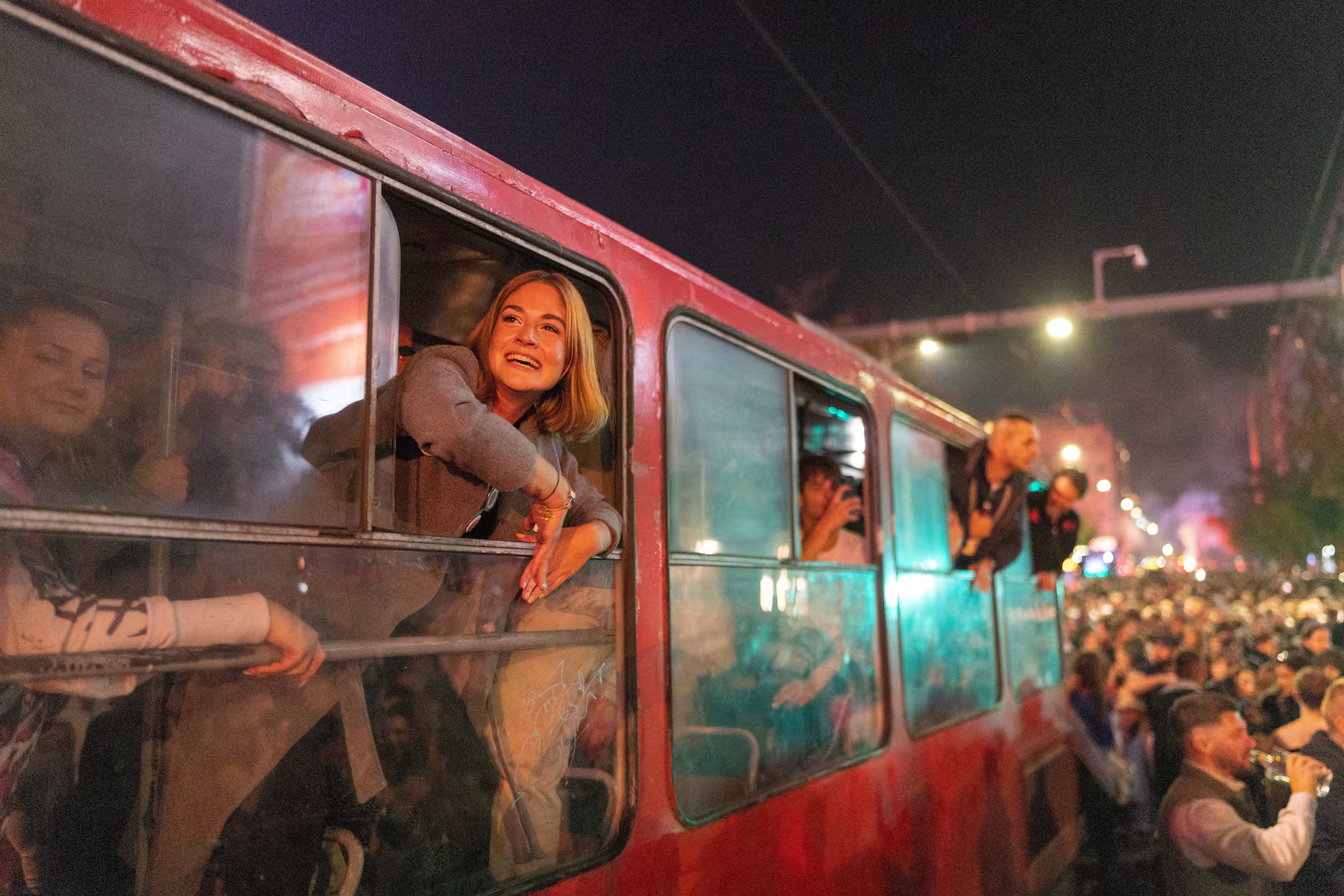
“Studenti su pobedili!” The students have won. The chant electrified the intersection of Kralja Milana and Kneza Miloša, just a few metres from the Republic Electoral Commission (RIK in Serbian). Seconds earlier, the long-standing autocrat and former president Aleksandar Vučić had conceded defeat, ending fourteen years of political dominance.
The implications of this event are much bigger. Vučić is not just Vučić. He represents a style, a power, a system, and a network that has operated in this small country for decades. And now, a student-led movement has dealt that system a powerful blow.
Vučić, Milošević’s former information minister, began his political career in the 1990s. He is a product of an era that, for many young people now jumping and chanting “We won!”, belongs to a murky, disappointing past.
The chants of victory, the arms pointing towards the sky, the prayers, the icons, the flags, the handmade placards, the tears: all are part of an exorcism that leaves behind decades of trauma and political pain. And that, in part, explains the powerful energy unleashed across the country in the final hours of 25 October.
Yet, burdened by its past, Serbia has spent decades absorbed in its own heaviness. Although history is neither linear nor simple, the country’s collective memory tends to single out its darkest moments to explain the derailment of democracy. The ashes of the Second World War had barely settled when Marshal Tito’s rule began. After his death came the wars of the 1990s, followed by a failed democracy whose fate seemed sealed by the assassination of Prime Minister Zoran Đinđić in Belgrade on 12 March 2003.
Đinđić was seen as a central figure in Serbia’s democratic transition after the fall of Slobodan Milošević in 2000. However, he was assassinated by men connected to organised crime and the security services who opposed his reforms and his fight against corruption. His death remains imprinted in the collective memory of many Serbs as a return to reality. For some, it also opens the door to endless speculation about who really pulls the strings of power.
However much you dream of living in a normal, functioning state, “Serbia is Serbia,” many people have told me, “and that will never change.” Then came years in which corruption consolidated itself as a principal mechanism of social life, infiltrating institutions and becoming an accepted, even expected, practice. Đinđić’s death marked the end of a brief hope of transformation and the beginning of an era of structural disenchantment.
In the years that followed, successive Democratic Party and Serbian Progressive Party governments set the country’s political rhythm. Politics seemed to move from a terrain of struggle to a spectacle in which each new government recycled the practices it claimed to oppose. Memories of war, sanctions and economic crisis settled into a diffuse resignation, leaving society caught between the desire for change and the certainty that nothing would really change.
This is the subjective context in which many people understood the events in Novi Sad almost two years ago, when the railway station canopy collapsed. For many, it immediately appeared as the result of the systematic corrosion of public institutions rather than an isolated failure.
So, this accumulation of everyday hardships and political disillusionment reinforced the conviction that nothing could change. That was the wall that fell on the night of 25 October. A night in which tears of victory brought back memories of political disenchantment, now in the form of hope.
A victory that will resonate across the region and the world
In the days leading up to the election, several polls gave Vučić’s list the advantage. Alongside conventional polling, the prediction markets Polymarket and Kalshi also placed the students behind the ruling list. Kalshi, for instance, showed a 71.7% implied probability of victory for the SNS-led list on 24 October, while Polymarket showed 71.5% for Vučić’s list on 25 October. Even among those fighting for change, there was a sense that securing second place in parliament would already be an achievement.
Then the numbers came in. At around 9.30 pm, Aleksandar Vučić, the man who represented that past and that politics, conceded victory to the student-led movement.
We usually devote our attention to elections in larger countries. I think this process will need to be studied more carefully. The way the students organised themselves, and the maturity with which they channelled anger into a nationwide political movement, offers something for other movements around the world to consider.
Among the immediate political consequences is the scale of mobilisation. CeSID/Ipsos estimated final turnout at 69.3%. The provisional RIK figures reported on the morning of 26 October, with 8,077 of 8,392 polling stations processed, put the Students’ List at 52.54%, Vučić’s list at 39.29% and the Socialist Party-led list at 2.18%. CeSID/Ipsos separately projected 141 seats for the students and 103 for Vučić’s list, based on 96% of its sample.
Another consequence is the defeat of the Socialist Party of Serbia. If confirmed, its failure to reach the parliamentary threshold would leave it outside parliament for the first time since its foundation and the restoration of multiparty politics in 1990. That would be an enormous symbolic blow to a formation long accused of corruption and opportunistic alliances to remain in power. The SPS has lacked a recognisably independent programme, and that has finally caught up with it.
The traditional opposition parties that fielded their own lists have also failed. European Serbia, bringing together the Party of Freedom and Justice and Serbia Centre, and Authentic Right, led by the New Democratic Party of Serbia, would remain outside parliament according to the projections. The displacement affects both parts of the pro-European opposition and the national conservative right.
This, however, cannot be read as the defeat of every established opposition party. In fact, some of them supported the students rather than contesting the election separately.
Certainly, the next stage will involve rebuilding institutions around a programme centred on freeing the country from corruption. This matters beyond Serbia, particularly when security and corruption have become central demands in so many electoral contests. Here, those demands had already brought a national movement together long before election day.
The Serbian experience also offers a model of political organisation that emerged from the streets with its own particular characteristics. Its popular character reflects a renewed way of thinking about social participation and collective agency.
The students organised themselves through faculty assemblies that dealt with everything from logistics to political matters. Alongside these student assemblies, neighbourhood assemblies, or zborovi, formed as spaces for sharing information and organising collective action. This is a movement without a single commanding leadership or dominant charismatic figures. If there is something new here, it lies in this renewed understanding of a horizontal mandate and the willingness to conceive of political authority as a network rather than a vertical chain of command.
Visually, the movement managed to create a distinctive language that broke through the propaganda apparatus of the traditional parties.
Vučić’s overwhelming television presence made it immediately obvious that the students would have to find other ways to deliver their message. Social media was an obvious part of that effort. But I think the achievement also lay in the message itself, in the content and its delivery. They created a new language and carried the logic of social networks into the streets, neighbourhoods and face-to-face encounters, reaching people with less access to the internet or limited media literacy.
Through long-distance walks, marathons and bicycle rides, they gave the movement a body. That physical presence also reached older generations that understand politics through face-to-face encounters. Crucially, this language was understood by older people as well as the young, helping to mobilise the country across generations.
Finally, by refusing to place itself within a conventional political category, the movement took on another difficult task. Yet the approach worked well enough to carry it through to the night of 25 October. The movement found a rare balance between political idealism and pragmatism. It set aside deeper differences and bracketed some of the hardest questions in Serbian politics. Its concentration on specific demands, combined with a practical determination to include people across political divisions, could have lasting implications for pro-democratic movements confronting authoritarian power elsewhere.
The future is bright, but complex
Despite all this, the victory and its wider implications face considerable challenges.
Defeating authoritarianism involves more than winning an election as democracy is a daily and sustained practice. In that regard, the country’s principal institutions have been captured by Vučić and his party. The police, the security services and the Interior Ministry may eventually have new leadership, but they retain bureaucratic structures that will be difficult to renew. The same is true of other institutions.
Second, the distrust that helped sustain this national movement could also turn against it over time. As mentioned earlier, a politics without hope characterised both the Vučić era and the years before it. It worked, in part, because this politics of disengagement fragments social movements and weakens citizens’ capacity for critical initiative, reducing their political activity to a merely emotional response.
Third, the unity of different forces made Vučić’s defeat possible. Many joined because of their opposition to him rather than their agreement with a programme. This election must also be understood as a referendum on the leader and what he represents. But the fact that people want to look towards the future, and that their hopes have found a common political expression, does not mean they agree on how to get there. Different opinions, programmes and intentions remain latent within this national movement inspired by the students.
It is reasonable to expect internal divisions to become more apparent over time. The success of a government formed from this list, with its transitional purpose, will depend on its ability to manage those differences long enough to change the intermediate structures of power that remain standing.
To do so, it will need to draw on the collective agency that brought the movement this far and, above all, acknowledge its own transitory and open-ended character. It will need to accept the differences that emerge, work through them as part of the country’s democratic life, and carry the communication strategy developed so far into existing institutions, restoring politics to the realm of face-to-face relations.
Calling this a revolution of hope presents problems. Yet I think the student-led movement has finally confronted us with what hope means. In Serbian, hope is nada. In Spanish, my own language, nada means nothing. I like to think of hope through that coincidence: a particular kind of nothingness that forces you to rethink the ground beneath your feet. The agency of change comes from within, from a collective “us.” On the night of 25 October, that possibility took on a body.
What comes next depends on whether this collective agency can survive the exercise of power. But “Serbia is Serbia” can no longer mean quite what it did before. The country will now have to discover what else it can be.